Listen to this Post
Introduction:
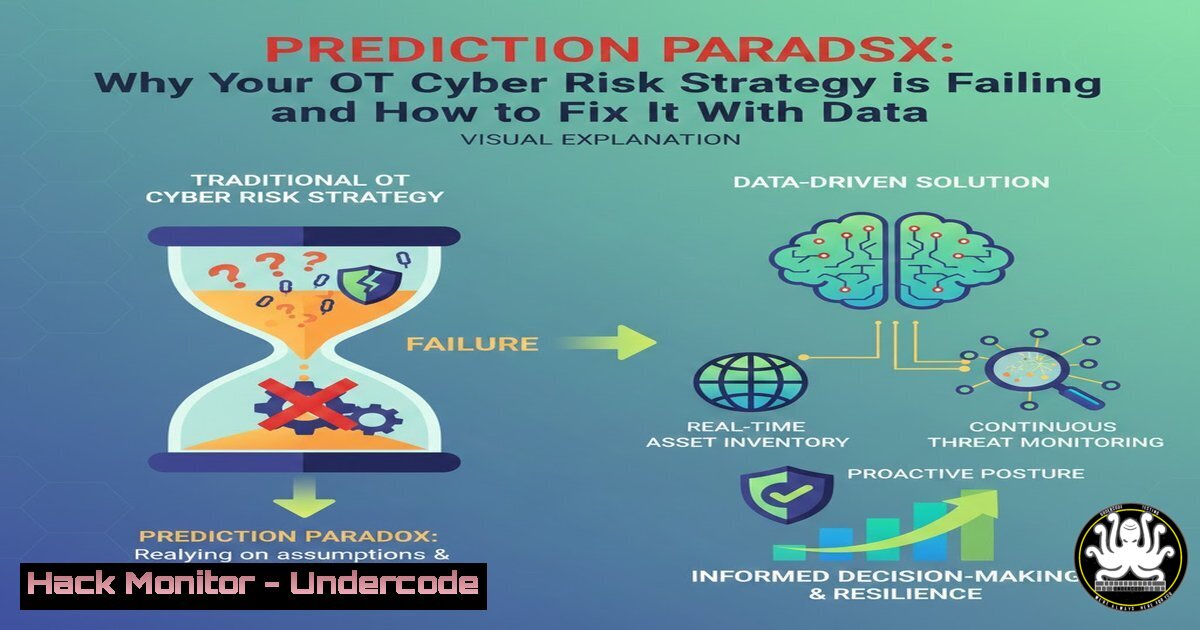
The Operational Technology (OT) security landscape is paralyzed by a fundamental contradiction: professionals are expected to manage cyber-physical risk, a predictive concept, without the historical data or analytical frameworks to make reliable forecasts. This gap between expectation and reality renders many risk assessments meaningless and leaves critical infrastructure vulnerable. Moving from vague trend discussions to quantified, data-driven prediction is not just an academic exercise—it’s a operational imperative for securing power grids, water treatment plants, and manufacturing lines.
Learning Objectives:
- Understand the critical distinction between qualitative risk trends and quantitative, predictive risk modeling.
- Learn how to establish a foundational data collection framework for OT security events.
- Gain practical skills to implement basic predictive analytics and hardening measures based on collected data.
You Should Know:
- Building Your OT Security Data Foundation: Log Everything
You cannot predict what you do not measure. The first step is instrumenting your OT environment to collect security-relevant data. This involves configuring logging on OT assets, network devices, and security appliances, then centralizing that data for analysis.
Step-by-Step Guide:
Step 1: Enable Syslog on Critical OT Devices (e.g., PLCs, RTUs, Historians). Access the engineering workstation or directly configure the device.
Example Command (Linux-based Historian): Modify `/etc/rsyslog.conf` to forward logs.
 Uncomment to forward logs to a central server (e.g., 10.0.10.50)
. @10.0.10.50:514
Restart service: `sudo systemctl restart rsyslog`
Step 2: Capture Network Traffic Data. Use span ports or network TAPs to mirror OT network traffic (e.g., Industrial Ethernet, PROFINET, Modbus TCP) to a collector.
Tool: Security Onion or a dedicated sensor running Zeek.
Zeek Command to run a specific policy on an interface:
zeek -i eth1 -C Local::site_policy.zeek
This generates conn.log, http.log, and, crucially for OT, `modbus.log` or `dnp3.log` files.
Step 3: Centralize Logs in a SIEM. Ingest syslog and Zeek logs into a Security Information and Event Management (SIEM) system like Elastic Stack (ELK), Splunk, or a commercial OT-SIEM.
Elasticsearch Ingest Pipeline Config (Sample): Create a pipeline to parse Modbus function codes.
{
"processors": [
{
"grok": {
"field": "message",
"patterns": ["Function Code: %{NUMBER:modbus.function_code}"]
}
}
]
}
- From Data to Threat Modeling: The STRIDE Framework for OT
Raw data is noise. Apply a structured threat modeling framework like STRIDE (Spoofing, Tampering, Repudiation, Information Disclosure, Denial of Service, Elevation of Privilege) to categorize incidents and identify attack vectors unique to cyber-physical systems.
Step-by-Step Guide:
Step 1: Asset Inventory & Communication Mapping. Use your collected network data to build a map of all OT assets and their communication paths. Tools like `nmap` can be used cautiously in controlled environments.
Command (Discretion Advised – Test in Lab First):
nmap -sU -p 161,502 --script modbus-discover.nse 10.0.10.0/24
Step 2: Categorize Historical Incidents. Review past alerts or outages. Classify each using STRIDE.
Example: An unauthorized PLC programming change is Tampering. A flooded HMI with network packets is Denial of Service.
Step 3: Quantify Frequency. In your SIEM, create dashboards that count STRIDE-categorized events per month/quarter. This is your initial “how many” baseline.
3. Implementing Predictive Detection: Simple Anomaly Detection Rules
Use your historical baseline to write detection rules that flag anomalous behavior predictive of an attack, moving beyond signature-based detection.
Step-by-Step Guide:
Step 1: Establish a Baseline. From your Zeek/SIEM data, determine normal traffic volumes and permitted function codes for a key PLC (e.g., PLC-101 normally receives 5-10 Modbus writes/hour, only using function code 06).
Step 2: Create a Statistical Alert. In your SIEM, create an alert that triggers on deviation.
Example Elasticsearch Query for Kibana Alerting:
{
"query": {
"bool": {
"must": [
{ "match": { "dest_ip": "10.0.10.101" } },
{ "match": { "modbus.function_code": "06" } }
],
"filter": {
"range": {
"@timestamp": {
"gte": "now-1h"
}
}
}
}
},
"aggs": {
"writes_per_hour": {
"value_count": {
"field": "modbus.function_code"
}
}
}
}
Set a condition: `writes_per_hour > 15`
Step 3: Tune and Refine. False positives will occur. Adjust thresholds and add context (e.g., only alert if writes come from an engineering station not currently logged in to).
4. Proactive Hardening: Mitigating the Most Predictable Vectors
Denial of Service (DoS) and unauthorized access are highly predictable OT attack vectors. Proactively harden against them.
Step-by-Step Guide (Network Segmentation):
Step 1: Implement a Firewall Rule (Windows/Linux Example). Use a host-based firewall to restrict access to a critical OT server.
Windows Command (Admin PowerShell): Only allow Modbus TCP (502) from a specific subnet.
New-NetFirewallRule -DisplayName "Allow Modbus from OT Cell" -Direction Inbound -Protocol TCP -LocalPort 502 -RemoteAddress 10.0.20.0/24 -Action Allow
Linux Command (iptables):
sudo iptables -A INPUT -p tcp --dport 502 -s 10.0.20.0/24 -j ACCEPT
sudo iptables -A INPUT -p tcp --dport 502 -j DROP
Step 2: Harden PLCs and Controllers. Disable unused services, change default credentials, and implement controller-specific ACLs if supported.
- Building Your Predictive Analysis: A Simple Regression Model
For a truly predictive stance, apply basic statistical modeling to your quantized historical incident data.
Step-by-Step Guide (Python Example):
Step 1: Export Data. From your SIEM, export monthly counts of security events (e.g., “Tampering” incidents) for the past 24 months.
Step 2: Run a Time-Series Forecast.
import pandas as pd
from sklearn.linear_model import LinearRegression
import numpy as np

Sample data: Months and Incident Counts
data = {'month': [1,2,3,4,5,6,7,8,9,10,11,12,13,14,15,16,17,18,19,20,21,22,23,24],
'incidents': [5,7,6,8,10,9,12,15,13,16,18,20,17,19,22,25,23,24,28,26,30,29,33,31]}  Your data here
df = pd.DataFrame(data)

Prepare data for linear regression
X = df['month'].values.reshape(-1, 1)
y = df['incidents'].values

Create and train model
model = LinearRegression()
model.fit(X, y)

Predict next 12 months (months 25-36)
future_months = np.array([25, 26, 27, 28, 29, 30, 31, 32, 33, 34, 35, 36]).reshape(-1, 1)
predictions = model.predict(future_months)

print("Predicted incident counts for the next 12 months:")
for month, pred in zip(future_months.flatten(), predictions):
print(f"Month {month}: {pred:.1f}")
Step 3: Integrate Findings. Use this projected trend to justify budget for additional controls aimed at the rising threat vector.
What Undercode Say:
- Key Takeaway 1: The credibility of OT security is directly tied to its shift from qualitative fear-mongering to quantitative, data-supported forecasting. Organizations that fail to build this data foundation will remain in a reactive cycle of compliance checkboxes without genuine resilience.
- Key Takeaway 2: Prediction in this context is less about pinpointing an exact number of attacks and more about establishing probabilistic models that inform where to allocate resources. It’s a continuous cycle of Measure -> Model -> Harden -> Re-measure.
The core analysis from the original debate reveals a tension between ideal and practical risk management. Langner correctly identifies the hypocrisy in discussing “risk” without prediction, while Stuart K. validly highlights the inherent uncertainty. The resolution lies in the middle: adopting data science practices—collection, statistical analysis, and machine learning for anomaly detection—to transform OT security from a philosophical debate into an engineering discipline. The organizations that win will be those that treat their security event data as a critical asset for predictive modeling.
Prediction:
Within the next 2-3 years, regulatory frameworks for critical infrastructure (like NERC CIP, EU NIS2) will begin to mandate evidence-based, predictive risk assessment models, moving beyond static asset inventories. This will drive massive investment in OT-specific security analytics platforms and AI-powered tools capable of modeling complex cyber-physical cause-and-effect chains. The role of the OT security professional will consequently bifurcate: one path focusing on deep industrial protocol expertise, and another, more lucrative path, focusing on data science and predictive threat intelligence specifically for cyber-physical systems. Failure to adapt will render many current practitioners obsolete.
▶️ Related Video (72% Match):
🎯Let’s Practice For Free:
IT/Security Reporter URL:
Reported By: Ralph Langner – Hackers Feeds
Extra Hub: Undercode MoN
Basic Verification: Pass ✅


