Listen to this Post
Introduction:
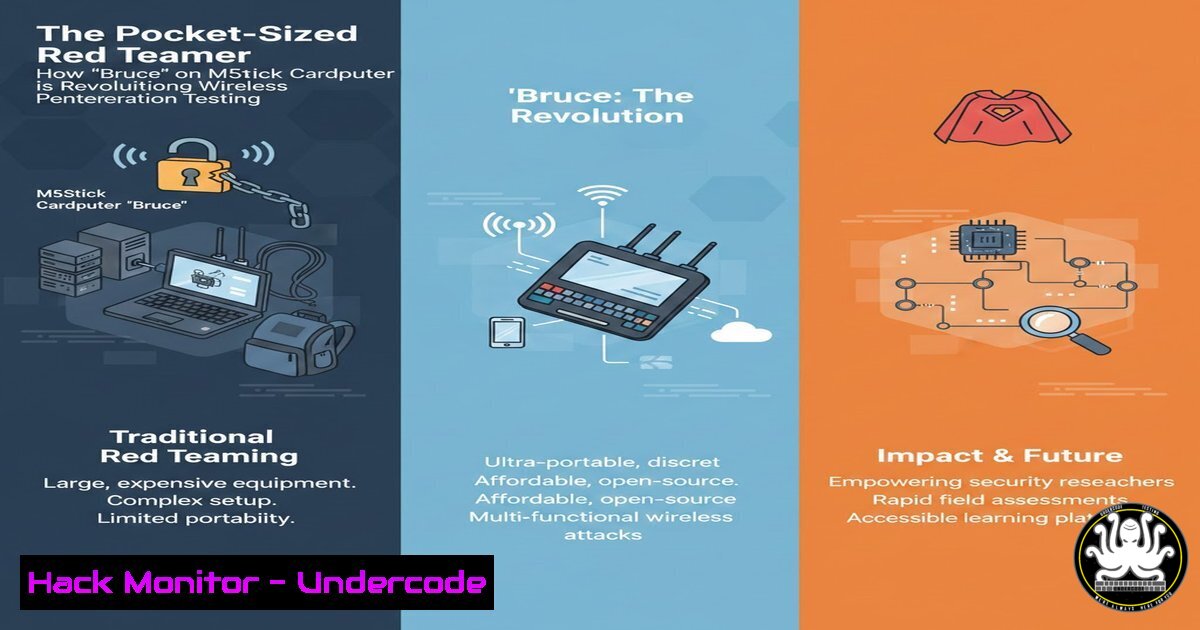
The landscape of cybersecurity is shifting towards the physical and wireless domains, where ubiquitous Internet of Things (IoT) devices and radio frequency (RF) communications present a vast new attack surface. A new project, “Bruce,” demonstrates this evolution by packing powerful wireless penetration testing capabilities into a pocket-sized device. Built on the M5Stick Cardputer and augmented with external CC1101 and NRF24L01 radio modules, this tool empowers security researchers to conduct critical assessments of the wireless world around them.
Learning Objectives:
- Understand the hardware components of the “Bruce” project and their role in wireless security research.
- Learn how to set up and configure a portable device for sniffing and analyzing NRF24L01 and sub-1 GHz CC1101 communications.
- Grasp the ethical implications and practical methodologies for using such a tool in authorized red team engagements and IoT penetration tests.
You Should Know:
1. Deconstructing the “Bruce” Hardware Stack
The power of “Bruce” lies in its carefully selected hardware components, each serving a distinct purpose in the wireless attack chain. The M5Stick Cardputer acts as the brain of the operation. It’s a compact device featuring an ESP32 microcontroller, a small keyboard, and a display, making it a self-contained unit perfect for on-the-go research. The external CC1101 module is a low-cost transceiver for sub-1 GHz ISM bands, commonly used in garage door openers, weather stations, and industrial sensors. The NRF24L01 module operates in the 2.4 GHz band and is notoriously common in a vast array of devices, from wireless keyboards and mice to custom IoT projects and even some toy drones.
Step-by-step guide:
Step 1: Acquire Components. You will need an M5Stick Cardputer, CC1101 module, NRF24L01 module, jumper wires, and a breadboard or custom PCB for a permanent build.
Step 2: Physical Assembly. Connect the modules to the M5Stick’s GPIO pins. Typically, this involves connecting the SPI (Serial Peripheral Interface) lines – MISO, MOSI, SCK, and CSN/CS – from the radio modules to the corresponding pins on the M5Stick. Power (3.3V) and Ground (GND) must also be connected.
Step 3: Power Considerations. Ensure your power source can handle the current draw. Using a small, high-capacity Li-Po battery attached to the M5Stick is ideal for true portability.
2. Firmware Flashing and Tool Configuration
With the hardware assembled, the next step is to install the specialized firmware that brings “Bruce” to life. This firmware is likely based on the Arduino core for ESP32 or the ESP-IDF, incorporating libraries for the CC1101 and NRF24L01 modules. The key functionality includes packet sniffing, channel hopping, and data logging to the MicroSD card.
Step-by-step guide:
Step 1: Install Arduino IDE/PlatformIO. Set up your development environment and install the ESP32 board support.
Step 2: Acquire Libraries. Install the necessary libraries, such as `printf` for debugging, the SD card library, and dedicated libraries for the NRF24L01 (e.g., nRF24) and CC1101 (e.g., ELECHOUSE_CC1101).
Step 3: Compile and Upload. Write or obtain the “Bruce” sketch, which initializes all modules and presents a menu system on the display. Verify the code and upload it to the M5Stick Cardputer via its USB-C port.
3. Sniffing NRF24L01 Communications
The NRF24L01 is often deployed with little to no security, making it a prime target. “Bruce” can scan the 2.4 GHz spectrum, identify active NRF24L01 data streams, and log the raw packets for analysis.
Step-by-step guide:
Step 1: Enter Sniffing Mode. From the “Bruce” main menu, select the NRF24L01 sniffer tool.
Step 2: Configure Parameters. Set the correct data rate (250kbps, 1Mbps, 2Mbps), channel, and payload width. If these are unknown, use a scanning mode to brute-force these parameters.
Step 3: Capture and Log. Start the sniffing process. “Bruce” will display captured packets on the screen and save them to the MicroSD card in a `.pcap` or `.txt` format for later analysis in tools like Wireshark.
4. Intercepting Sub-1 GHz Traffic with the CC1101
The CC1101 module allows “Bruce” to tap into the long-range, low-power world of sub-1 GHz communications. This band is used for critical functions like car key fobs, alarm systems, and remote sensors.
Step-by-step guide:
Step 1: Frequency Selection. Identify the target frequency (e.g., 315 MHz in North America, 433 MHz in Europe/Asia). Configure the CC1101 module to this frequency within the “Bruce” tool.
Step 2: Modulation and Data Rate. Set the correct modulation (e.g., ASK, FSK, GFSK) and data rate. This often requires prior reconnaissance or documentation analysis.
Step 3: Capture and Replay. Sniff the raw transmissions. Advanced firmware may include a replay function, allowing a captured signal (like a key fob unlock) to be retransmitted, testing the system’s vulnerability to replay attacks.
5. Post-Exploitation: Analyzing Captured Data
The data captured by “Bruce” is only as valuable as the analysis performed on it. The MicroSD card serves as a repository for all captured traffic, which can be analyzed on a more powerful machine.
Step-by-step guide:
Step 1: Transfer Data. Remove the MicroSD card from “Bruce” and insert it into a computer.
Step 2: Analyze with Wireshark. For NRF24L01 captures, you may need to use a custom dissector or script to parse the payloads. Look for patterns, plaintext credentials, or predictable sequence numbers.
Step 3: Decode Protocols. For proprietary protocols, use tools like GNU Radio or custom Python scripts to reverse-engineer the packet structure. The goal is to understand the command set to potentially craft malicious packets.
6. Ethical Deployment and Defensive Hardening
A tool as powerful as “Bruce” must be used responsibly. Its primary purpose is authorized security testing to help organizations build better defenses.
Step-by-step guide for Defenders:
Step 1: Wireless Inventory. Identify all wireless devices in your environment operating on 2.4 GHz and sub-1 GHz bands.
Step 2: Enable Encryption. Where possible, ensure devices use encryption (e.g., AES) rather than transmitting data in plaintext.
Step 3: Implement Rolling Codes. For systems like garage doors and gates, use rolling code technology that makes replay attacks ineffective.
Step 4: Physical Layer Monitoring. Deploy wireless intrusion detection systems (WIDS) that can monitor for RF jamming, replay attacks, and anomalous signal patterns.
What Undercode Say:
- The democratization of advanced red teaming tools is accelerating. Projects like “Bruce” lower the barrier to entry for sophisticated wireless penetration testing, forcing a necessary elevation of defensive strategies across the IoT industry.
- The convergence of multiple radio technologies into a single, low-cost, portable platform represents a significant shift. It moves wireless exploitation from a niche, lab-based activity to a standard part of on-site physical and red team assessments.
The “Bruce” project is not just a technical showcase; it is a harbinger of the future of offensive security. It proves that the tools required to assess the security of the increasingly wireless and embedded world are becoming more accessible and powerful. For defenders, this means the assumption that obscurity or proprietary protocols provide security is now completely invalid. The focus must shift to robust cryptographic implementations, proper key management, and active monitoring of the RF spectrum. For red teamers and researchers, it underscores the critical need to expand testing methodologies beyond traditional networks and into the airwaves that connect our physical and digital infrastructures.
Prediction:
The proliferation of portable, multi-protocol tools like “Bruce” will lead to a sharp increase in the discovery of vulnerabilities in consumer and industrial IoT devices over the next 12-24 months. We will see a rise in CVEs related to insecure RF implementations in products previously considered “non-computational,” such as industrial control systems sensors, medical devices, and smart city infrastructure. This will force regulatory bodies and standards organizations to incorporate stricter wireless security requirements, much like the push for HTTPS on the web. Furthermore, the defensive market will respond with a new class of affordable, automated RF monitoring solutions designed for enterprise and critical infrastructure environments.
🎯Let’s Practice For Free:
IT/Security Reporter URL:
Reported By: Sahil Kumar – Hackers Feeds
Extra Hub: Undercode MoN
Basic Verification: Pass ✅


