Listen to this Post
Introduction:
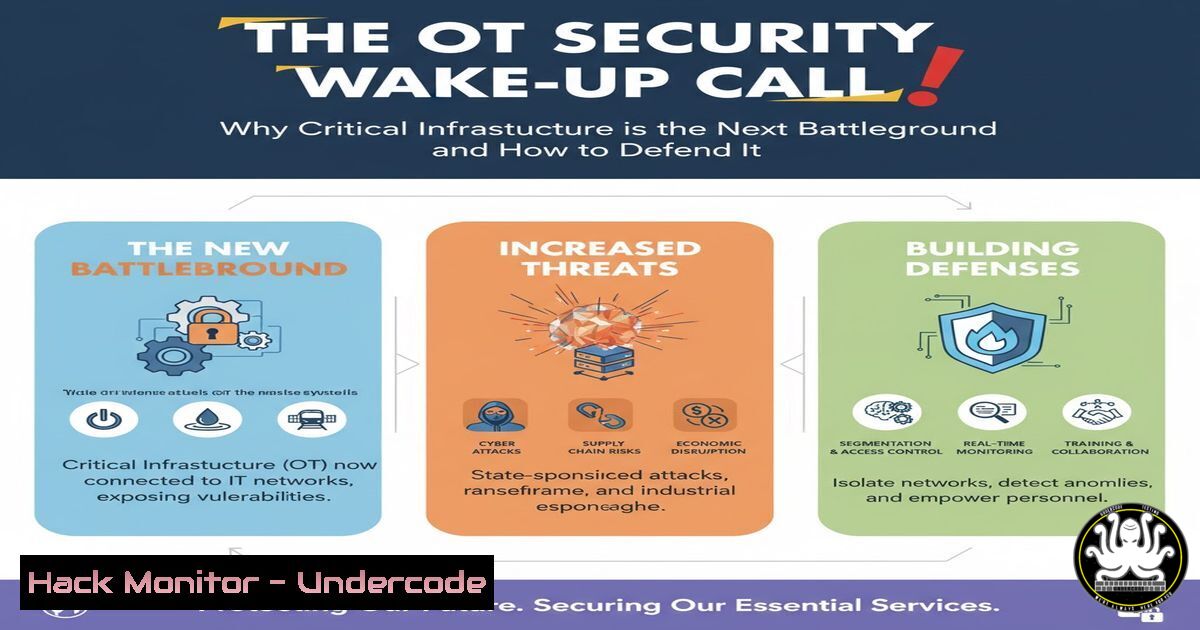
The convergence of IT and Operational Technology (OT) networks has created a massively expanded attack surface for critical infrastructure. Recent findings, highlighted at Industrial Cyber Days: Critical Infrastructure 2025, reveal a 146% increase in OT-focused disruptions, driven by internet-exposed devices, legacy system vulnerabilities, and sophisticated “living-off-the-land” techniques. This new reality demands a shift from theoretical frameworks to actionable, resilient defense strategies that account for both cyber and physical consequences.
Learning Objectives:
- Understand the critical vulnerabilities in OT environments, including exposed assets and unsecured industrial protocols.
- Learn practical steps for implementing network segmentation, asset discovery, and Zero Trust principles in an OT context.
- Develop skills to detect low-noise, LOTL (Living-Off-The-Land) attacks and hardkey crown jewel systems against modern adversaries.
You Should Know:
1. Mapping Your Internet-Exposed OT Attack Surface
The first step in defending a network is knowing what is visible to attackers. Research presented at the event highlighted “large numbers of internet-exposed OT devices,” often unbeknownst to organizations that believe their networks are properly segmented. These devices, including PLCs, HMIs, and SCADA systems, provide a direct entry point for ransomware gangs and state-sponsored actors.
Step‑by‑step guide explaining what this does and how to use it.
1. External Reconnaissance (Shodan): Attackers use search engines like Shodan to find internet-connected OT devices. Defenders must use the same tools offensively.
Command/Tool: Use Shodan CLI or website.
Example Search: `shodan search “port:502 Siemens”` or `shodan search “Modbus”`
What it does: This scans the internet for devices with port 502 (common Modbus port) or containing “Siemens” or “Modbus” in their banner, revealing your publicly accessible assets.
2. Internal Asset Discovery (Nmap): Once inside, attackers map the internal network. Regular internal scanning is crucial.
Command/Tool: `nmap`
Example Command: `nmap -sS -sU -p 1-1024,T:1025-49151,U:1025-49151 –script modbus-discover
What it does: This performs a SYN scan (-sS) and UDP scan (-sU) on common OT and IT ports, using Nmap’s NSE script to specifically discover Modbus devices.
3. Remediation: For any device found in step 1, immediately remove it from public internet access. Implement a firewall rule to block all unsolicited inbound traffic from the internet to OT networks. For internal assets (step 2), ensure they are placed in correctly segmented zones.
2. Implementing Hazard-Based Zones and Conduits
While standards like IEC 62443 advocate for zones and conduits, speakers argued this is not enough. A purely network-based segmentation model fails to account for how a cyber-induced deviation (e.g., a manipulated sensor value) can propagate through a physical process, causing safety and operational hazards.
Step‑by‑step guide explaining what this does and how to use it.
1. Identify Crown Jewels: Conduct a crown jewel analysis as emphasized in the event. This isn’t just about data, but systems whose failure could cause physical damage, environmental harm, or loss of life. Example: A pressure safety valve control system.
2. Map Cyber-Physical Interactions: For each crown jewel, document the entire data flow and physical process. What sensors does it read from? What actuators does it control? Which engineering workstations can program it?
3. Define Conduits with Deep Packet Inspection (DPI): Instead of just allowing traffic on a port, use next-generation firewalls with OT-specific DPI to enforce what kind of commands can pass through a conduit.
Tool Configuration: In a firewall like Palo Alto Networks or Tofino, create a security policy that only allows specific Modbus function codes (e.g., Read Holding Registers) to a PLC and explicitly blocks dangerous codes like “Write Multiple Registers” from unauthorized engineering stations.
4. Implement Application Whitelisting: On critical assets like HMIs, use application whitelisting (e.g., Windows AppLocker) to prevent the execution of unauthorized scripts or tools that could be used in a LOTL attack.
3. Hardening Industrial Protocols Against Exploitation
Sessions on protocol exploitation highlighted the inherent fragility of industrial protocols like Modbus, DNP3, and PROFINET. Most lack authentication and encryption, making them susceptible to manipulation, replay, and man-in-the-middle attacks.
Step‑by‑step guide explaining what this does and how to use it.
1. Deploy Protocol Scanners and Intrusion Detection Systems (IDS): Use specialized OT IDS to monitor network traffic for malicious commands.
Tool: Suricata or Zeek (Bro) with OT-specific rulesets.
Example Suricata Rule: `alert modbus any any -> any any (msg:”Modbus Possible Malicious Write”; flow:to_server; content:”|06|”; depth:1; content:”|10|”; depth:1; sid:1000001;)`
What it does: This simple rule triggers an alert if it detects a Modbus “Write Single Register” (0x06) or “Write Multiple Registers” (0x10) command. In a read-only segment, this is highly suspicious.
2. Segment by Protocol: Create separate VLANs or network segments for different protocols to contain any potential exploitation.
3. Where Possible, Encrypt and Authenticate: For modern devices that support it, implement solutions like OPC UA with Security (Sign & Encrypt) or use VPN tunnels for communications across untrusted networks.
- A Measured, Phased Approach to Zero Trust in OT
Zero Trust cannot be implemented as a sweeping transformation in OT environments where availability is paramount. The recommended approach is to introduce it as a set of measured principles in stages, focusing on “never trust, always verify.”
Step‑by‑step guide explaining what this does and how to use it.
1. Phase 1: Strong Identity and Access Management.
Action: Implement Multi-Factor Authentication (MFA) for all remote access (VPNs) and for administrative access to critical assets like HMIs and engineering workstations.
Tool: Deploy a RADIUS server integrated with an MFA provider.
2. Phase 2: Micro-segmentation for Crown Jewels.
Action: Using the crown jewel analysis from earlier, create the smallest possible network segments around your most critical systems. Enforce strict East-West traffic policies using firewalls.
Command (Linux host-based firewall): `iptables -A OUTPUT -d
3. Phase 3: Continuous Monitoring and Validation.
Action: Deploy tools that can monitor for anomalous user and device behavior, such as a technician account accessing a system at an unusual time or from an unfamiliar location.
5. Detecting Living-Off-the-Land (LOTL) Techniques
Adversaries are increasingly using quiet, low-noise techniques that leverage built-in system tools (like PowerShell, WMI, and RDP) to avoid detection. This was a key trend identified by MITRE’s CIPIC.
Step‑by‑step guide explaining what this does and how to use it.
1. Enable Enhanced Logging:
Windows Command (via GPO): Enable PowerShell Script Block Logging and Module Logging. This captures the full content of PowerShell scripts being run.
Command to check status: `Get-ItemProperty -Path “HKLM:\SOFTWARE\Policies\Microsoft\Windows\PowerShell\ScriptBlockLogging” -Name “EnableScriptBlockLogging”`
2. Monitor for Lateral Movement:
Action: Scrutinize Windows Security Event Logs for Event ID 4624 (successful logon) with Logon Type 3 (network logon) which indicates RDP or SMB file share access. A flurry of these from a single source IP is a red flag.
3. Use EDR/NDR with OT Context: Deploy Endpoint Detection and Response (EDR) and Network Detection and Response (NDR) platforms that are tuned for OT environments. They can baseline normal command-line activity and alert on anomalous use of system utilities.
What Undercode Say:
- Visibility is Non-Negotiable. You cannot defend what you cannot see. Comprehensive, continuous asset discovery across both IT and OT is the absolute foundation of any security program. Assumptions about segmentation are a primary cause of breaches.
- Focus on Consequences, Not Just Compliance. Frameworks like IEC 62443 are a starting point, but a hazard-based analysis that understands how a cyber event leads to a physical consequence is what truly builds resilience. Protecting the process is as important as protecting the network.
The insights from Industrial Cyber Days 2025 mark a pivotal moment. The industry is moving beyond checkbox compliance and acknowledging the sophisticated, targeted nature of modern OT threats. The blend of IT exploitation techniques with deep knowledge of physical processes means defenders must be equally hybrid in their skills. Success hinges on closing the gap between perceived and actual security postures through relentless visibility, consequence-driven prioritization, and the phased adoption of principles like Zero Trust that respect the unique demands of operational environments.
Prediction:
The next 18-24 months will see a surge in AI-powered attacks targeting OT environments. Adversaries will use machine learning to analyze normal process behavior and then execute subtle, multi-stage attacks designed to cause maximum physical damage with minimal digital footprint. These attacks will expertly manipulate sensor data and control signals to bypass traditional threshold-based alarms, forcing the industry to adopt AI-driven anomaly detection that can identify deviations in physical process logic, not just network traffic. The blurred IT/OT boundary will be the primary attack vector, making unified security platforms that span both domains essential for survival.
🎯Let’s Practice For Free:
IT/Security Reporter URL:
Reported By: Anna Ribeiro – Hackers Feeds
Extra Hub: Undercode MoN
Basic Verification: Pass ✅


