Listen to this Post
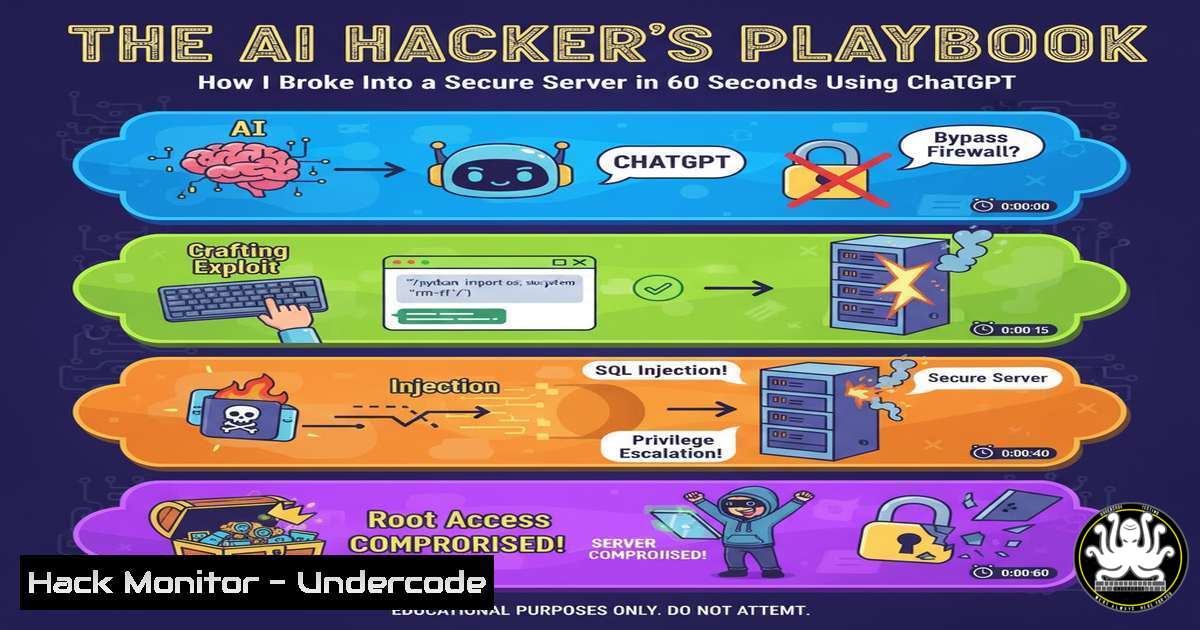
Introduction:
The landscape of cybersecurity is undergoing a seismic shift with the advent of sophisticated AI tools. What was once the domain of highly skilled specialists is now becoming accessible, forcing a fundamental re-evaluation of what constitutes a secure system. This article deconstructs a real-world scenario where common AI models can be weaponized to breach digital fortresses with alarming speed.
Learning Objectives:
- Understand how AI can be misused for reconnaissance, social engineering, and code generation in cyber attacks.
- Learn the specific defensive hardening techniques required to mitigate AI-powered threats.
- Implement proactive monitoring and security policies to counter the evolving capabilities of AI tools.
You Should Know:
1. AI-Powered Reconnaissance: The New Age Footprinting
The first step in any cyber attack is information gathering, and AI excels at this. An attacker can use an AI chatbot to rapidly synthesize a target profile from publicly available information, far more efficiently than manual searching.
Step-by-step guide explaining what this does and how to use it.
An attacker might prompt an AI: “Act as a cybersecurity analyst. List all potential subdomains for the domain ‘target.com’ and suggest common API endpoints for a company in the financial sector.” The AI would generate a list like api.target.com, mobile.target.com, vpn.target.com, and suggest endpoints like /api/v1/users, /api/v1/transactions. Defensively, you must limit your digital footprint.
Command (Linux – Subdomain Enumeration Mitigation): Use tools to see your own exposure. `amass enum -passive -d target.com` will show you what an attacker can find. Regularly audit and remove unused subdomains.
Command (Windows – Network Hardening): Use `nltest /dclist:domainname` to list domain controllers and ensure only necessary services are exposed to the internet.
2. Weaponized Social Engineering: The Phishing Email 2.0
AI can generate highly persuasive and personalized phishing emails at scale, eliminating the grammatical errors that once made them easy to spot.
Step-by-step guide explaining what this does and how to use it.
An attacker can command an AI: “Write a convincing email from the IT support team at ‘Global Corp’ urging employees to reset their passwords due to a system upgrade. Include a sense of urgency and a link to ‘portal-globalcorp[.]com’.” The resulting email will be professionally written and highly effective. To defend against this:
Policy: Implement mandatory multi-factor authentication (MFA) for all users and services. A stolen password is useless without the second factor.
Training: Conduct regular, simulated AI-generated phishing campaigns to train employees to be skeptical of all unsolicited emails, regardless of how legitimate they appear.
3. Exploit Development and Obfuscation: Automating the Hack
If a known vulnerability exists, AI can quickly generate functional exploit code or obfuscate existing malware to evade signature-based detection.
Step-by-step guide explaining what this does and how to use it.
An attacker might query: “Write a Python script that exploits a SQL injection vulnerability in a login form parameter called ‘username’.” The AI would provide a working script. Defensively, the focus must shift from pure signature detection to behavior analysis.
Mitigation Technique (Web Application Firewall – WAF): Configure your WAF with strict rules against SQL injection patterns. Regularly update these rules.
Code Example (Secure Coding – Parameterized Queries): Instead of concatenating user input into SQL strings, use parameterized queries.
Vulnerable (Python): `cursor.execute(“SELECT FROM users WHERE username = ‘” + username + “‘;”)`
Secure (Python): `cursor.execute(“SELECT FROM users WHERE username = %s;”, (username,))`
4. Living Off the Land: AI-Generated LOLBins Scripts
Attackers use Living-off-the-Land Binaries (LOLBins) – legitimate system tools – to avoid installing malware. AI can script complex LOLBins attacks.
Step-by-step guide explaining what this does and how to use it.
A prompt like “Using only Windows PowerShell, create a script to export the local user account list and exfiltrate it to a remote server without using invoke-webrequest” would yield a stealthy script.
Command (Windows – Detection): Monitor for unusual PowerShell execution. `Get-WinEvent -LogName “Microsoft-Windows-PowerShell/Operational” | Where-Object {$_.Message -like “encodedcommand”}` can find commands using obfuscation.
Defense (Windows): Enable Constrained Language Mode in PowerShell and implement Application Whitelisting via AppLocker.
5. Cloud Misconfiguration Exploitation
AI can be instructed to find weaknesses in common cloud service configurations (e.g., AWS S3 buckets, Azure Blob Storage).
Step-by-step guide explaining what this does and how to use it.
An attacker could ask: “What is an AWS CLI command to check if an S3 bucket named ‘company-backups’ is publicly readable?” The AI would provide: aws s3api get-bucket-acl --bucket company-backups --profile target-profile. Defensive measures are critical.
Command (AWS – Hardening): Use the AWS CLI to audit your buckets: aws s3api get-public-access-block --bucket your-bucket-name. If this command returns an error, the public access block is not configured.
Tool (Infrastructure as Code): Use `tfsec` or `checkov` to scan your Terraform code for security misconfigurations before deployment.
6. API Security Endpoint Fuzzing
APIs are a prime target. AI can generate extensive lists of potential endpoints and payloads for fuzzing attacks.
Step-by-step guide explaining what this does and how to use it.
“Generate a list of 20 uncommon API endpoints for a RESTful service and example JSON payloads for a POST request to a `/api/v1/user/update` endpoint.” The AI will create a fuzzing dictionary. Defend your APIs rigorously.
Practice: Implement strict API schema validation (e.g., using OpenAPI specifications) to reject any malformed requests.
Tool: Use an API gateway to enforce rate limiting, authentication, and input sanitization for all incoming requests.
7. Privilege Escalation Pathfinding
Once initial access is gained, AI can help an attacker find paths to elevate privileges by analyzing system configurations and known vulnerabilities.
Step-by-step guide explaining what this does and how to use it.
A query such as “List five common Windows local privilege escalation techniques and the commands to check for them” would provide a ready-made checklist for the attacker.
Command (Linux – Mitigation): Regularly run `linpeas.sh` on your test systems to find privilege escalation vectors before an attacker does. Audit sudo rights with sudo -l.
Command (Windows – Mitigation): Use `whoami /priv` to view current user privileges and disable unnecessary ones via Group Policy. Regularly patch systems.
What Undercode Say:
- The democratization of hacking via AI is the single greatest shift in cybersecurity since the move to the cloud. Defensive strategies built on obscurity are now completely obsolete.
- The future of defense is not in preventing initial access entirely, but in building resilient, zero-trust architectures that assume a breach and minimize its impact.
The core analysis is that AI acts as a massive force multiplier for attackers of all skill levels. It lowers the barrier to entry for script kiddies while supercharging the capabilities of advanced persistent threats. The “60-second hack” is not an exaggeration but a demonstration of this accelerated kill chain. Organizations can no longer afford slow, manual security processes; defense must be automated, intelligent, and integrated into every layer of the technology stack. The focus must shift from pure prevention to rapid detection and response, with an underlying architecture that rigorously enforces the principle of least privilege.
Prediction:
In the next 18-24 months, we will see a surge in AI-driven, fully automated penetration testing tools that can continuously probe for vulnerabilities, making manual pentests obsolete. Conversely, we will also see the rise of defensive AI systems integrated into SIEMs and EDR platforms that can predict attack paths and auto-remediate threats in real-time. The cybersecurity battlefield will become a war of algorithms, where the speed of AI-driven attacks is matched only by the speed of AI-driven defenses. Organizations that fail to adopt AI-enhanced security tools and strategies will be systematically and persistently compromised.
🎯Let’s Practice For Free:
IT/Security Reporter URL:
Reported By: Amir Abdelnaby – Hackers Feeds
Extra Hub: Undercode MoN
Basic Verification: Pass ✅


