Listen to this Post
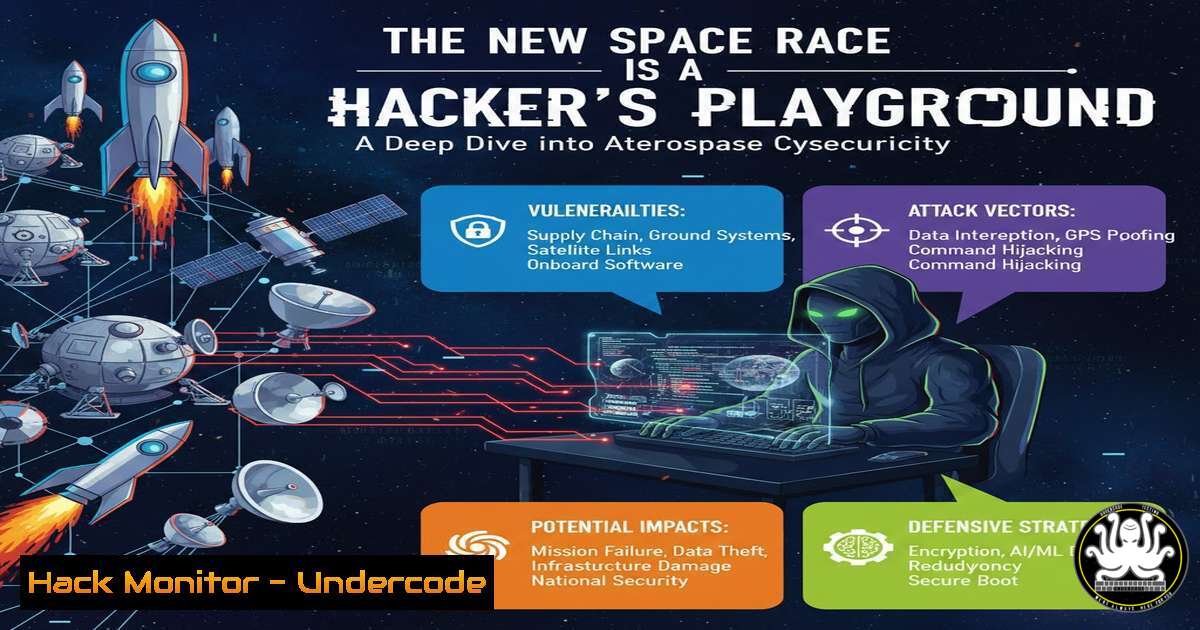
Introduction:
The final frontier is no longer the exclusive domain of governments and billionaires; it has become a new attack surface for cyber threats. As presented at BugCON 2025, aerospace cybersecurity addresses the critical vulnerabilities in satellite systems, spacecraft, and the entire space infrastructure that modern society depends upon for communications, navigation, and global security. This emerging field focuses on protecting these assets from sophisticated threat actors who could disrupt everything from GPS networks to in-flight aviation systems.
Learning Objectives:
- Understand the key attack vectors and threat models in modern aerospace systems.
- Learn the fundamental tools and methodologies for testing aerospace security.
- Identify critical mitigation strategies to harden satellite and avionic systems against cyber attacks.
You Should Know:
1. The Expanding Attack Surface of Modern Satellites
Modern satellites are essentially Linux servers in orbit, but with vastly greater consequences if compromised. Unlike traditional IT systems, they operate on long lifecycles with legacy components, making patch management nearly impossible. Their attack surface includes the satellite bus (the physical infrastructure), the payload (mission-specific equipment like cameras or transponders), and the ground station communication links. A single vulnerability in any component can lead to a complete loss of control, data exfiltration, or even kinetic destruction.
Step-by-step guide:
- Step 1: Reconnaissance – Identify target satellites using public databases like Celestrak or Space-Track.org. These provide orbital parameters (TLEs – Two-Line Elements) and basic telemetry.
- Step 2: Ground Station Mapping – Use tools like Shodan or Censys to search for internet-connected ground station components with specific keywords (e.g., “SATCOM,” “SCADA,” “Iridium”). Search queries can look for specific ports like 2101 (CCSDS) or 8002 (Satellite Telemetry).
- Step 3: Protocol Analysis – Intercept and analyze communication protocols, primarily the Consultative Committee for Space Data Systems (CCSDS) stack. Use a software-defined radio (SDR) like a HackRF or USRP with GNU Radio to capture downlink/uplink signals.
Basic GNU Radio command to capture a signal sample

<h2 style="color: yellow;">uhd_usrp_probe</h2>

Use GQRX for initial signal discovery and tuning

<h2 style="color: yellow;">gqrx
2. Exploiting Satellite Communication (SATCOM) Protocols
SATCOM networks have historically relied on security through obscurity, but many protocols lack basic authentication and encryption. Vulnerabilities in the implementation of protocols like Space Packet Protocol or Advanced Orbiting Systems (AOS) can allow for command injection, signal jamming, or spoofing.
Step-by-step guide:
- Step 1: Signal Acquisition – Using an SDR and a suitable antenna (e.g., a discone or Yagi), tune to the target satellite’s frequency, which is often publicly listed.
- Step 2: Demodulation and Decoding – Use GNU Radio Companion to build a flowgraph that demodulates the signal (e.g., BPSK, QPSK) and decodes it from the raw I/Q samples into a binary stream.
- Step 3: Fuzzing and Manipulation – Once the protocol structure is understood (often through reverse engineering), use a tool like `boofuzz` to fuzz the telecommand channel, looking for vulnerabilities that cause unexpected behavior in the satellite simulator.
` Example boofuzz setup for a custom protocol
session = Session(target=Target(connection=SocketConnection(“192.168.1.100”, 2101, proto=’tcp’)))
s_initialize(“SATCOM_CMD”)
s_static(“\x1A\xCF\xFC\x1D”) Header
s_string(“CMD”)
s_delim(” “)
s_string(“PARAM”)
s_static(“\x0D”) Trailer
session.connect(s_get(“SATCOM_CMD”))
session.fuzz()`
3. GPS Spoofing and Jamming for Navigation Disruption
GPS and other Global Navigation Satellite Systems (GNSS) are notoriously vulnerable to spoofing and jamming due to the weak power of their signals. Attackers can broadcast more powerful, false signals to trick receivers into reporting incorrect location, time, or velocity—a critical threat to aviation, maritime, and financial systems.
Step-by-step guide:
- Step 1: Setup – Use an SDR (e.g., HackRF One) and software like `gps-sdr-sim` to generate a fake GPS signal.
- Step 2: Generate Spoofing Trajectory – Create a text file containing the spoofed trajectory coordinates and time.
` Generate a fake GPS signal file
./gps-sdr-sim -e brdc3540.14n -l 40.7128,-74.0060,100 -o gpssim.bin`
- Step 3: Transmit the Spoofed Signal – Use the SDR to transmit the generated binary file, effectively overriding the legitimate GPS signals in the local area.
` Transmit with HackRF (be mindful of legal regulations!)
hackrf_transfer -t gpssim.bin -f 1575420000 -s 2600000 -a 1 -x 0`
4. Hardening Avionic Systems: The ARINC 823 Standard
Avionics Full-Duplex Switched Ethernet (AFDX) is the backbone of modern aircraft data networks, based on ARINC 823 standards. Hardening these systems involves implementing strict network segmentation, integrity checks, and robust configuration of the Avionics Bay Switches to prevent data injection or denial-of-service attacks that could affect flight controls.
Step-by-step guide:
- Step 1: Network Segmentation – Physically and logically segregate critical flight control systems (e.g., A664 – AFDX) from passenger entertainment networks (e.g., A665 – Cabin Wireless). Implement strict firewall rules, ideally with an air-gap.
- Step 2: Virtual Link (VL) Configuration – On the AFDX network, each Virtual Link has a defined Bandwidth Allocation Gap (BAG). Ensure switches are configured to police traffic and discard any frames that violate their VL’s BAG and jitter limits, preventing bus congestion.
- Step 3: End-System Hardening – On avionic end-systems (e.g., a Flight Control Computer), disable all unused network services and ports. Enforce application whitelisting to prevent unauthorized code execution.
- Cloud-Based Ground Station Security (e.g., AWS Ground Station)
The shift to cloud-based ground station services like AWS Ground Station introduces traditional cloud misconfiguration risks into the space domain. Common issues include improperly configured IAM roles, missing encryption for data at rest, and exposed S3 buckets containing telemetry or mission data.
Step-by-step guide:
- Step 1: Audit IAM Policies – Regularly audit AWS IAM policies associated with the Ground Station service to ensure the principle of least privilege. No role should have unnecessary permissions.
Use AWS CLI to list IAM policies for a user/role

<h2 style="color: yellow;">aws iam list-attached-user-policies --user-name GroundStationUser - Step 2: Enable Comprehensive Logging – Ensure AWS CloudTrail is enabled and logging across all regions, including global services. Monitor these logs for unauthorized API calls like `DeleteContact` or unusual `DescribeContact` patterns.
- Step 3: Encrypt Data End-to-End – Mandate the use of AWS KMS (Key Management Service) for encrypting all data related to contacts, telemetry, and mission plans, both in transit and at rest. Never rely on default encryption.
6. Mitigating Vulnerabilities in CubeSat and NewSpace Architectures
The CubeSat and “NewSpace” revolution prioritizes cost and speed-to-orbit, often at the expense of security. These systems frequently use commercial off-the-shelf (COTS) components with known vulnerabilities and lack secure boot processes, making them easy targets.
Step-by-step guide:
- Step 1: Implement Secure Boot – Ensure the onboard computer (OBC) firmware verifies the cryptographic signature of the bootloader and operating system before execution. This prevents the execution of malicious firmware uploaded via a compromised ground station.
- Step 2: COTS Component Hardening – For common components like Raspberry Pi or Arduino-based OBCs, change default credentials, disable unused interfaces (e.g., SSH, UART), and apply all available security patches before launch.
On a Linux-based OBC, disable password-based SSH logins

<h2 style="color: yellow;">echo "PasswordAuthentication no" | sudo tee -a /etc/ssh/sshd_config</h2>

<h2 style="color: yellow;">sudo systemctl restart ssh - Step 3: Apply Software-Defined Perimeter (SDP) – Instead of traditional VPNs for ground-to-satellite links, use an SDP architecture. This creates a “black cloud” where the satellite’s services are invisible to the internet until the ground station controller authenticates and authorizes itself, drastically reducing the attack surface.
What Undercode Say:
- The democratization of space technology has paradoxically created a democratization of space-based attack vectors, lowering the barrier to entry for threat actors.
- Traditional IT “patch Tuesday” cycles are impossible in space; security must be designed-in from the first component, making DevSecOps non-negotiable for aerospace.
+ analysis around 10 lines.
The BugCON 2025 presentation underscores a critical inflection point. Aerospace is no longer a siloed, government-only domain but a connected, software-defined environment. The core challenge is the convergence of IT and Operational Technology (OT) security principles with the immutable physical constraints of space. An attacker can now potentially disrupt global logistics, finance, and communications from a small, inexpensive SDR setup, making the ROI for nation-states and cybercriminals alarmingly high. The industry’s reliance on legacy systems and COTS components creates a “foundation of sand” upon which critical infrastructure is being built. The only viable path forward is a paradigm shift towards “security-by-design,” where resilience is engineered into the system architecture, assuming compromise is inevitable. This involves robust encryption for all communications, hardware-enforced trusted execution environments on satellites, and continuous threat modeling that evolves with the rapidly changing new space landscape.
Prediction:
The next five years will see the first major, publicly attributed cyberattack resulting in the permanent loss of a commercial satellite. This event will act as a “Sputnik moment” for the industry, triggering sweeping regulatory changes and mandatory cybersecurity frameworks for spacecraft licensing. We will witness the rise of “orbital incident response” as a specialty and the development of in-orbit “cyber patching” technologies, such as redundant, secure FPGA configurations that can be switched to in the event of a compromise. Furthermore, AI-powered threat detection will become standard in ground station operations, autonomously identifying anomalous telemetry patterns indicative of an ongoing attack, fundamentally changing how we defend assets beyond the atmosphere.
🎯Let’s Practice For Free:
IT/Security Reporter URL:
Reported By: Romel Marin – Hackers Feeds
Extra Hub: Undercode MoN
Basic Verification: Pass ✅


