Listen to this Post
Introduction:
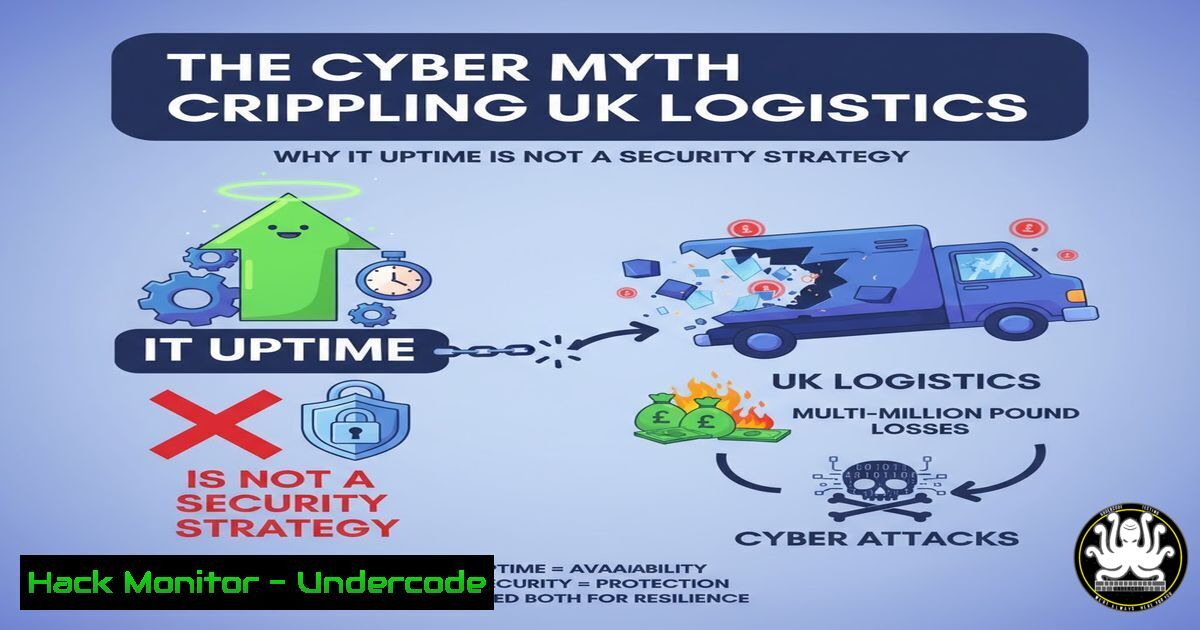
A dangerous misconception is pervasive among UK logistics boardrooms: the belief that maintaining high IT uptime equates to a robust cybersecurity posture. This conflation of operational continuity with active cyber defence leaves supply chains critically exposed to sophisticated threats, where the financial impact of a single breach often surpasses an entire year’s cybersecurity investment. Industry leaders must urgently decouple these functions, establishing cybersecurity as an independent business discipline with dedicated ownership, accountability, and metrics.
Learning Objectives:
- Differentiate between IT continuity management and proactive cybersecurity defence strategies.
- Implement foundational cybersecurity controls specific to logistics and supply chain environments.
- Develop and measure key risk indicators (KRIs) for cybersecurity that are separate from IT performance metrics.
You Should Know:
- Conduct a Cyber Risk Assessment Separate from IT Health Checks
A cyber risk assessment focuses exclusively on identifying threats, vulnerabilities, and impacts to your critical data and systems, moving far beyond uptime monitoring. For logistics firms, this means mapping where sensitive data (like shipment manifests, customer PII, and customs documentation) flows and resides, and identifying how an adversary could exploit this.
Step‑by‑step guide explaining what this does and how to use it.
Step 1: Asset Inventory. Identify all critical assets. Use network scanning tools to build a comprehensive list.
Linux Command: `nmap -sS -O 192.168.1.0/24` (This performs a SYN scan and OS detection on the entire subnet to discover live hosts and their operating systems).
Windows Command: `Get-WmiObject -Class Win32_ComputerSystem` (PowerShell cmdlet to get basic system info) combined with network discovery.
Step 2: Threat Modeling. Use a framework like STRIDE (Spoofing, Tampering, Repudiation, Information Disclosure, Denial of Service, Elevation of Privilege) to hypothesize attack vectors against your key assets, such as tampering with shipment tracking data.
Step 3: Vulnerability Analysis. Regularly scan for vulnerabilities. Do not assume patching for uptime covers security holes.
Tool: Use OpenVAS or a commercial scanner to perform credentialed scans on critical servers, focusing on known exploits for logistics management software.
- Implement Strict Access Controls and Multi-Factor Authentication (MFA)
Uptime ensures systems are available; access control ensures they are only available to authorized users and processes. This is a primary defence against credential theft and lateral movement by attackers.
Step‑by‑step guide explaining what this does and how to use it.
Step 1: Enforce Principle of Least Privilege (PoLP). Audit user accounts, especially service accounts used by warehouse and tracking systems. Ensure users only have the access absolutely necessary for their role.
Windows Command: `net user
` (to view a user's group memberships and privileges). Use Group Policy to enforce PoLP.
 Linux Command: `groups [bash]` and `sudo -l -U [bash]` (to list groups and sudo privileges for a user).
 Step 2: Mandate MFA Everywhere Possible. Especially for remote access (VPNs, RDP), cloud admin consoles (AWS, Azure), and email systems. This single action neutralizes the vast majority of credential-based attacks.
 Step 3: Implement Application Whitelisting. On critical systems like those controlling logistics orchestration, use whitelisting to prevent execution of unauthorized software or scripts, a common post-exploitation tactic.

<h2 style="color: yellow;">3. Segment Your Operational Network</h2>

A flat network where warehouse IoT devices, corporate desktops, and shipment tracking servers all communicate freely is a gift to attackers. Network segmentation contains breaches and protects critical assets.

Step‑by‑step guide explaining what this does and how to use it.
 Step 1: Map Data Flows. Understand which systems need to talk to each other. Your warehouse scanning system does not need direct access to the corporate HR server.
 Step 2: Create VLANs. Logically separate networks (e.g., Corporate, Operational Technology/Warehouse, DMZ for public tracking).

<h2 style="color: yellow;"> Configuration Example (Cisco):</h2>

[bash]
interface GigabitEthernet0/1
switchport mode access
switchport access vlan 20
description Warehouse Scanner Network
Step 3: Configure Firewall ACLs. Create strict Access Control Lists (ACLs) on firewalls between segments, denying all traffic by default and only allowing specific, required protocols and ports.
4. Harden Your Endpoints Beyond Basic Antivirus
IT teams often deploy standard antivirus to ensure endpoint stability. Cybersecurity requires a hardened configuration to prevent exploitation, even if it marginally impacts “performance.”
Step‑by‑step guide explaining what this does and how to use it.
Step 1: Disable Unnecessary Services and Ports. On all servers and workstations, turn off services that are not required.
Windows Command (PowerShell): `Get-Service | Where-Object {$_.Status -eq ‘Running’}` (to audit running services). `Stop-Service -Name “servicename”` and Set-Service -Name "servicename" -StartupType Disabled.
Linux Command: `systemctl list-unit-files –type=service | grep enabled` (to see enabled services). sudo systemctl disable [bash].
Step 2: Apply Application Sandboxing. Use tools like Windows Defender Application Guard for browsing or Sandboxie for executing untrusted files to contain potential malware.
Step 3: Enable EDR (Endpoint Detection and Response). Deploy an EDR solution, which goes beyond signature-based AV by using behavioural analytics to detect and respond to advanced threats.
5. Secure Your Cloud APIs and Configurations
Modern logistics relies heavily on cloud services for tracking, analytics, and coordination. Misconfigured cloud storage (S3 buckets) and insecure APIs are low-hanging fruit for attackers.
Step‑by‑step guide explaining what this does and how to use it.
Step 1: Enable Cloud Security Posture Management (CSPM). Use tools like AWS Security Hub, Azure Security Center, or third-party solutions to continuously detect and remediate misconfigurations, such as publicly exposed storage buckets.
Step 2: Implement API Security Gateways. For any custom or third-party APIs used in your supply chain, enforce rate limiting, input validation, and authentication via an API gateway to prevent abuse and data scraping.
Step 3: Use Infrastructure as Code (IaC) Security Scanners. Scan your Terraform or CloudFormation templates for security flaws before deployment to prevent “misconfiguration as code.”
Tool: Use `tfsec` or `checkov` to scan Terraform configurations for common security issues.
6. Develop and Test an Incident Response Plan
IT disaster recovery plans focus on getting systems back online. A cybersecurity incident response (IR) plan focuses on containing an active adversary, preserving evidence, and managing communications.
Step‑by‑step guide explaining what this does and how to use it.
Step 1: Form a Cross-Functional IR Team. Include members from Legal, Communications, IT, and Operations—not just IT.
Step 2: Define Communication and Escalation Procedures. Who is notified when a breach is suspected? What are the criteria for engaging external forensics?
Step 3: Run Tabletop Exercises. Quarterly, simulate a realistic attack (e.g., ransomware on your freight management system) and walk through the IR plan to identify gaps and improve team coordination.
What Undercode Say:
- Ownership is the Antidote to Assumption. The core failure is a delegation of cyber risk to IT without clear, C-level ownership. Cybersecurity must be a board-level accountability with its own budget and strategy, distinct from IT infrastructure management.
- Financial Justification is Pre-Incident. Framing cybersecurity spending as an insurance premium against a quantifiable financial loss is more effective than technical arguments. Calculate the potential cost of a 3-day shipping disruption versus the cost of a robust security control framework.
The analysis reveals a critical gap in risk governance. The logistics sector’s operational focus has led to a culture where “availability” supersedes “integrity” and “confidentiality.” This creates a fragile ecosystem where a sophisticated attacker can manipulate shipment data, disrupt entire supply chains, or steal sensitive commercial intelligence, all while systems appear to have high “uptime.” The conversation must shift from technical uptime to business resilience.
Prediction:
In the next 12-24 months, we will see a landmark cyber-attack on a major UK logistics firm that exploits this exact myth, leading to a multi-week operational shutdown and triggering stringent, government-mandated cybersecurity regulations for the entire supply chain sector. This event will force a rapid decoupling of cyber and IT functions, creating a new market for integrated cyber-physical security solutions tailored for logistics, and making cyber resilience a key differentiator in carrier selection and insurance premiums. The companies that act now to separate and professionalize their cyber defence will not only survive but will become the trusted backbone of UK trade.
🎯Let’s Practice For Free:
IT/Security Reporter URL:
Reported By: Michael Mcquade – Hackers Feeds
Extra Hub: Undercode MoN
Basic Verification: Pass ✅


