Listen to this Post
Introduction:
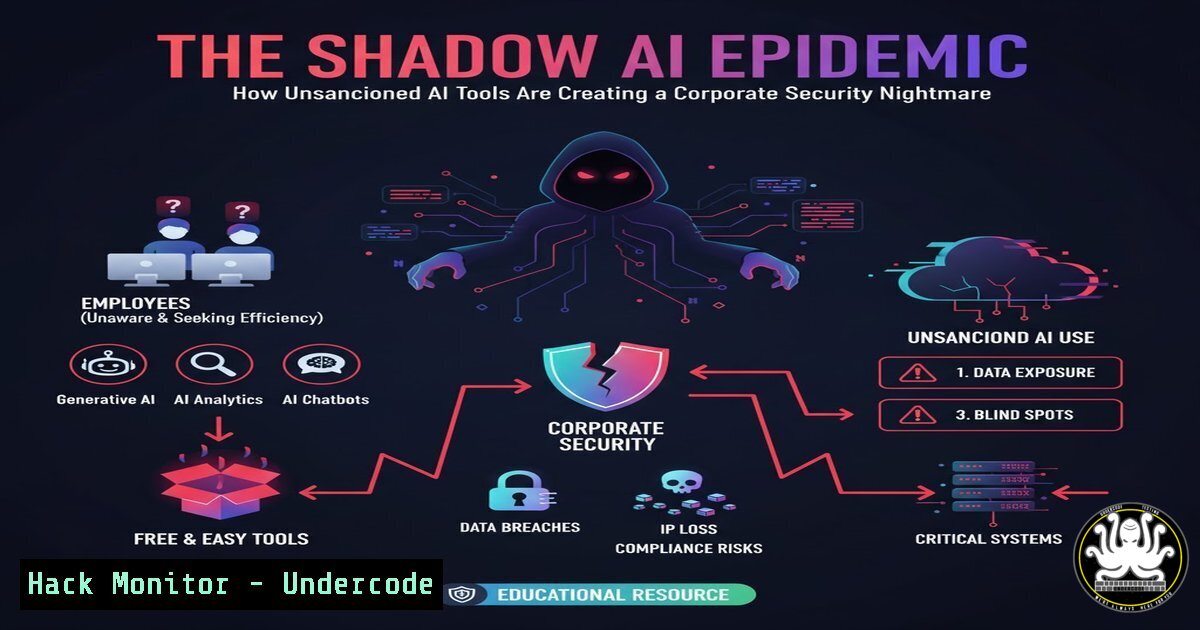
The rapid proliferation of generative AI has given birth to a dangerous and unmanaged attack surface known as “Shadow AI.” This refers to the use of unauthorized AI applications and large language models (LLMs) by employees without the knowledge, oversight, or approval of the organization’s IT and security teams. While driven by a desire for productivity, these tools pose severe data exfiltration, compliance, and intellectual property theft risks, creating a new frontier of unseen cyber risk that traditional security controls are ill-equipped to handle.
Learning Objectives:
- Understand the concrete technical risks associated with unsanctioned AI usage, including data leakage and model poisoning.
- Learn how to detect Shadow AI activity within your network using logging and monitoring tools.
- Implement technical controls and policies to mitigate the risks and secure approved AI integrations.
You Should Know:
- The Data Exfiltration Vector: How Shadow AI Leaks Your Crown Jewels
When an employee pastes proprietary source code, a confidential business strategy, or sensitive customer data into an unauthorized public AI chatbot, that data is no longer under your control. It becomes part of the model’s training data or, worse, could be exposed in a data breach at the AI provider. This is not theoretical; it’s a continuous, unintentional data leak.
Step‑by‑step guide explaining what this does and how to use it.
Step 1: Identify Common Exfiltration Channels. The primary channels are web browsers and unofficial API integrations. Employees use ChatGPT, Midjourney, or other web-based tools directly, or they use browser extensions and scripts that call AI APIs.
Step 2: Implement Web Traffic Logging and Filtering. Use your existing Secure Web Gateway (SWG) or firewall to log and control traffic to known AI domains.
Linux (Using `curl` to test firewall rules): `curl -I https://chat.openai.com` – This command tests if the endpoint is reachable and can be used to validate block pages.
Windows PowerShell (To check for established connections): `Get-NetTCPConnection | Where-Object {$_.RemoteAddress -like “openai” -or $_.RemotePort -eq 443}` – This can help identify active connections to AI services from a host.
Step 3: Deploy Data Loss Prevention (DLP). Configure DLP policies to scan outbound traffic for keywords and data patterns (like source code or customer IDs) and block their transmission to unauthorized AI domains. This is your critical technical control to prevent the actual data loss.
2. Detecting Shadow AI with Network Traffic Analysis
You cannot secure what you cannot see. Proactive monitoring of your network is essential to discover the scope of Shadow AI usage before a major incident occurs.
Step‑by‑step guide explaining what this does and how to use it.
Step 1: Ingest DNS Logs. Centralize DNS query logs from your internal servers or DNS filtering service. Look for queries related to AI providers.
Step 2: Create Detection Rules. In your SIEM (e.g., Splunk, Elasticsearch), create correlation rules to alert on traffic to AI domains.
Example Sigma Rule (YAML) for detecting OpenAI usage:
title: HTTP Request to OpenAI API
status: experimental
description: Detects HTTP POST requests to api.openai.com which are indicative of ChatGPT or API usage.
logsource:
category: proxy
detection:
selection:
c-uri: 'api.openai.com/v1/chat/completions'
method: 'POST'
condition: selection
falsepositives:
- Legitimate, approved business use.
level: medium
Step 3: Triage and Investigate. When an alert fires, investigate the source IP and user to determine if the activity is authorized. This data provides the evidence needed to enforce your Acceptable Use Policy.
- The Threat of Poisoned Models and Malicious Code Generation
Shadow AI isn’t just about data going out; it’s also about threats coming in. Employees might use unvetted, open-source models from public repositories that could be deliberately poisoned to produce malicious outputs, such as code with hidden vulnerabilities or backdoors.
Step‑by‑step guide explaining what this does and how to use it.
Step 1: Establish a Approved AI Registry. Create a centralized list of vetted and approved AI tools and models that have undergone a security review.
Step 2: Harden Developer Environments. For teams that must use AI for coding (e.g., GitHub Copilot), ensure it is the officially managed version. Then, implement strict code scanning before commit.
Git Pre-commit Hook (Example): Use a tool like `gitleaks` in a pre-commit hook to scan for secrets that might have been generated by an AI.
 Install gitleaks
 In your project's .git/hooks/pre-commit file:
!/bin/sh
gitleaks detect --source . --no-git
if [ $? -eq 0 ]; then
echo "Gitleaks scan passed."
exit 0
else
echo "Gitleaks found secrets! Commit blocked."
exit 1
fi
Step 3: Mandatory SAST Scanning. Integrate Static Application Security Testing (SAST) into your CI/CD pipeline to catch vulnerabilities introduced by AI-generated code, treating it with the same skepticism as human-written code.
4. Securing Approved AI Integrations with API Hardening
Simply blocking all AI is not a sustainable strategy. The goal is to secure approved integrations, and this hinges on API security.
Step‑by‑step guide explaining what this does and how to use it.
Step 1: Use API Keys Securely. Never hardcode API keys in application source code or client-side applications.
Linux/Cloud (Using Environment Variables):
 Set the key in your shell profile or cloud environment
export OPENAI_API_KEY='your-secret-key'
 Reference it in your Python script
import os
api_key = os.environ.get('OPENAI_API_KEY')
Step 2: Implement a AI API Gateway. Route all AI API calls through a central proxy. This allows for logging, rate limiting, data sanitization, and key rotation in one place. You can use a cloud-native solution or build a simple one with a framework like Python Flask.
Step 3: Apply Rate Limiting and Quotas. Prevent cost overruns and abuse by implementing strict rate limits on your AI gateway, ensuring a single user or department cannot exhaust resources.
5. Policy and Training: The Human Firewall
Technical controls are futile without a clear policy and ongoing user education. The goal is to guide behavior, not just block it.
Step‑by‑step guide explaining what this does and how to use it.
Step 1: Draft and Disseminate an AI Acceptable Use Policy (AUP). This policy must clearly define prohibited and approved AI uses, explicitly stating that data classified as Confidential or above must not be entered into public AI tools.
Step 2: Conduct Interactive Training. Move beyond boring slides. Use real-world scenarios: “You need to summarize a quarterly report for your manager. What do you do?” Make the secure choice the easy choice by providing links to approved tools.
Step 3: Enforce Policy with Technical Controls. Link the policy to your technical enforcement. For example, when your DLP blocks a paste into ChatGPT, the block page should include a link to the company’s AI AUP and a form to request access to an approved alternative.
What Undercode Say:
- Shadow AI is not a technology problem; it’s a governance and risk management failure. The tools are visible and their traffic patterns are known; the gap is in leadership’s willingness to enforce control over a “productivity” tool.
- The most significant long-term risk is the silent, permanent loss of competitive advantage. Leaked intellectual property trains external models, which can then benefit your competitors. This is a corporate espionage vector that is largely self-inflicted.
The analysis reveals that organizations are repeating the mistakes of the “Shadow IT” era but with far greater consequences. While Shadow IT risked non-compliance and wasted licenses, Shadow AI risks the core intellectual property and data that define the business. The solution requires a unified effort from Security, Legal, and HR to create a culture of secure innovation, where employees are empowered to use AI but within a clearly defined and technically enforced safety corridor.
Prediction:
Within the next 18-24 months, a major data breach or stock-moving intellectual property theft directly attributable to Shadow AI will force regulatory action. This will likely manifest as new data privacy amendments specifically covering data submitted to third-party AI models, mandating explicit consent and logging. Furthermore, cyber insurance providers will begin requiring audited AI usage controls as a prerequisite for coverage, turning Shadow AI mitigation from a best practice into a financial and compliance necessity.
🎯Let’s Practice For Free:
IT/Security Reporter URL:
Reported By: Mrdigitalexhaust Shadow – Hackers Feeds
Extra Hub: Undercode MoN
Basic Verification: Pass ✅


