
Listen to this Post
Introduction:
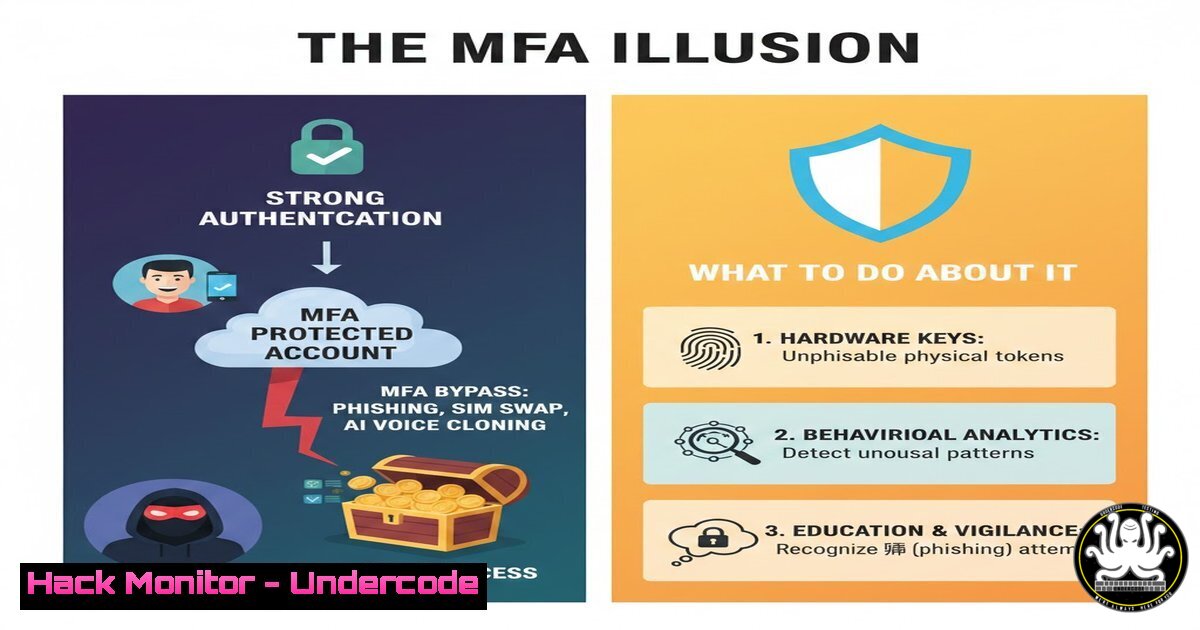
The foundational assumption that Multi-Factor Authentication (MFA) is an impenetrable barrier is crumbling. Cybersecurity professionals are witnessing a paradigm shift where attackers bypass technical controls not through code exploitation, but by manipulating human psychology. As highlighted in recent analyses, sophisticated voice phishing (vishing) campaigns are successfully hijacking sessions in real-time, proving that the authentication layer is now the primary, and most vulnerable, attack surface. This article deconstructs modern authentication threats and provides a technical blueprint for building a truly resilient defense.
Learning Objectives:
- Understand the technical and social engineering techniques used to bypass MFA, including MFA fatigue, session hijacking, and real-time phishing.
- Learn how to implement and configure phishing-resistant authentication standards like FIDO2/WebAuthn.
- Gain actionable skills for hardening Identity Providers (IdPs), monitoring authentication logs, and conducting effective security awareness training.
You Should Know:
- Deconstructing the Modern MFA Bypass: From Vishing to Token Theft
The post references attackers tricking users into entering credentials and MFA codes in real time. This is often part of an adversary-in-the-middle (AiTM) phishing attack. The attacker sets up a proxy server between the user and the legitimate site (like Okta). When the user enters credentials and approves the MFA prompt, the attacker’s proxy forwards them instantly to the real site, stealing the session cookie that is generated upon successful login. This cookie is then used to impersonate the user, rendering the stolen password and spent MFA code useless.
Step-by-step guide explaining what this does and how to use it:
Attacker Setup: An attacker uses a phishing kit (e.g., Evilginx2, Modlishka) to clone a corporate login portal.
Phish Delivery: A vishing call or urgent email directs the victim to the malicious URL.
Credential Harvesting: The victim enters username/password. The proxy forwards this to the real IdP.
MFA Interception: The real MFA prompt appears (via the proxy). The victim approves it.
Session Cookie Theft: The proxy captures the post-authentication session cookie.
Lateral Movement: The attacker injects this cookie into their own browser, gaining full access.
- Implementing Phishing-Resistant MFA: A Technical Guide to FIDO2/Passkeys
The solution advocated is phishing-resistant MFA, primarily FIDO2 security keys or platform-integrated passkeys. These use public-key cryptography where the private key never leaves the authenticator device and is unlocked locally via a PIN or biometric. The cryptographic proof is unique to the specific website domain, making proxy-based phishing impossible.
Step-by-step guide for implementation:
IdP Configuration (Okta Example): Navigate to Security -> Authenticators. Add a new authenticator, choose “Security Key or Biometric (FIDO2 WebAuthn)”. Enforce verification for password-less login or as a second factor.
Windows Server (For AD Integration): Configure Windows Hello for Business, which is a FIDO2-compliant solution. Use Group Policy (Computer Configuration -> Administrative Templates -> Windows Components -> Windows Hello for Business) to enable and enforce it.
Linux Server (PAM Integration): For SSH or sudo authentication, use pam_u2f. Install `libpam-u2f` and configure /etc/udev/rules.d/70-u2f.rules. Generate a key mapping for each user: pamu2fcfg -o username > ~/.config/Yubico/u2f_keys.
3. Hardening Your Identity Provider: Context-Aware Access Policies
Merely enabling MFA is insufficient. You must implement conditional access policies that evaluate risk signals such as unfamiliar location, device compliance status, and network reputation. This moves security from a static checkpoint to a dynamic evaluation.
Step-by-step guide for Microsoft Entra ID:
- Navigate to
Microsoft Entra Admin Center -> Protect & secure -> Conditional Access. - Create a new policy named “Block high-risk sign-ins from non-managed devices”.
- Under
Users or workload identities, selectAll users. - Under
Cloud apps or actions, selectAll cloud apps. - Under
Conditions, set `Device platform` to `Any` and `Client apps` toAll. - Under
Access controls -> Grant, selectBlock access. ClickSelect. - Under
Session, select `Sign-in frequency` and set it to a value like `12` hours to limit token lifetime.
8. Enable the policy and `Save`.
4. Proactive Defense: Monitoring Authentication Logs for Anomalies
Continuous monitoring is critical. You must analyze IdP logs to detect patterns indicative of attacks, such as multiple MFA denials followed by a success (MFA fatigue), or logins from disparate geographic locations in an impossible time window.
Step-by-step guide using Wazuh SIEM (as referenced in the post):
1. Collect Logs: Configure your IdP (Okta, Entra ID) to send Syslog or API-based logs to your Wazuh server.
2. Create Decoders/Rules: Write custom decoders in `/var/ossec/etc/decoders/` to parse authentication events.
3. Implement a Detection Rule: Create a rule in `/var/ossec/etc/rules/local_rules.xml` to flag potential MFA fatigue:
<group name="authentication,">
<rule id="100100" level="10">
<field name="idp.eventType">^user.mfa.factor_attempt_fail$</field>
<same_field>idp.actor.alternateId</same_field>
<description>Multiple MFA failures for the same user in 5 minutes.</description>
</rule>
</group>
4. Automate Response: Integrate with Wazuh’s active response to trigger a script that temporarily disables the user’s account or notifies an analyst via webhook.
5. Building Human Firewalls: Beyond Compliance-Based Training
The post correctly states training must be experiential. Theoretical slides fail. Use controlled phishing simulation platforms to create muscle memory for reporting real attacks.
Step-by-step guide for a technical phishing simulation:
- Tool Selection: Use an open-source tool like GoPhish or a commercial platform.
- Campaign Design: Craft a campaign mimicking the described vishing/SSO attack. Use a cloned internal portal.
- Infrastructure Setup: Deploy GoPhish on a cloud server, configuring landing pages and sending profiles. Use commands like:
On Ubuntu server
wget https://github.com/gophish/gophish/releases/download/v0.12.1/gophish-v0.12.1-linux-64bit.zip
unzip gophish-.zip
sudo ./gophish
- Delivery & Measurement: Send the campaign to a test group. Track opens, clicks, and credential submissions.
- Immediate Remediation Training: Automatically direct users who “fail” the test to a short, interactive training module that explains the red flags in the specific email they received.
-
Securing Service Accounts: The Principle of Least Privilege
Human accounts aren’t the only target. Service accounts with excessive privileges are goldmines. Implement Just-In-Time (JIT) and Just-Enough-Access (JEA) principles.
Step-by-step guide for Azure PIM & AWS IAM:
Microsoft Entra PIM: For Azure resources, use Privileged Identity Management. Don’t assign permanent owner/contributor roles. Instead, make users/service principals eligible for a role. They must activate it for a limited time via MFA-enforced request.
AWS IAM: For AWS, avoid long-term access keys. Use IAM Roles for workloads.
1. Create an IAM Role with a strict trust policy and required permissions.
2. For EC2, attach the role. For external apps, use IAM Identity Center or assume-role with temporary credentials.
3. Enforce MFA for CLI access by adding an IAM policy condition: "Condition": {"BoolIfExists": {"aws:MultiFactorAuthPresent": "true"}}.
- Incident Response Drill: Simulating a Compromised Authenticated Session
When a session token is stolen, speed is critical. Run tabletop exercises focused on authentication incidents.
Step-by-step guide for an IR drill:
- Scenario: “An analyst finds a suspicious sign-in from an unfamiliar country in your Entra ID logs for a finance user, 10 minutes ago.”
- Action 1 (Containment): Immediately revoke the user’s sessions. In Entra ID:
Users -> Select user -> Sign-ins -> Revoke Sessions. In Okta:Directory -> People -> User -> More Actions -> Clear Sessions. - Action 2 (Investigation): Query your SIEM for all activity from that user’s account in the last hour across all systems (cloud consoles, VPN, databases).
- Action 3 (Eradication & Recovery): Force a password reset and re-enroll MFA for the affected user. Review and rollback any changes made during the compromised period.
- Action 4 (Post-Mortem): Document the timeline, identify detection gaps (e.g., could we have alerted faster?), and update policies (e.g., add a geographic block for high-risk departments).
What Undercode Say:
- The Perimeter is Now Identity: The most critical security boundary is no longer the network firewall; it is the authentication event. Your defense-in-depth strategy must be re-centered on securing identity workflows with a blend of technical controls and human awareness.
- Technology is an Enabler, Not a Savior: FIDO2, conditional access, and SIEMs are powerful tools, but their effectiveness is bottlenecked by user behavior and operational processes. Investing in continuous, engaging training and streamlined incident response is not auxiliary—it is foundational.
The analysis reveals a critical inflection point. Organizations clinging to the old “set-and-forget” MFA model are operating with a severe false sense of security. The adversary’s ROI has shifted from exploiting software vulnerabilities to exploiting the predictable human element in the authentication chain. The future of authentication security is adaptive, context-rich, and requires equal investment in both cutting-edge technology and the cultivation of a pervasive security culture. The organizations that survive the next wave of identity-based attacks will be those that recognize their people not as a “weak link,” but as a trainable, integral layer of their detection and response fabric.
Prediction:
By 2027, AI-driven social engineering will make real-time MFA bypass attacks more scalable and personalized, pushing phishing-resistant authentication from a best practice to a mandatory compliance requirement. Simultaneously, we will see the rise of AI-powered defensive systems that analyze user behavior, device telemetry, and authentication context in real-time to autonomously adjust risk scores and block suspicious sessions before human intervention is needed. The arms race will escalate from human-vs-human to AI-vs-AI at the authentication layer, with the “human firewall” component evolving to focus on recognizing and reporting increasingly sophisticated socio-technical attacks that bypass initial automated defenses.
▶️ Related Video (76% Match):
🎯Let’s Practice For Free:
IT/Security Reporter URL:
Reported By: Cedrick Foko – Hackers Feeds
Extra Hub: Undercode MoN
Basic Verification: Pass ✅


