Listen to this Post
Introduction:
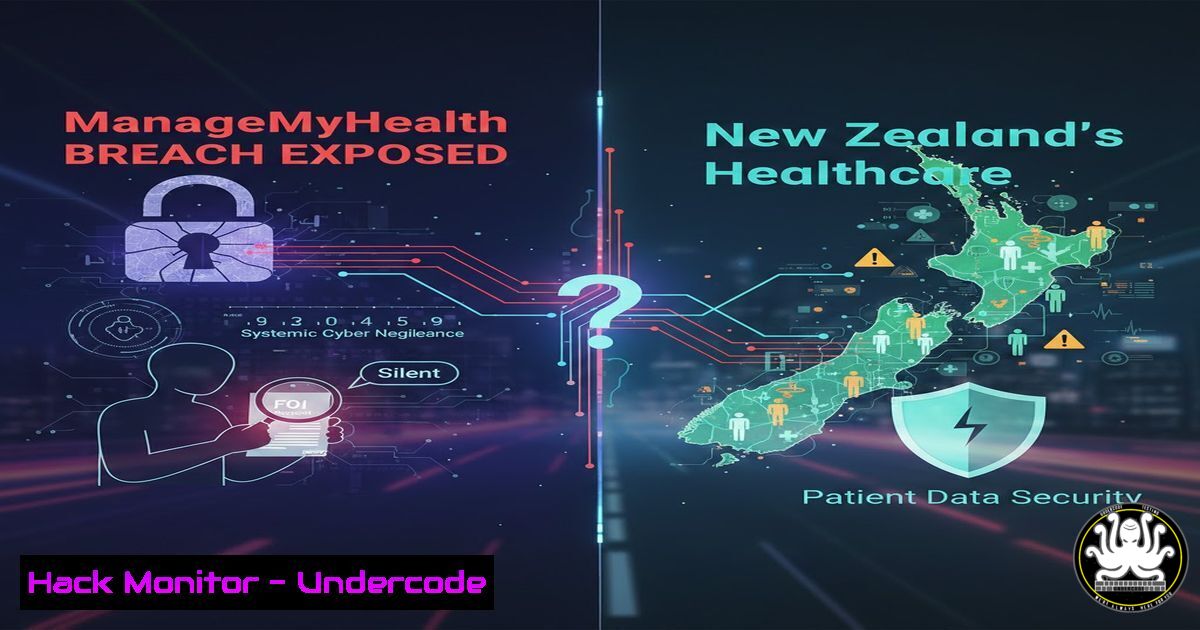
A Freedom of Information (FOI) request regarding the significant ManageMyHealth healthcare platform breach in New Zealand appears to have been met with official silence, highlighting critical failures in transparency and incident response. This incident underscores a dangerous trend where cyber governance and public accountability mechanisms break down following a major data breach, leaving citizens in the dark about the security of their most sensitive personal health information. The convergence of poor notification systems, potential regulatory evasion, and inadequate public disclosure creates a perfect storm for eroding trust in digital health infrastructure.
Learning Objectives:
- Understand the systemic risks posed by inadequate breach transparency and failed FOI processes in cybersecurity incident management.
- Learn key technical practices for securing healthcare APIs and auditing access logs, which are often the attack vectors in such breaches.
- Develop a actionable checklist for IT and compliance teams to harden systems and ensure regulatory communication protocols are maintained post-breach.
You Should Know:
- The Anatomy of a Healthcare API Breach and Logging Failures
The ManageMyHealth breach likely involved unauthorized access to patient data through application programming interfaces (APIs). Healthcare APIs, if not properly secured, are prime targets. Attackers often exploit weak authentication, excessive data exposure, or misconfigured endpoints. A critical failure post-breach is the inability to provide a forensic timeline, which stems from poor logging.
Step-by-step guide explaining what this does and how to use it.
Step 1: Enable Comprehensive API Audit Logging. Without logs, you cannot trace the breach. For a typical REST API server, ensure all authentication attempts, data queries, and administrative actions are logged.
Linux (using journald for a service): `sudo journalctl -u your-api-service –since “2024-09-01” –until “2024-09-30” -f`
Cloud (AWS CloudTrail for API Gateway): Ensure CloudTrail is enabled in all regions and logs are delivered to an immutable S3 bucket. Use the CLI to check: `aws cloudtrail describe-trails`
Step 2: Implement Structured Logging. Logs must be structured (e.g., JSON) for automated analysis.
Example Node.js (Winston logger):
const logger = winston.createLogger({
format: winston.format.json(),
transports: [new winston.transports.File({ filename: 'api-audit.log' })],
});
logger.info('API_ACCESS', { userId: req.user.id, endpoint: req.path, timestamp: new Date().toISOString() });
Step 3: Centralize and Immutably Store Logs. Use a Security Information and Event Management (SIEM) system or a dedicated log server. Prevent tampering by setting file permissions.
Linux: `sudo chattr +i /var/log/api-audit.log` (makes file immutable, even for root).
Windows (PowerShell): Use `Set-ACL` to restrict access to the log directory and enable Windows Event Log forwarding to a central collector.
- Hardening Identity and Access Management (IAM) for Patient Portals
Weak or stolen credentials are a primary attack vector. Multi-factor authentication (MFA) and strict role-based access control (RBAC) are non-negotiable.
Step-by-step guide explaining what this does and how to use it.
Step 1: Enforce MFA at the Infrastructure Level. Don’t rely on optional MFA.
AWS IAM Example: Create a policy that forces MFA for console and API access.
Azure AD: Use Conditional Access policies to require MFA for all users accessing the health application.
Step 2: Implement Just-In-Time (JIT) and Least-Privilege Access. Administrative accounts should have no standing permissions.
Using PAM Tools (e.g., CyberArk) or cloud-native solutions: Configure workflows where elevated access (e.g., to a database with PHI) is requested, approved, and automatically revoked after a set time (e.g., 60 minutes).
Step 3: Regular Access Reviews. Automate the de-provisioning of stale accounts.
AWS CLI to list old access keys: `aws iam list-users –query “Users[].
" --output text | while read user; do echo "User: $user"; aws iam list-access-keys --user-name $user --query "AccessKeyMetadata[?CreateDate<='2024-06-01'].AccessKeyId" --output text; done`
 Active Directory PowerShell: Use `Search-ADAccount -AccountInactive -TimeSpan 90:00:00:00` to find inactive users.

<ol>
<li>Securing Database Backends Containing Protected Health Information (PHI)
The exfiltrated data likely resided in a database. Encryption at rest and in transit is a basic requirement, but network isolation is key.</li>
</ol>

Step-by-step guide explaining what this does and how to use it.
 Step 1: Encrypt All PHI at Rest. Use transparent data encryption (TDE) provided by your database engine.
 PostgreSQL: `ALTER SYSTEM SET ssl = 'on';` and configure `ssl_cert_file` and <code>ssl_key_file</code>. For storage, use LUKS encryption on the underlying Linux disk.
 Microsoft SQL Server: Enable TDE via SQL Server Management Studio (Right-click database > Tasks > Manage Database Encryption).
 Step 2: Enforce Network Segmentation. The database should not be directly accessible from the public internet or the general application subnets.
 Example AWS Security Group Rule (INBOUND): Only allow TCP/5432 (PostgreSQL) from the specific security group ID of the application servers, not from <code>0.0.0.0/0</code>.
 Step 3: Implement Database Activity Monitoring (DAM). Use tools to alert on anomalous queries (e.g., large SELECT  operations).
 PostgreSQL Audit Extension (pgAudit): `ALTER DATABASE mydb SET pgaudit.log = 'READ, WRITE';`

4. Establishing a Verifiable and Transparent Incident Response Communication Protocol
The ignored FOI request represents a catastrophic failure in communication protocol. Organizations must have a pre-defined, auditable disclosure process.

Step-by-step guide explaining what this does and how to use it.
 Step 1: Define a Regulatory and Public Disclosure Playbook. This must include timelines for notifying regulators (per the Privacy Act 2020) and affected individuals. The playbook should be a living document in a version-controlled system (e.g., Git).
 Step 2: Automate Initial Breach Notification Logging. Use a ticketing system (e.g., Jira Service Management) with mandatory fields. All FOI requests and breach-related inquiries must create an immutable ticket.
 Bash script to log receipt of an FOI request to a ticket system via API:
[bash]
!/bin/bash
REQUEST_ID=$(curl -X POST -H "Content-Type: application/json" \
-d '{"fields":{"project":{"key":"IR"},"summary":"FOI Request - Breach Related","description":"'"$REQUEST_DETAILS"'"}}' \
https://your-jira-instance/rest/api/2/issue/)
echo $REQUEST_ID >> /secure/audit/foi-log.txt
Step 3: Conduct Tabletop Exercises. Quarterly exercises simulating a breach and the subsequent FOI/media inquiry process are essential to test and refine the communication protocol.
5. Proactive Threat Hunting in Cloud Health Environments
Assume breach. Proactively search for indicators of compromise (IOCs) that automated tools may miss.
Step-by-step guide explaining what this does and how to use it.
Step 1: Hunt for Anomalous Data Egress. Look for large, unusual data transfers from your storage services.
AWS Athena Query on CloudTrail Logs: Search for `GetObject` or `ListBucket` calls from unusual IP addresses or at unusual times.
Step 2: Identify Unusual API Call Patterns. Use machine learning-based anomaly detection if available, or establish baseline patterns.
Azure Sentinel KQL Query Example:
AWSCloudTrail
| where EventName == "DescribeInstances" or EventName == "CopyDBSnapshot"
| where EventTime > ago(1h)
| summarize CallCount = count() by EventName, UserIdentityArn, bin(EventTime, 5m)
| where CallCount > 10 // Threshold for anomalous frequency
Step 3: Check for Backdoor User Accounts and Unauthorized Roles. Regularly audit IAM configurations.
AWS CLI to list all IAM users and their attached policies: `aws iam list-users –query “Users[].UserName” –output text | xargs -I {} aws iam list-attached-user-policies –user-name {}`
What Undercode Say:
- Transparency is a Technical Control. The failure to respond to an FOI request is not just a bureaucratic failing; it is a critical failure of the security accountability framework. Logging, immutable audit trails, and clear communication workflows are as vital as firewalls.
- Healthcare Data Requires “Zero-Trust” by Default. The high value of PHI demands that architecture moves beyond perimeter-based security. Every access request must be authenticated, authorized, and encrypted, with the assumption that the network is already compromised.
The ManageMyHealth saga, marked by the silent FOI request, is a textbook case of post-breach negligence exacerbating the original technical failure. It demonstrates that governance, risk, and compliance (GRC) processes collapse under pressure when they are not engineered with the same rigor as technical systems. The technical vulnerabilities—likely in APIs, IAM, and data storage—were only the first phase. The second, more damaging phase was the failure to enact a transparent, accountable, and communicative response, which fundamentally breaches the social contract required for successful digital health initiatives.
Prediction:
This incident will catalyze stricter regulatory amendments to New Zealand’s Privacy Act, mandating not just breach notification but also publicly accessible, detailed post-incident reports within defined timeframes. We will see a rise in “cyber transparency” ratings for public-sector IT projects, influencing funding and procurement. Technologically, there will be accelerated adoption of homomorphic encryption and confidential computing in healthcare, allowing data to be processed without ever being fully exposed, even in memory. The market for verifiable, immutable audit trails (potentially leveraging blockchain-like ledgers for access logs) will see significant growth in the public health sector as a direct response to this failure in accountability.
▶️ Related Video (74% Match):
🎯Let’s Practice For Free:
IT/Security Reporter URL:
Reported By: Adam Voulstaker – Hackers Feeds
Extra Hub: Undercode MoN
Basic Verification: Pass ✅


