Listen to this Post
Introduction:
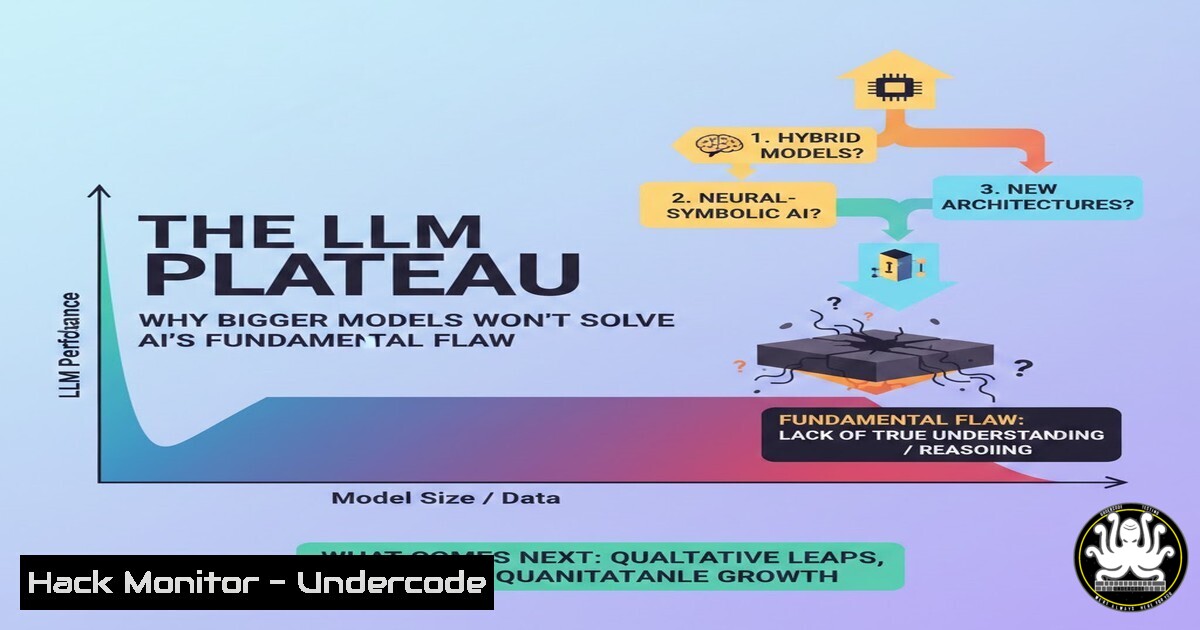
The artificial intelligence landscape is dominated by Large Language Models (LLMs) like GPT-4, celebrated for their vast parameter counts and textual prowess. However, a fundamental paradox is emerging, highlighting a critical disconnect between statistical pattern recognition and genuine, embodied understanding of the physical world. This article delves into the limitations of pure LLMs and explores the next frontier in AI: world models that learn from observation and interaction, not just text.
Learning Objectives:
- Understand the core limitations of LLMs as defined by Moravec’s Paradox and the “embodiment problem.”
- Differentiate between text-based predictive models and vision-based world models like Meta’s V-JEPA.
- Explore the technical shift from scaling parameters to building internal representations of physical reality.
You Should Know:
- The Embodiment Problem: Why a Cat Outsmarts GPT-4
The post opens with a striking comparison: a cat’s 800 million neurons versus GPT-4’s 1.8 trillion parameters. The cat, with far less raw computational power, possesses a superior, intuitive understanding of physics, cause and effect, and spatial reasoning. This is the embodiment problem. LLMs are trained exclusively on text, a symbolic representation of the world that lacks the sensory-rich, continuous data stream that biological intelligence uses to learn. An LLM can describe gravity poetically, but it has never experienced a object falling. A child, or a cat, learns gravity through direct sensory-motor interaction.
Step-by-step guide explaining what this does and how to use it:
This isn’t a tool to be used, but a concept to be understood. The “embodiment problem” explains why:
1. LLMs Hallucinate on Simple Logic: They manipulate symbols without grounding them in reality. Asking an LLM to stack imaginary blocks can lead to physically impossible configurations.
2. They Lack Common Sense: Common sense is largely unconscious knowledge about how the world works, learned through observation. An LLM must infer this from text, which is an inefficient and often incomplete proxy.
3. Robotic Control is Difficult: Training a robot to clear a table via text instructions alone is incredibly complex compared to how a 10-year-old learns the same task through observation and practice.
2. Deconstructing Moravec’s Paradox
Moravec’s Paradox states that what is difficult for humans (e.g., complex calculus) is often easy for AI, and what is easy for humans (e.g., motor skills, perception) is incredibly difficult for AI. The LinkedIn post perfectly illustrates this: an AI can pass a bar exam but cannot reliably clear a dinner table. This is because the skills we consider “high-level” are recent evolutionary developments, while sensorimotor skills are the product of billions of years of evolution. They are so fundamental to our existence that they are mostly unconscious and thus incredibly hard to reverse-engineer and encode explicitly.
Step-by-step guide explaining what this does and how to use it:
To grasp the practical implications of Moravec’s Paradox for AI development:
1. Identify “Easy” vs. “Hard” Tasks: When designing an AI system, do not assume that tasks simple for a human will be simple for the AI. Perceiving a cluttered room and navigating it is a “hard” AI problem.
2. Prioritize Sensor Data: For applications in robotics, autonomous vehicles, or any system interacting with the physical world, prioritize training on video, LIDAR, and other sensor data over purely textual data.
3. Focus on Benchmarking: The AI community is developing new benchmarks that test physical reasoning and common sense, moving beyond purely textual or image classification tasks.
- The Architectural Shift: From LLMs to World Models
Yann LeCun, Chief AI Scientist at Meta, advocates for a radical departure from the autoregressive, next-word-prediction architecture of LLMs. His proposed solution is World Models. These models aim to create an internal, abstract representation of how the world works. The core idea is prediction in a latent space—predicting the world’s state in an abstract representation rather than predicting every pixel or word. This allows the model to ignore irrelevant details and focus on high-level concepts, making it more data-efficient and robust.
Step-by-step guide explaining what this does and how to use it:
A World Model functions through a multi-stage process:
- Observation (Vision): The model ingests high-dimensional data from the environment, typically video.
- Representation Learning: It encodes these observations into a compact, abstract latent space. This step discards unpredictable details (e.g., the texture of a wall) while preserving semantically important information (e.g., the position and velocity of an object).
- Prediction & Planning: The model predicts future states within this latent space. An agent (like a robot) can then simulate different actions and their outcomes within this internal model before acting in the real world, enabling efficient planning.
-
Case Study: Meta’s V-JEPA – A World Model in Action
The post references Meta’s V-JEPA (Video Joint Embedding Predictive Architecture) as a tangible implementation of a world model. V-JEPA is trained on video data in a self-supervised manner. It doesn’t try to predict every future pixel, which is computationally expensive and inefficient. Instead, it learns to predict the abstract representation of future states. The results are significant: it’s reported to be 15x faster to train and excels at tasks requiring an understanding of physical interactions, even with limited examples, because its internal model has learned fundamental concepts of object permanence and motion.
Step-by-step guide explaining what this does and how to use it:
While you cannot directly run V-JEPA, you can understand its core technical principle: contrastive learning in a latent space.
 Conceptual Pseudo-Code for a JEPA-like training step
import torch
import torch.nn as nn

<ol>
<li>Encode two different views of a video (e.g., different time segments)
latent_representation_1 = encoder(video_segment_1)
latent_representation_2 = encoder(video_segment_2)</p></li>
<li><p>Predict the representation of the second segment from the first
predicted_latent_2 = predictor(latent_representation_1)</p></li>
<li><p>The loss function maximizes the similarity between the predicted and actual latent of the second segment,
while minimizing similarity with latents from other, unrelated videos in the same batch.
loss = contrastive_loss(predicted_latent_2, latent_representation_2)
This approach teaches the model what should happen next, without getting bogged down in pixel-level accuracy.
- The Data Paradigm: Why Video is the New Text
The transition from LLMs to World Models necessitates a shift in training data. Text is a poor medium for learning physics. Video, however, provides a rich, temporal stream of data about object interactions, occlusion, and cause-and-effect. Training on video allows a model to develop an intuitive sense of physics, much like a human infant. The next generation of foundational models will likely be multi-modal from the start, with video as a primary data source, not an afterthought.
Step-by-step guide explaining what this does and how to use it:
For developers and researchers:
- Data Sourcing: Look beyond text corpora. Explore video datasets like Something-Something, Ego4D, or Kinetics for training or fine-tuning models intended for real-world interaction.
- Pre-processing: Video data requires heavy pre-processing. Standardize frame rates, resolutions, and consider techniques like frame sampling to manage computational load.
Example using ffmpeg to extract frames at 1 FPS for a dataset
ffmpeg -i input_video.mp4 -vf "fps=1" frames/frame_%04d.png
- Model Architecture: Choose or design architectures that can handle temporal data, such as 3D CNNs, Transformers with temporal attention, or Recurrent Neural Networks.
6. Future-Proofing Your AI Strategy
The “bigger is better” race in LLMs is showing diminishing returns for physical understanding. For businesses and developers, this signals a need to align AI strategy with the underlying technology’s strengths. Use LLMs for text-based tasks where they excel: content generation, summarization, and code assistance. For applications involving the physical world—robotics, AR/VR, advanced video analysis—investigate and prototype with architectures and models inspired by the world model paradigm.
Step-by-step guide explaining what this does and how to use it:
1. Audit Your AI Use Cases: Categorize your projects. Are they about manipulating symbols (text, code) or interacting with a physical/dynamic environment?
2. Stay Informed on Research: Follow developments from groups like Meta’s FAIR and DeepMind, who are at the forefront of world model research.
3. Experiment with Frameworks: Use deep learning frameworks like PyTorch or Jax to implement simpler versions of predictive learning models on video data to build in-house expertise.
What Undercode Say:
- The LLM Era is a Stepping Stone, Not the Destination. LLMs have proven the power of scale and self-supervised learning, but they represent a specific, text-centric path to intelligence. The next breakthrough will come from models that learn the rules of the world, not just the rules of language.
- The True Bottleneck is Understanding, Not Data. Throwing more text at LLMs will not solve the fundamental issue of physical reasoning. The focus must shift to architectural innovations that can efficiently learn from multi-modal, interactive data streams.
The analysis suggests that Yann LeCun’s critique is not a dismissal of current AI but a roadmap for its evolution. The immense investment in LLMs has created valuable infrastructure and knowledge, but it has also illuminated a hard ceiling. The companies and research labs that successfully pivot to developing and integrating world models will lead the next wave of AI, creating systems that can truly interact with and understand our world, moving from sophisticated parrots to capable partners. This shift will be crucial for achieving robust autonomous systems, advanced robotics, and AI that can safely and reliably operate in unstructured human environments.
Prediction:
The next 3-5 years will see a rapid bifurcation in AI development. The LLM market will mature, focusing on optimization, cost reduction, and vertical-specific applications. Simultaneously, a new, parallel track of “embodied” or “grounded” AI research will accelerate, fueled by world models. We will see the first commercially viable robots using these models for complex tasks in warehouses and homes, and a new class of video understanding AIs that power immersive entertainment and training simulations. The company that successfully builds and productizes the first widely adopted “World Model-as-a-Service” could challenge the current dominance of pure-play LLM providers.
🎯Let’s Practice For Free:
IT/Security Reporter URL:
Reported By: Activity 7398291752400392192 – Hackers Feeds
Extra Hub: Undercode MoN
Basic Verification: Pass ✅


