
Listen to this Post
Introduction:
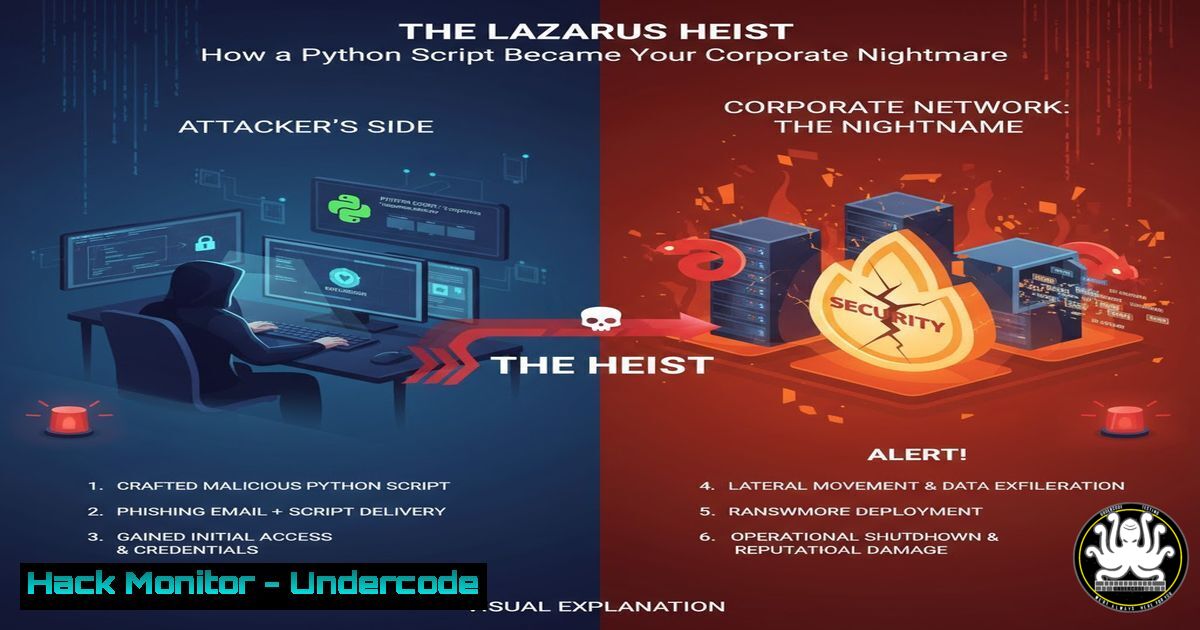
The Lazarus Group, a notorious state-sponsored hacking entity, has weaponized a deceptively simple Python script to orchestrate a sophisticated software supply chain attack. By embedding malicious code within a seemingly legitimate package, they demonstrate how open-source dependencies can become a primary attack vector, compromising entire development pipelines and enterprise networks. This incident underscores the critical need for robust software composition analysis and runtime protection mechanisms in modern DevOps environments.
Learning Objectives:
- Analyze the technical execution of Lazarus Group’s Python-based supply chain attack
- Implement defensive coding practices and dependency verification protocols
- Deploy advanced monitoring and containment strategies for development environments
You Should Know:
1. Malicious Package Detection with Safety Check
 Scan Python dependencies for known vulnerabilities
pip install safety
safety check --json --output report.json

Verify package integrity against PyPI hashes
pip hash package_name
This command sequence uses Safety, a vulnerability scanner specifically designed for Python environments. The first command installs the safety package, while the second executes a comprehensive scan of all installed dependencies, checking against a continuously updated database of known vulnerabilities. The `–json` flag formats output for integration with CI/CD pipelines, and the hash verification ensures package integrity hasn’t been compromised during distribution.
2. Dependency Integrity Verification
 Generate requirements with hash checking
pip freeze > requirements.txt

Install with hash verification
pip install --require-hashes -r requirements.txt

Audit packages with pip-audit
pip install pip-audit
pip-audit -r requirements.txt
This methodology implements cryptographic verification of dependencies. The `–require-hashes` flag forces pip to verify that each package matches previously recorded cryptographic hashes, preventing installation of tampered packages. Pip-audit provides vulnerability scanning specifically for Python packages, complementing Safety’s functionality with additional vulnerability databases.
3. Network Traffic Analysis for C2 Detection
 Monitor outbound connections with netstat
netstat -tuln | grep ESTABLISHED

Advanced network monitoring with tcpdump
tcpdump -i any -w suspicious_traffic.pcap host <suspicious_ip>

Analyze with Wireshark post-capture
wireshark suspicious_traffic.pcap
These commands provide layered network monitoring capabilities. Netstat offers real-time visibility into established connections, while tcpdump enables deep packet inspection of traffic to and from suspicious IP addresses. The packet capture file can be analyzed in Wireshark for detailed protocol analysis and IOC extraction.
4. Process Monitoring for Malicious Activity
 Real-time process monitoring
ps aux --sort=-%cpu | head -20

Monitor child processes and execution chains
pstree -p -a

System call monitoring with strace
strace -f -o malicious_trace.txt python suspicious_script.py
This approach provides comprehensive process visibility. The ps command identifies resource-intensive processes, pstree reveals parent-child process relationships crucial for detecting process injection, and strace captures system calls made by suspicious Python scripts, revealing file access, network communication, and other malicious behaviors.
5. File Integrity Monitoring
 Create baseline of critical directories
find /opt /usr/local/lib -type f -exec md5sum {} \; > /opt/baseline.md5

Regular integrity checks
md5sum -c /opt/baseline.md5 | grep FAILED

Monitor filesystem changes with inotify
inotifywait -m -r /opt/python_apps
This implements continuous filesystem integrity monitoring. The baseline creation captures cryptographic hashes of critical application files, while regular checks identify unauthorized modifications. Inotify provides real-time monitoring of filesystem events, alerting on file creations, modifications, and deletions in protected directories.
6. Container Security Hardening
 Scan container images for vulnerabilities
docker scan <image_name>

Run with minimal privileges
docker run --read-only --cap-drop=ALL --user nobody <image>

Runtime container monitoring
docker logs <container_id> | grep -i "error|warning|connect"
These commands implement defense-in-depth for containerized Python applications. Docker Scan integrates vulnerability assessment directly into the container lifecycle, while the runtime flags enforce minimal privilege principles. Log monitoring provides detection capabilities for runtime exploitation attempts.
7. API Security and Input Validation
 Secure input validation example
import re
from typing import Union

def validate_package_name(input: Union[str, bytes]) -> bool:
"""Validate package name against PyPI specifications"""
if isinstance(input, bytes):
input = input.decode('utf-8')

pattern = r'^([A-Z0-9]|[A-Z0-9][A-Z0-9._-][A-Z0-9])$'
return re.match(pattern, input, re.IGNORECASE) is not None
This Python code demonstrates secure input validation critical for preventing dependency confusion attacks. The function enforces PyPI naming conventions while handling both string and byte inputs, using strict regex patterns to block malicious package names that might exploit dependency resolution mechanisms.
What Undercode Say:
- Supply chain attacks have evolved from simple typosquatting to sophisticated dependency confusion and repository hijacking
- Development environments represent high-value targets due to their elevated privileges and access to production systems
- Organizations must implement zero-trust principles even within development pipelines and build systems
The Lazarus Group’s adaptation of supply chain attacks demonstrates significant evolution in tradecraft. By targeting development dependencies rather than production systems directly, they bypass traditional perimeter defenses and gain persistent access throughout the software lifecycle. This approach leverages the inherent trust in open-source ecosystems and the common practice of pulling dependencies directly from public repositories without adequate verification. The technical sophistication suggests these groups are investing heavily in understanding software development workflows and identifying weak links in the chain from code commit to deployment.
Prediction:
Supply chain attacks will increasingly target lesser-known dependencies and build tools, with attackers compromising maintainer accounts through social engineering rather than technical exploits. We anticipate rise in “sleeping” malware that remains dormant until specific deployment conditions are met, making detection more challenging. The industry will respond with increased adoption of cryptographic software bills of materials (SBOMs) and blockchain-based package verification, but attackers will simultaneously develop techniques to compromise these verification mechanisms through build server exploitation and certificate theft.
🎯Let’s Practice For Free:
IT/Security Reporter URL:
Reported By: Davidajuzie This – Hackers Feeds
Extra Hub: Undercode MoN
Basic Verification: Pass ✅


