
Listen to this Post
Introduction:
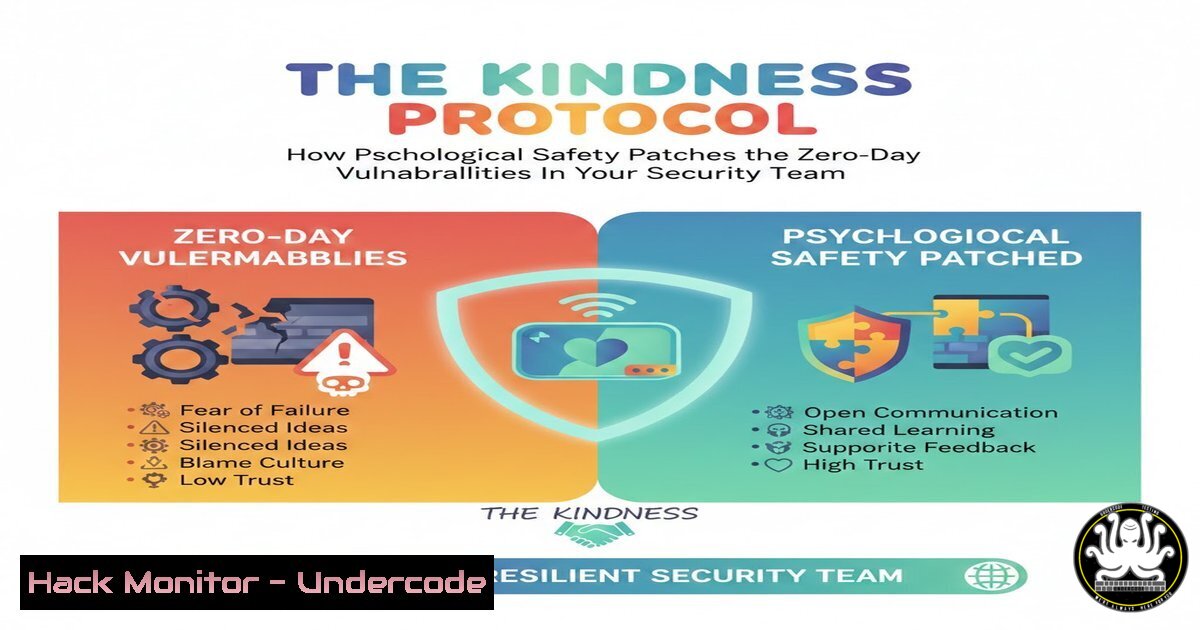
In the high-stakes world of cybersecurity, we often focus on hardening perimeters and patching software exploits, yet we neglect the most critical component of defense: the human element. A security team suffering from toxic stress, burnout, or social isolation develops “cognitive vulnerabilities” akin to unpatched systems, leading to misconfigurations and overlooked threats. By adopting a “Kindness Protocol,” organizations can shift from a culture of blame to one of psychological safety, effectively remediating the human-layer vulnerabilities that sophisticated social engineering attacks exploit.
Learning Objectives:
- Understand the correlation between workplace psychological safety and reduced security misconfigurations.
- Learn to implement technical “check-in” scripts and logging mechanisms to monitor team burnout.
- Identify how threat actors leverage social isolation to facilitate insider threat scenarios.
- Analyze Linux and Windows commands to audit user behavior for signs of disengagement or irregular access patterns.
You Should Know:
- Auditing the Human Firewall: Using Sysmon and Auditd to Detect Disengagement
Just as a struggling employee “replays mistakes in their head,” a struggling system logs errors. Security professionals can utilize system monitoring tools to identify patterns that may correlate with team burnout or disengagement, which often precedes mistakes. When an analyst is overwhelmed, they may skip verification steps, leading to anomalous system access.
To monitor for signs of irregular behavior that could stem from human error, we use auditing tools.
– On Linux (using auditd): Track failed sudo attempts or unusual login times that might indicate an analyst working odd hours due to stress.
 Install auditd
sudo apt-get install auditd -y

Watch for failed authentication attempts that spike during off-hours
sudo ausearch -m USER_AUTH,USER_LOGIN -ts today | grep -i "failed"

Monitor changes to critical config files that a burnt-out engineer might misconfigure
sudo auditctl -w /etc/ssh/sshd_config -p wa -k ssh_config_changes
sudo ausearch -k ssh_config_changes
– On Windows (using Sysmon): Monitor for process terminations or application errors in SIEM tools that an analyst uses frequently, which could indicate frustration or tool fatigue.
 View Sysmon events for application crashes (Event ID 1 for process creation, but correlate with Event ID 3 for network disconnects)
Get-WinEvent -FilterHashtable @{LogName="Microsoft-Windows-Sysmon/Operational"; ID=1,3} -MaxEvents 50 | Where-Object {$<em>.Message -match "terminated" -or $</em>.Message -match "error"}
This step-by-step guide explains that by auditing system stress signals, we can proactively address team stress before it leads to a critical oversight in a firewall rule or an incident response playbook.
- Configuring Secure Collaboration Tools to Foster “Positive Intent”
The post emphasizes assuming “positive intent instead of incompetence.” In a technical environment, this translates to secure, transparent communication channels that reduce friction. When teams feel safe, they are less likely to hide security incidents. We can configure Mattermost (an open-source Slack alternative) with end-to-end encryption to create a private space for “no-blame” incident retrospectives.
– Step 1: Deploy Mattermost on a hardened Ubuntu server.
sudo apt update && sudo apt upgrade -y
wget https://releases.mattermost.com/9.11.0/mattermost-9.11.0-linux-amd64.tar.gz
tar -xvzf mattermost-.tar.gz
sudo mv mattermost /opt
sudo useradd --system --user-group mattermost
sudo chown -R mattermost:mattermost /opt/mattermost
– Step 2: Configure the database (PostgreSQL) and enable TLS.
– Step 3: Enforce MFA for all team members to secure this psychological safe space, ensuring that the “kindness” channel is not a vector for external attack.
– Step 4: Create a dedicated channel named `post-mortem-psychological-safety` where logs can be shared without attribution to encourage reporting.
- Hardening Cloud IAM to Prevent “Quiet Quitting” Escalation
The text mentions a “quiet team member who used to be high-performing.” In cloud environments, a disengaged but privileged user is a major risk. They may fail to rotate keys or revoke unused permissions. We must implement Just-In-Time (JIT) access to ensure that even if a user is mentally “absent,” their credentials cannot be abused.
– On AWS: Transition from permanent keys to IAM Identity Center with temporary credentials.
 Using AWS CLI to request temporary credentials
aws sso login --profile dev-profile

Audit for users with console access who haven't logged in for 30 days (potential disengagement)
aws iam generate-credential-report
aws iam get-credential-report --query 'Content' --output text | base64 -d | cut -d, -f1,4,5,11 | grep -v "password_enabled" | grep "true" | awk -F, '$4 == "N/A" {print $1 " has not logged in."}'
This command helps identify zombie accounts belonging to disengaged employees, allowing the team to revoke access preemptively, demonstrating “support” by removing the burden of unused permissions.
- API Security: Rate Limiting and Error Handling with Empathy
Just as we should “correct in private and encourage in public,” APIs should handle errors gracefully without exposing stack traces (shaming the developer) while logging them internally for improvement.
– Configure Nginx as a reverse proxy with empathetic error pages.
server {
listen 80;
server_name api.undercode.local;

location / {
proxy_pass http://localhost:3000;
proxy_intercept_errors on;
error_page 404 500 502 503 504 = @empathetic_fallback;
}

location @empathetic_fallback {
 Return a generic message to the user, but log specifics internally
add_header Content-Type text/plain;
return 200 "Service temporarily unavailable. We are aware and working on it. - Your Security Team";
}
}
– Implement rate limiting to protect the service from brute-force attacks, which often target overwhelmed or lone workers who might fall for phishing attempts.
limit_req_zone $binary_remote_addr zone=mylimit:10m rate=10r/s;
server {
location /login {
limit_req zone=mylimit burst=20 nodelay;
proxy_pass http://localhost:3000;
}
}
5. Vulnerability Exploitation: The Social Engineering of Isolation
The post highlights the “little monkey, Punch,” trying to join a group and being met with solitude. Threat actors weaponize this. An isolated employee is a prime target for “Pretexting.” They are desperate for connection and more likely to engage with a friendly attacker.
– Simulation Command (Phishing Resistant MFA Enforcement): To combat this, enforce FIDO2/WebAuthn.
 Azure AD PowerShell to require phishing-resistant MFA for all
Connect-MgGraph -Scopes "Policy.ReadWrite.AuthenticationMethod"

Define a policy requiring Windows Hello for Business or FIDO2 keys
 This ensures that even if a lonely employee clicks a link, the attacker can't authenticate.
– Linux Hardening against Phishing: Use `seclists` to test internal employees’ ability to recognize malicious intent.
sudo apt install seclists
 Use a custom phishing wordlist to simulate a "friendly" attacker trying to be accepted
cat /usr/share/seclists/Phishing/  | grep -i "help|support|friend"
What Undercode Say:
- Key Takeaway 1: Psychological safety is a security control. It reduces the “Mean Time to Acknowledge” (MTTA) for incidents because team members report errors without fear, acting as an early warning system.
- Key Takeaway 2: The configuration of your SIEM and IAM should mirror your human resources strategy. Just as you monitor for failed logins, you must monitor for failed human interactions. Automating the revocation of access for disengaged users is the technical equivalent of offering support.
The integration of empathy into cybersecurity architecture is not just a cultural nicety; it is a defensive strategy. By implementing technical controls that reduce friction and support the analyst—such as JIT access and empathetic error handling—we build a resilient infrastructure that acknowledges human limitations. The most advanced EDR is useless if the analyst monitoring it is too afraid of blame to click “alert.” A kind environment creates a secure one, proving that the human layer, when properly supported, becomes the strongest intrusion detection system of all.
Prediction:
As AI-driven social engineering becomes indistinguishable from human interaction, the “human firewall” will face unprecedented stress. We predict the rise of “Digital Empathy Officers” (DEOs) in Security Operations Centers (SOCs) by 2028. These roles will combine clinical psychology with cybersecurity analysis, using machine learning to monitor not just network traffic, but team communication patterns for signs of burnout that precede security lapses. Organizations that fail to automate kindness through supportive IAM and collaboration policies will see a sharp rise in insider threats, not from malice, but from isolation-induced negligence.
▶️ Related Video (80% Match):
🎯Let’s Practice For Free:
IT/Security Reporter URL:
Reported By: Jared Kucij – Hackers Feeds
Extra Hub: Undercode MoN
Basic Verification: Pass ✅


