Listen to this Post
Introduction:
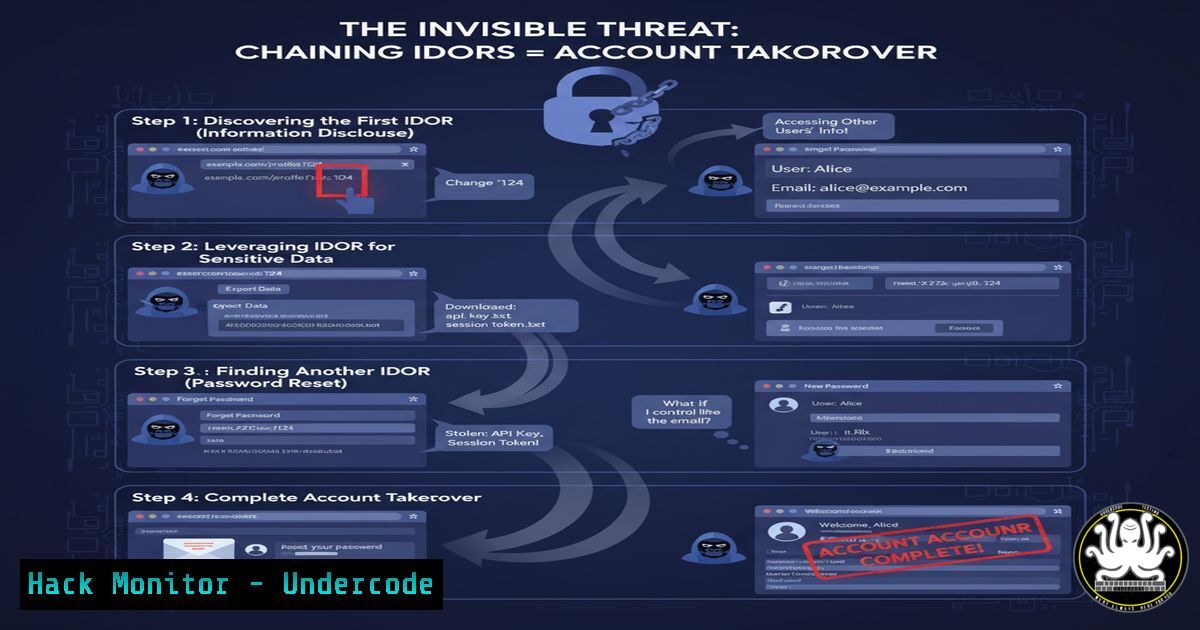
In a recent security disclosure, a critical vulnerability chain exploiting Insecure Direct Object References (IDORs) was demonstrated, leading to a full account takeover. This incident underscores the pervasive risk of improper access controls in modern web applications, where seemingly minor flaws can be combined to create a devastating impact.
Learning Objectives:
- Understand the mechanics of Insecure Direct Object Reference (IDOR) vulnerabilities.
- Learn how to chain multiple low-severity IDORs to escalate an attack into a high-severity compromise.
- Identify methods to test for, mitigate, and prevent IDOR vulnerabilities in your applications.
You Should Know:
1. Understanding the IDOR Attack Chain
The attack involved two distinct IDOR flaws. The first allowed unauthorized access to a user’s profile data by manipulating a user ID parameter in a GET request. The second, more critical IDOR, permitted the attacker to change the password of any account by manipulating the same user ID in a POST request to the password change endpoint.
Step-by-step guide:
This demonstrates a simple IDOR test using `curl` to manipulate the `userId` parameter.
 Step 1: Discover an endpoint that returns user-specific data.
curl -H "Authorization: Bearer <YOUR_TOKEN>" https://api.victim.com/v1/users/12345/profile

Step 2: Increment or decrement the user ID to access another user's data.
curl -H "Authorization: Bearer <YOUR_TOKEN>" https://api.victim.com/v1/users/12346/profile

Step 3: If data for user 12346 is returned, an IDOR is confirmed.
 Step 4: Locate a password change function and test for the same flaw.
curl -X POST -H "Authorization: Bearer <YOUR_TOKEN>" -H "Content-Type: application/json" -d '{"newPassword":"Hacked123!", "userId":12346}' https://api.victim.com/v1/users/changePassword
This sequence shows how an attacker can traverse from data exposure to a full account takeover by chaining IDORs on the same parameter.
2. Automated IDOR Detection with Burp Suite
Manual testing is effective, but automation can help uncover IDORs that are not based on simple sequential IDs. Burp Suite’s Autorize extension can automate the process of testing for broken access control.
Step-by-step guide:
This guide explains how to configure Burp Suite’s Autorize extension to scan for IDORs.
1. Install the "Autorize" extension from the BApp Store in Burp Suite.
2. Configure your browser to use Burp as a proxy and browse the application normally to populate your history.
3. In the Autorize tab, set a "Reference" user (e.g., a low-privilege account you control).
4. Switch to a different user (e.g., a high-privilege account or a different user ID) in your browser and continue browsing.
5. Autorize will automatically re-issue every request from the "Reference" user context and flag any responses that differ, indicating a potential IDOR.
6. Manually verify any flagged requests to confirm the vulnerability.
This method is highly effective for finding IDORs in complex applications where user roles and object references are not straightforward.
3. Mitigating IDOR with Access Control Checks
The root cause of IDOR is the lack of server-side access control verification. The server must validate that the authenticated user is authorized to perform the requested action on the target object for every request.
Step-by-step guide:
The following pseudo-code demonstrates a secure server-side check.
 VULNERABLE CODE (Using user input directly)
user_id = request.get('user_id')
user_profile = User.objects.get(id=user_id)
return user_profile

SECURE CODE (Using the authenticated user's session)
@login_required
def get_profile(request):
 The user object is taken from the session, not the request parameters.
user_profile = request.user.profile
return user_profile

SECURE CODE FOR ACTIONS ON OTHER OBJECTS
@login_required
def change_user_password(request, target_user_id):
 Check if the current user is authorized to change the target user's password.
if request.user.is_admin or request.user.id == target_user_id:
target_user = User.objects.get(id=target_user_id)
target_user.set_password(new_password)
target_user.save()
return HttpResponse("Password changed")
else:
return HttpResponse("Unauthorized", status=403)
This code ensures that the application logic, not the client-supplied parameters, dictates authorization.
4. Implementing Indirect Reference Maps
A robust defense-in-depth strategy is to use indirect reference maps instead of exposing direct database keys or sequential integers. This involves mapping a random, unguessable string (a UUID) to an internal object ID on the server.
Step-by-step guide:
Here is how to implement an indirect reference map in a web application.
import uuid

A simple in-memory map (use a persistent database in production)
reference_map = {}

def create_user_reference(user_id):
 Generate a unique reference for a user ID
user_ref = str(uuid.uuid4())
reference_map[bash] = user_id
return user_ref

def get_user_id_from_reference(user_ref):
 Resolve the reference back to the internal user ID
return reference_map.get(user_ref)

Usage in a view
def user_profile(request, public_user_ref):
internal_user_id = get_user_id_from_reference(public_user_ref)
if internal_user_id is None:
return HttpResponse("User not found", status=404)

Proceed with secure access control check using internal_user_id
if not is_authorized(request.user, internal_user_id):
return HttpResponse("Unauthorized", status=403)
...
By using these unguessable references, even if an attacker tries to manipulate IDs, they cannot easily enumerate or guess valid ones.
5. Hardening APIs with UUIDs and Rate Limiting
For APIs, always use Globally Unique Identifiers (GUIDs/UUIDs) for publicly exposed object references. Couple this with rate limiting to deter automated enumeration attacks.
Step-by-step guide:
This command uses `curl` to interact with a more secure API that uses UUIDs.
 A secure API endpoint using a UUID instead of an integer ID.
curl -H "Authorization: Bearer <YOUR_TOKEN>" https://api.secure.com/v1/users/c6f3a6b0-5a5a-4c7a-bbc1-123456789abc

Attempting to enumerate users becomes computationally infeasible.
To implement rate limiting in a Django application using the `django-ratelimit` library:
from django_ratelimit.decorators import ratelimit
from django.utils.decorators import method_decorator

@method_decorator(ratelimit(key='user', rate='100/h', method='GET'), name='dispatch')
class UserProfileView(APIView):
 This view will be limited to 100 requests per hour per user.
def get(self, request, user_uuid):
 ... secure logic here
This combination significantly raises the barrier for attackers attempting to find and exploit IDOR vulnerabilities.
What Undercode Say:
- Chaining is King: A single IDOR might be a low-severity information leak, but when chained with another IDOR—especially one that allows a state-changing action like password reset—it becomes a critical, business-impacting threat. Penetration testers must think in terms of attack chains, not just isolated vulnerabilities.
- The Server is the Single Source of Truth: Client-side controls are meaningless. Every single API endpoint and server-side handler must enforce authorization checks independently. Relying on the client to submit the “correct” user ID is a fundamental design flaw.
The analysis of this account takeover reveals a classic yet devastating oversight. The developers correctly implemented authentication but fatally assumed that an authenticated user would only ever request their own data. This “trusted user” fallacy is at the heart of most IDOR vulnerabilities. Modern development frameworks often handle session management seamlessly, which can lead developers to overlook the manual, business-logic-level access controls required for object-specific actions. The shift towards stateless API-based architectures further exacerbates this risk, as the context of “who is making the request” must be explicitly validated against “what are they trying to access” for every single call. This case is not an anomaly; it is a symptom of a widespread failure to integrate security into the application’s core authorization logic.
Prediction:
The prevalence of API-based architectures and microservices will make IDOR vulnerabilities one of the most common and damaging classes of web application flaws in the coming years. As applications become more complex, with data flowing between numerous services, the attack surface for broken object-level authorization will expand dramatically. We predict a rise in automated tools specifically designed to crawl and test for chained IDOR vulnerabilities, moving beyond simple sequential ID testing to analyze complex relationships and user hierarchies. Furthermore, regulatory frameworks and security standards will increasingly mandate formal access control testing, pushing organizations to adopt more robust authorization frameworks and shift-left security testing to catch these flaws before they reach production.
🎯Let’s Practice For Free:
IT/Security Reporter URL:
Reported By: Sheraz Khalid – Hackers Feeds
Extra Hub: Undercode MoN
Basic Verification: Pass ✅


