Listen to this Post
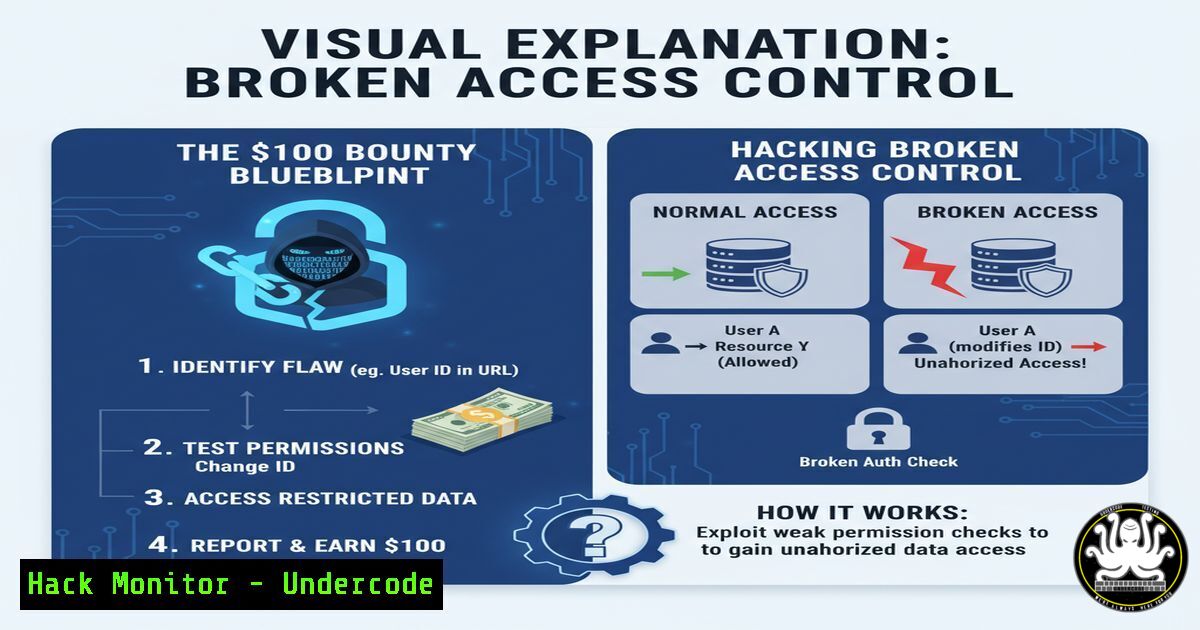
Introduction:
Broken Access Control consistently ranks as a critical security risk, allowing attackers to act outside their intended permissions. A recent real-world bounty case demonstrates how a systematic approach to identifying and exploiting these flaws can yield tangible rewards and significantly improve an application’s security posture.
Learning Objectives:
- Understand the core concepts of Broken Access Control vulnerabilities.
- Learn practical methodologies for testing Vertical and Horizontal Privilege Escalation.
- Master the commands and tools used to identify, exploit, and validate these common flaws.
You Should Know:
1. Enumerating User Roles and API Endpoints
Before testing, you must map the application’s structure and privilege levels.
Verified Commands & Tools:
– `gobuster dir -u https://target.com -w /usr/share/wordlists/dirb/common.txt -x php,html,json` (Discovers hidden directories and endpoints)
– `nikto -h https://target.com` (Performs a comprehensive web server scan)
– Browser Developer Tools (F12 -> Network Tab): Manually review all API calls and endpoints during normal user interaction.
Step-by-Step Guide:
This reconnaissance phase is critical. Use `gobuster` with a common wordlist to find administrative panels like /admin, /api/v1/users, or /config. Simultaneously, use your browser’s developer tools to observe every request made as you navigate the application. Note any endpoints that return different data based on your user role, as these are prime targets for Broken Access Control.
2. Testing for Insecure Direct Object References (IDOR)
IDOR occurs when an application provides direct access to objects based on user-supplied input without proper authorization checks.
Verified Commands & Code Snippets:
– `curl -H “Authorization: Bearer
– Browser Extension: “Autorize” (Automates testing for access control bypasses across a session)
– Custom Python script to iterate through object IDs: `for id in range(100, 150): requests.get(f”https://target.com/api/order/{id}”)`
Step-by-Step Guide:
If you find an endpoint like `/api/user/
` or <code>/api/orders/[bash]</code>, try changing the ID value. If you can view records belonging to other users, you've found a classic IDOR. Use a tool like Autorize, which acts as a proxy, automatically re-sending all your requests with modified IDs and session cookies to quickly scan for these vulnerabilities.

<h2 style="color: yellow;">3. Exploiting Horizontal Privilege Escalation</h2>

Horizontal escalation involves accessing resources of another user who has the same privilege level as you (e.g., viewing another user's private profile).

<h2 style="color: yellow;">Verified Code Snippet & Tool:</h2>

<ul>
<li>Using Burp Suite's Repeater tool: Capture a request for your own profile (e.g., <code>GET /api/users/your_user_id</code>). Send this request to Repeater and change the `user_id` parameter to another user's ID.</li>
<li>Browser Manipulation: Log in as User A, copy your session cookie. Open a private browser, log in as User B, and then try replacing User B's session cookie with User A's to see if you can impersonate them.</li>
</ul>

<h2 style="color: yellow;">Step-by-Step Guide:</h2>

The most straightforward method is using Burp Suite. After mapping the application, intercept a legitimate request for your data. In Burp's Repeater, systematically alter the identifier in the request (e.g., in the URL, JSON body, or headers) to that of another user. A successful response with the other user's data confirms the vulnerability.

<h2 style="color: yellow;">4. Chaining to Vertical Privilege Escalation</h2>

This is more severe, allowing a standard user to perform actions reserved for administrators.

<h2 style="color: yellow;">Verified Commands & Techniques:</h2>

<ul>
<li>`curl -X POST -H "Content-Type: application/json" -d '{"role":"admin"}' https://target.com/api/v1/user/profile/update` (Modifying your own user profile attribute to grant admin role)</li>
<li>JWT Manipulation: If the app uses JWTs, decode your token at <code>jwt.io</code>. Look for a `"role":"user"` claim. Try changing it to `"role":"admin"` and see if the application accepts the modified token.</li>
<li>Direct API Access: As a low-privilege user, try directly accessing an admin endpoint like `GET /api/admin/users` or <code>POST /api/admin/delete_user</code>.</li>
</ul>

<h2 style="color: yellow;">Step-by-Step Guide:</h2>

First, understand how the application manages roles. Check if your user profile has a hidden `role` field that can be updated via a POST request. If the application uses JWTs, this is a common failure point. Decode the token, alter the role, and resend it. If the application doesn't validate the token's signature, the escalation will work.

<h2 style="color: yellow;">5. Bypassing Path-Based Access Control</h2>

Sometimes, access control is only enforced by the front-end, not the back-end API routes.

<h2 style="color: yellow;">Verified Linux Command:</h2>

- `ffuf -w /usr/share/wordlists/seclists/Discovery/Web-Content/common.txt -u https://target.com/api/FUZZ/user -fs 0` (Fuzzing for API endpoints)
- `curl -H "X-Original-URL: /admin" https://target.com/normal-page` (Testing for header-based bypasses)

<h2 style="color: yellow;">Step-by-Step Guide:</h2>

Use `ffuf` to fuzz for API endpoints. You might find that `/api/admin/user` is blocked, but `/api/v1/user` is not, and still returns admin data if called with an admin user's ID. Also, test for path traversal vulnerabilities by requesting `https://target.com/../admin` or using headers like `X-Original-URL` or `X-Rewrite-URL` which some proxies use to bypass front-end checks.

<h2 style="color: yellow;">6. Automating the Hunt with Scripts</h2>

Manual testing is key, but automation can help cover more ground.

<h2 style="color: yellow;">Verified Python Script Snippet:</h2>

[bash]
import requests

cookies = {'session': 'your_low_priv_session_cookie'}
for user_id in range(1000, 1020):
response = requests.get(f'https://target.com/api/user/{user_id}', cookies=cookies)
if response.status_code == 200 and 'admin' in response.text:
print(f'Potential admin user found at ID: {user_id}')
print(response.text)
Step-by-Step Guide:
This script automates the search for user profiles, specifically looking for responses that contain the string ‘admin’. You can adapt it to look for different keywords, check for different HTTP status codes, or test a range of endpoint IDs. Always run such scripts against authorized targets only.
7. Validating the Fix Post-Disclosure
After reporting the issue, you must verify the vendor’s patch.
Verified cURL Commands for Validation:
– `curl -H “Authorization: Bearer
– Re-run all your original exploit commands. They should now consistently return access denied errors instead of sensitive data.
Step-by-Step Guide:
Once the vendor deploys a fix, re-run your entire testing methodology. Every request that previously succeeded in exploiting the Broken Access Control should now fail with a `403 Forbidden` or `401 Unauthorized` status code. This confirms that proper server-side authorization checks have been implemented.
What Undercode Say:
- The Human Element is Key: Automated scanners often miss nuanced Broken Access Control flaws because they require a deep understanding of user roles, business logic, and stateful session management. A manual, reasoning-based approach is irreplaceable.
- Prevention is a Architectural Decision: Mitigating these flaws cannot be done with patches alone. It requires a secure-by-design architecture where access control checks are centralized, mandatory, and applied on every request to a protected resource, with a default-deny policy.
The recent bounty case underscores a persistent industry-wide issue. While the financial reward was modest, the discovered vulnerability had the potential for significant data breach. The fact that such a fundamental flaw remains prevalent highlights a gap between the adoption of modern development frameworks and the correct implementation of their security features. The future impact of these hacks will continue to be severe, leading to massive data leaks, unless developers move beyond front-end controls and enforce authorization logic rigorously at the server-side API level.
Prediction:
The automation of business logic vulnerability discovery is the next frontier for offensive AI tools. We predict that within two years, AI-powered scanners will be able to understand application context, user roles, and state, systematically hunting for flaws like Broken Access Control at a scale and depth currently impossible. This will force a paradigm shift in secure development lifecycle (SDL) practices, making manual penetration testing and automated AI-based testing a mandatory phase before production deployment.
🎯Let’s Practice For Free:
IT/Security Reporter URL:
Reported By: Dubeyom Bugbounty – Hackers Feeds
Extra Hub: Undercode MoN
Basic Verification: Pass ✅


