
Listen to this Post
Introduction:
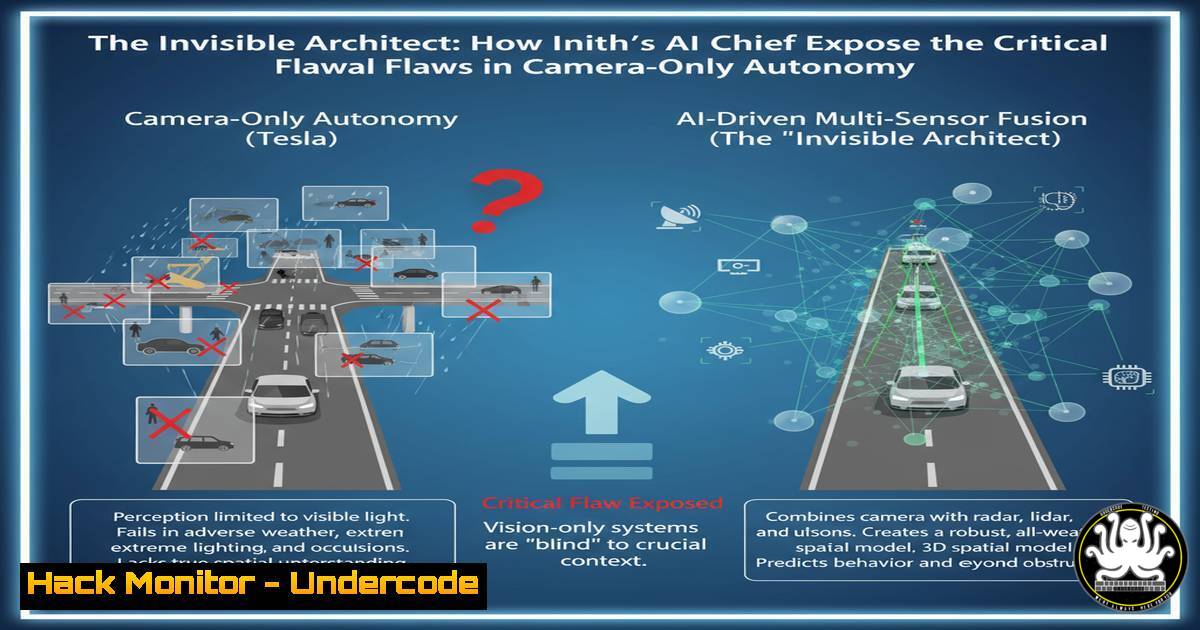
The public debate between industry experts like Michael DeKort and Tesla’s autonomy strategy, led by Ashok Elluswamy, highlights a fundamental schism in the path to self-driving cars. At the core is the reliance on a vision-only, deep learning system versus a multi-sensor fusion approach, a decision with profound implications for cybersecurity, AI safety, and real-world risk. This article dissects the technical vulnerabilities inherent in this design philosophy.
Learning Objectives:
- Understand the technical limitations and failure modes of camera-only deep learning systems in autonomous vehicles.
- Learn the principles of sensor fusion and how combining LiDAR, radar, and cameras creates a more resilient system.
- Explore the cybersecurity and AI safety implications of relying on pixel-pattern recognition for critical safety decisions.
You Should Know:
1. The Perils of Pixel-Based Pattern Recognition
Tesla’s system relies on deep neural networks to interpret camera images. This “pixel out” approach is inherently fragile and can be deceived.
` Example of a simple image preprocessing command for a TensorFlow-based vision model`
`import tensorflow as tf`
`def preprocess_image(image_path):`
` image = tf.io.read_file(image_path)`
` image = tf.image.decode_image(image, channels=3)`
` image = tf.image.resize(image, [224, 224])`
` image = tf.cast(image, tf.float32) / 255.0 Normalize pixel values`
` return tf.expand_dims(image, axis=0) Add batch dimension`
Step-by-step guide:
This Python code snippet, typical in systems like Tesla’s, shows how a raw image is prepared for a neural network. The image is resized to a fixed dimension (e.g., 224×224 pixels) and its pixel values are normalized. The critical weakness here is the massive reduction of real-world data into a simple numerical matrix. Context, depth, and material properties are lost, making the system vulnerable to misinterpreting complex or novel scenarios, such as confusing a harvest moon for a yellow light or a mural for real objects.
2. Simulating Sensor Fusion for Robust Perception
A resilient autonomous system uses multiple sensor types. LiDAR provides precise depth, radar sees through weather, and cameras offer rich semantic detail. Fusing them mitigates single-point failures.
` Pseudocode for a basic Kalman Filter sensor fusion loop`
`class SimpleSensorFusion:`
` def __init__(self):`
` self.estimated_position = 0`
` self.estimation_error = 1`
` def update(self, sensor_measurement, sensor_confidence):`
` Kalman Gain: How much to trust the new measurement`
` kalman_gain = self.estimation_error / (self.estimation_error + sensor_confidence)`
` Update estimate`
` self.estimated_position += kalman_gain (sensor_measurement – self.estimated_position)`
` Update error estimate`
` self.estimation_error = (1 – kalman_gain)`
Step-by-step guide:
This pseudocode illustrates a core concept in sensor fusion: the Kalman Filter. It continuously balances the current state estimate (e.g., a car’s position) with new sensor data (from camera, LiDAR, radar), weighted by their respective confidence levels. If the camera is blinded by direct sunlight, the system can rely more heavily on LiDAR and radar, maintaining a safe operational state. This creates a redundant, fault-tolerant system that a vision-only architecture fundamentally lacks.
3. Hardening the AI Development Pipeline
The “work set that is too large” problem necessitates robust offline security and testing. This involves securing training data and conducting rigorous adversarial testing.
` Using a Linux container to isolate and secure a model training environment`
`docker run –rm -it –gpus all -v $(pwd)/data:/data -v $(pwd)/models:/models tensorflow/tensorflow:latest-gpu python train.py`
` Securing the data volume with encryption at rest`
`sudo cryptsetup luksFormat /dev/sdb1`
`sudo cryptsetup open /dev/sdb1 secure_data_volume`
`sudo mkfs.ext4 /dev/mapper/secure_data_volume`
Step-by-step guide:
AI development must be treated as critical infrastructure. The first command runs a TensorFlow training session inside an isolated Docker container with GPU access, ensuring a consistent and reproducible environment. The subsequent commands demonstrate using Linux’s `cryptsetup` to encrypt the drive containing the training data, protecting sensitive datasets from theft or tampering. A breach in the training pipeline could lead to a corrupted model, making these security practices non-negotiable.
4. Adversarial Attack Simulation and Mitigation
Deep learning models are vulnerable to adversarial attacks—subtle, malicious manipulations of input data that cause incorrect outputs. Testing for these is crucial.
` Example using the IBM Adversarial Robustness Toolbox (ART) to create a Fast Gradient Sign Method (FGSM) attack`
`from art.attacks.evasion import FastGradientMethod`
`from art.classifiers import KerasClassifier`
`import numpy as np`
`classifier = KerasClassifier(model=my_model, clip_values=(0, 1))`
` Create attacker`
`attack_fgsm = FastGradientMethod(estimator=classifier, eps=0.05)`
` Generate adversarial examples`
`x_test_adv = attack_fgsm.generate(x=x_test)`
` Evaluate model performance on adversarial examples`
`predictions = np.argmax(classifier.predict(x_test_adv), axis=1)`
`accuracy = np.sum(predictions == y_test) / len(y_test)`
`print(f”Accuracy under FGSM attack: {accuracy:.2%}”)`
Step-by-step guide:
This code uses a common security tool to simulate an attack on a trained model. The FGSM attack adds a small, calculated perturbation to an image (e.g., a stop sign) that is imperceptible to a human but causes the model to misclassify it (e.g., as a speed limit sign). Running these tests reveals the model’s brittleness. A camera-only system on a public road is exposed to countless potential adversarial inputs, both natural and malicious, making this form of red-team testing essential for any safety-critical AI.
5. Implementing Fail-Safe Operational Design Domains (ODD)
An Operational Design Domain defines the specific conditions under which an automated system is designed to function. Enforcing ODD limits is a key software mitigation.
` Pseudocode for an ODD monitoring and fallback system`
`class OperationalDesignDomain:`
` def __init__(self):`
` self.max_rainfall = 10.0 mm/hr`
` self.min_light_lux = 50`
` self.sensor_health_threshold = 0.95`
` def is_operational(self, weather_data, light_sensor, sensor_confidence):`
` if (weather_data.rainfall > self.max_rainfall or`
` light_sensor.lux < self.min_light_lux or`
` sensor_confidence < self.sensor_health_threshold):`
` return False`
` return True`
` Main vehicle control loop`
`if not odd.is_operational(current_weather, camera_lux, cam_confidence):`
` initiate_minimal_risk_condition() e.g., pull over safely, request human takeover`
Step-by-step guide:
This code defines a software guardrail. The system continuously monitors its environment and its own health against a predefined ODD. If conditions exceed safety limits—such as heavy rain that obscures cameras, low light, or a drop in sensor confidence—the system does not attempt to drive outside its capabilities. Instead, it executes a fallback strategy, prioritizing safety over convenience. A criticism of current systems is that their ODD is too permissive for their actual capabilities.
6. Digital Forensics and Logging for Incident Analysis
When a failure occurs, as with the cited trailer collision, comprehensive, tamper-proof logging is required for analysis and accountability.
` Linux commands to configure secure, centralized logging with auditd`
` Install and enable the audit daemon`
`sudo apt-get install auditd`
`sudo systemctl enable auditd && sudo systemctl start auditd`
` Add a rule to log all commands executed by the root user (for critical systems)`
`sudo auditctl -a always,exit -F arch=b64 -S execve -F euid=0`
` View the audit logs`
`sudo ausearch -m EXECVE -ua root`
Step-by-step guide:
These commands set up advanced auditing on a Linux system, which could be part of the vehicle’s black box. The `auditd` daemon logs system calls, such as every command executed by the root user (or the autonomous driving software). This creates an immutable record of the system’s state and decisions leading up to an incident. For cybersecurity and safety investigations, this data is invaluable to determine if a failure was due to a software bug, a sensor malfunction, or a malicious cyber intrusion.
7. Cloud Hardening for AI Model Deployment
The backend infrastructure that pushes over-the-air (OTA) updates to the vehicle fleet is a high-value target and must be secured to prevent mass compromise.
` Terraform configuration snippet to deploy an AI model bucket on AWS with strict security`
`resource “aws_s3_bucket” “model_repository” {`
` bucket = “my-company-ai-models-prod”`
` acl = “private”`
` server_side_encryption_configuration {`
` rule {`
` apply_server_side_encryption_by_default {`
` sse_algorithm = “AES256″`
` }`
` }`
` }`
` versioning {`
` enabled = true Protect against accidental overwrites`
` }`
`}`
` Restrict access via a strict IAM policy`
`resource “aws_s3_bucket_policy” “model_policy” {`
` bucket = aws_s3_bucket.model_repository.id`
` policy = data.aws_iam_policy_document.model_policy.json`
`}`
Step-by-step guide:
This Infrastructure-as-Code (IaC) example uses Terraform to create a secure Amazon S3 bucket for storing AI models. It enables server-side encryption (SSE) for data at rest and versioning to track all model changes. A complementary IAM policy (not fully shown) would enforce the principle of least privilege, ensuring only authorized CI/CD systems can write new models and only vehicles can read them. A breach of this repository could allow an attacker to deploy a malicious AI model to millions of vehicles.
What Undercode Say:
- Sensor Fusion is Non-Negotiable for Safety: Relying on a single sensor modality like cameras creates a system with known, catastrophic failure modes that proper engineering, using sensor fusion, is designed to prevent. This is not an academic debate but a foundational principle of safety-critical systems engineering.
- AI Safety is a Cybersecurity Problem: The vulnerabilities of deep learning models to adversarial attacks and unexpected inputs mean that securing an autonomous vehicle is as much about protecting the AI as it is about securing the network. The entire pipeline, from data collection to OTA updates, must be hardened against intrusion and manipulation.
The critique of Tesla’s approach underscores a broader industry conflict between a rapid, software-centric deployment model and a more traditional, systems-engineering led safety model. The assertion that “deep learning relies on pixel out pattern recognition AI” resulting in a “work set that is too large” points to a fundamental challenge: ensuring robustness in an open-world environment. The incidents described are not mere bugs but symptoms of an architectural choice that prioritizes cost and simplicity over redundancy and resilience. The ethical question is whether it is acceptable to deploy a system with known, uncorrected limitations onto public roads, using the public as unwitting test subjects in a massive real-world beta program.
Prediction:
The ongoing scrutiny from regulators like the NTSB and NHTSA, combined with high-profile incidents, will force a regulatory reckoning. Future safety standards for autonomous vehicles will likely mandate performance and redundancy requirements that camera-only systems will struggle to meet, such as functional safety (ISO 26262) for perception systems and proven resilience in adverse conditions. This will catalyze a industry-wide shift towards multi-modal sensor fusion as the de facto standard for Level 4/5 autonomy, relegating vision-only systems to lower-level driver assistance features (Level 2) where human oversight remains the final failsafe. The companies that have invested in a comprehensive sensor suite will gain a significant regulatory and safety advantage.
🎯Let’s Practice For Free:
IT/Security Reporter URL:
Reported By: Activity 7379687151074074624 – Hackers Feeds
Extra Hub: Undercode MoN
Basic Verification: Pass ✅


