Listen to this Post
Introduction:
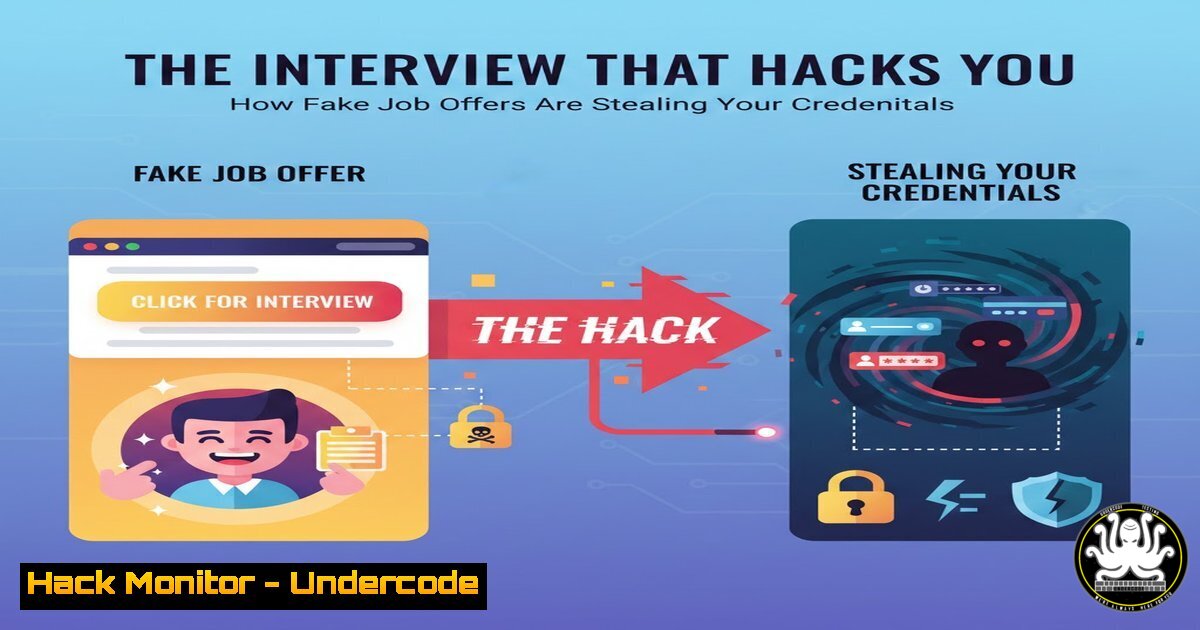
A sophisticated new social engineering campaign is targeting IT professionals through fake job interviews, weaponizing the interview process to deliver malware and harvest credentials. This attack vector exploits both human psychology and technical trust mechanisms, using legitimate platforms like Skype and WhatsApp to build credibility before deploying malicious payloads.
Learning Objectives:
- Understand the technical execution of job offer phishing campaigns
- Implement detection mechanisms for credential harvesting attempts
- Develop organizational protocols for secure interview processes
You Should Know:
1. The Initial Contact: Social Engineering at Scale
The attack begins with professionally crafted job offers distributed through platforms like LinkedIn and Indeed. Threat actors create convincing fake company profiles or impersonate legitimate organizations. The initial communication typically includes detailed job descriptions, competitive salary ranges, and benefits packages designed to appeal to high-value targets in IT and cybersecurity roles.
Step-by-step guide explaining what this does and how to use it:
– Research the company independently using official websites (not provided links)
– Verify recruiter identities through corporate directories
– Use command-line tools to analyze email headers:
 For email analysis
grep -i "received|return-path|message-id" suspicious_email.eml
python3 email_header_analyzer.py --input suspicious_email.eml
– Cross-reference phone numbers and addresses with official records
– Never download interview “preparation materials” before verification
2. The Technical Interview: Weaponized Code Reviews
During the technical screening phase, attackers present what appears to be legitimate coding challenges or infrastructure review tasks. The malicious payload is typically hidden within what seems to be routine code review exercises or system configuration files.
Step-by-step guide explaining what this does and how to use it:
– Use isolated environments for all technical assessments:
 Create isolated Docker container for code review
docker run --rm -it --name code-review-env -v $(pwd):/code alpine
cd /code
 Analyze files before execution
file suspicious_script.py
strings configuration_file.conf
– Implement pre-execution analysis:
 Linux file analysis commands
ls -la (check file permissions and sizes)
stat filename (verify creation/modification times)
sha256sum file (hash for threat intelligence lookup)
– Use automated scanning before opening any interview materials
3. Credential Harvesting Mechanisms: Beyond Keyloggers
Modern credential harvesting employs sophisticated techniques including memory scraping, browser injection, and API hooking. Attackers use custom malware that specifically targets password managers, SSO tokens, and session cookies rather than just keyboard input.
Step-by-step guide explaining what this does and how to use it:
– Monitor for unusual process behavior:
 Windows PowerShell monitoring
Get-Process | Where-Object {$<em>.CPU -gt 50 -and $</em>.ProcessName -notmatch "system|idle"}
 Linux process monitoring
ps aux --sort=-%cpu | head -10
lsof -p [bash]
– Implement credential protection:
 Check for unusual authentication events
sudo grep "authentication" /var/log/auth.log
 Windows event logs for credential access
Get-WinEvent -FilterHashtable @{LogName='Security'; ID=4624,4625}
4. Network Infrastructure Analysis: Identifying C2 Communications
Command and control servers often mimic legitimate cloud services and employment platforms. The malware establishes encrypted channels that blend with normal web traffic, making detection challenging without proper monitoring.
Step-by-step guide explaining what this does and how to use it:
– Analyze network connections:
 Network connection analysis
netstat -an | findstr ESTABLISHED
ss -tunp | grep ESTAB
 Deep packet inspection
tcpdump -i any -w interview_traffic.pcap
tshark -r interview_traffic.pcap -Y "http.request"
– Implement egress filtering and monitoring:
 iptables rules for suspicious outbound traffic
iptables -A OUTPUT -p tcp --dport 443 -m state --state NEW -j LOG --log-prefix "HTTPS-OUT: "
5. Cloud Service Exploitation: Compromising Corporate Accounts
Attackers leverage stolen credentials to access corporate cloud services, particularly targeting collaboration tools, code repositories, and infrastructure management consoles where a single compromise can yield extensive access.
Step-by-step guide explaining what this does and how to use it:
– Implement conditional access policies:
 Azure AD conditional access audit
Get-MgIdentityConditionalAccessPolicy
 AWS IAM policy review
aws iam list-users --query 'Users[].UserName'
aws iam get-user-policy --user-name username --policy-name policy-name
– Monitor for unusual cloud activity:
 AWS CloudTrail monitoring
aws cloudtrail lookup-events --lookup-attributes AttributeKey=Username,AttributeValue=suspicious_user
6. Incident Response: Containing Credential Theft
When credential theft is suspected, immediate containment actions must include credential rotation, session revocation, and comprehensive system audits to identify potential lateral movement.
Step-by-step guide explaining what this does and how to use it:
– Emergency credential rotation:
 Active Directory emergency password reset
Set-ADAccountPassword -Identity username -Reset -NewPassword (ConvertTo-SecureString -AsPlainText "TempPass123!" -Force)
 Linux password expiration enforcement
chage -d 0 username
– Session termination and investigation:
 Terminate active sessions
loginctl terminate-session [bash]
 Audit successful authentications
last -f /var/log/wtmp | grep username
7. Preventive Controls: Building Organizational Immunity
Technical controls must be complemented with organizational policies that define secure interview procedures, including approved communication channels, mandatory verification steps, and restricted environments for technical assessments.
Step-by-step guide explaining what this does and how to use it:
– Implement technical safeguards:
 Application whitelisting policies
 Windows AppLocker
Get-AppLockerPolicy -Effective | Test-AppLockerPolicy -UserName username -Path C:\temp\file.exe
 Linux application control
sudo aa-status (AppArmor)
sudo semodule -l (SELinux)
– Security awareness integration:
 Phishing simulation and training
 Regular social engineering tests
 Interview-specific security protocols
What Undercode Say:
- The professional desperation created by economic uncertainty creates ideal conditions for these sophisticated attacks
- Traditional security training often fails to address the interview context specifically, creating a critical gap
- The ROI for attackers is exceptionally high given the quality of credentials obtained from technical professionals
This attack methodology represents a significant evolution beyond traditional phishing by exploiting professional trust relationships and technical engagement processes. The multi-stage approach allows attackers to bypass conventional security awareness training that focuses on obvious phishing attempts rather than sophisticated professional interactions. Organizations must develop interview-specific security protocols that don’t undermine the candidate experience while maintaining robust security postures. The technical complexity suggests state-sponsored or highly organized criminal groups rather than opportunistic attackers, indicating this threat will continue evolving in sophistication.
Prediction:
This attack vector will likely expand to target other high-value professions including finance executives, research scientists, and government officials. We anticipate increased use of AI-generated content to create more convincing fake interviews and the weaponization of actual technical assessment platforms. The convergence of deepfake technology with these social engineering tactics could enable completely virtual interviews conducted by synthetic personas, making detection exponentially more challenging. Organizations that fail to adapt their security awareness programs to address these profession-specific social engineering attacks will face significant credential compromise incidents.
🎯Let’s Practice For Free:
IT/Security Reporter URL:
Reported By: Alexey6 Spacetech – Hackers Feeds
Extra Hub: Undercode MoN
Basic Verification: Pass ✅


