Listen to this Post
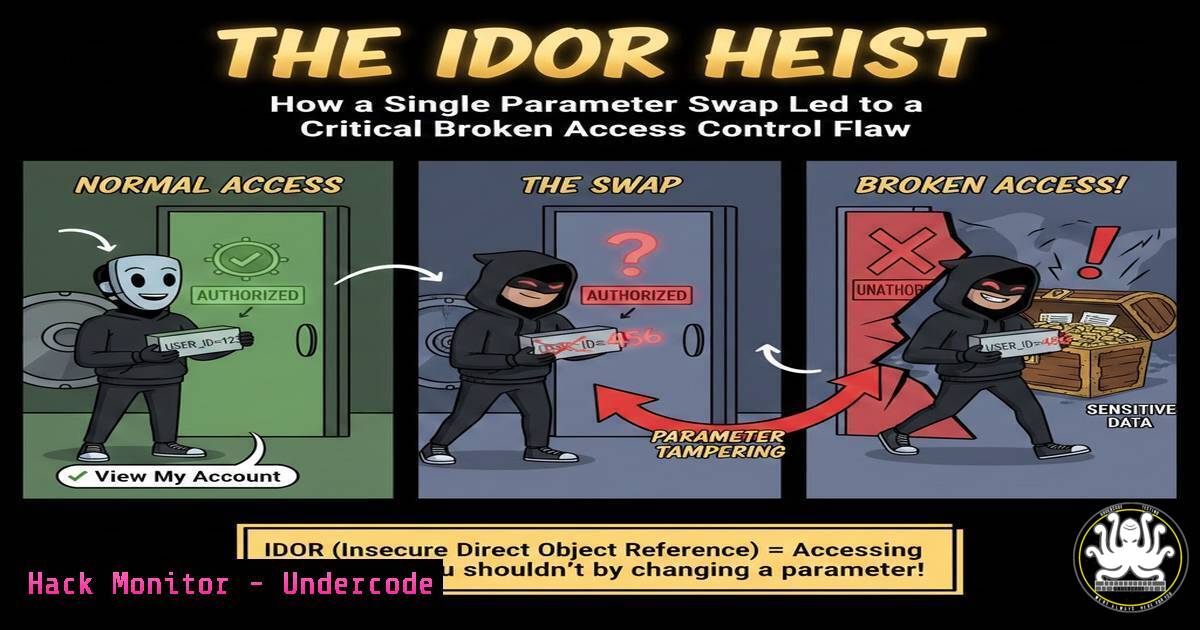
Introduction:
In the ever-evolving landscape of web application security, Broken Access Control consistently ranks as a critical threat, enabling attackers to act beyond their intended permissions. This article deconstructs a real-world critical vulnerability—an Insecure Direct Object Reference (IDOR) combined with flawed business logic—that allowed unauthorized impersonation of user actions, fundamentally compromising interaction integrity.
Learning Objectives:
- Understand the mechanics of Insecure Direct Object Reference (IDOR) within Broken Access Control.
- Learn the practical steps to reproduce an IDOR-based Action Impersonation flaw using intercepting proxies.
- Master server-side mitigation strategies and advanced testing techniques to defend against such vulnerabilities.
You Should Know:
- Deconstructing the Vulnerability: IDOR, Authorization, and Business Logic
The flaw was a confluence of three failures. First, an Insecure Direct Object Reference (IDOR) where user-controllable input (comment_id) directly referenced an object without authorization checks. Second, Broken Authorization where the server failed to verify if the authenticated user (attacker) had the right to perform the “love” action on the target object. Third, a Business Logic Flaw where the system incorrectly attributed the action’s source, changing the victim’s UI state to “You loved this.” This trifecta allowed action impersonation.
2. Essential Tools for Testing Access Control
To test for such flaws, you need intercepting proxies and browser tools.
Step‑by‑step guide:
- Burp Suite Community/Professional: The industry-standard proxy. Configure your browser (e.g., Firefox) to use Burp’s proxy listener (default
127.0.0.1:8080). Install Burp’s CA certificate to intercept HTTPS traffic. - Browser Developer Tools: Built into all major browsers (F12). Use the Network tab to monitor all client-server requests, headers, and parameters in real-time.
- Command-line with cURL: For scripting and manual request manipulation. Example base command:
curl -X POST 'https://target-api.com/action/like' -H 'Authorization: Bearer <ATTACKER_TOKEN>' -H 'Content-Type: application/json' -d '{"comment_id":"VICTIM_COMMENT_ID"}'This setup forms your testing harness to capture and manipulate requests.
3. Step-by-Step Reproduction: From Discovery to Exploitation
This guide mirrors the researcher’s process.
Step‑by‑step guide:
- Reconnaissance: Create two user accounts: Attacker (A) and Victim (V).
- Establish Baseline: Log in as V, post a comment, and note its `comment_id` (often in page source or network response). Log out.
- Attacker Normal Action: Log in as A. Like your own comment while intercepting traffic with Burp Suite. The captured POST request might look like: `POST /api/comment/love {“comment_id”:”ATTACKER_ID”}`
4. Identify Parameter: The `comment_id` parameter is the likely object reference. - Exploit: In Burp’s Proxy `Intercept` tab, change the `comment_id` value to the Victim’s
comment_id. Forward the request. - Verify: The server responds with a 200 OK, indicating success. Log in as the Victim account and observe the comment now shows “You loved this,” proving action impersonation.
4. Server-Side Mitigation: Implementing Proper Authorization Checks
The core fix is implementing server-side checks that ignore client-provided claims about the user’s identity for the action.
Step‑by‑step guide:
- Use Session Context: The user ID must be taken from the server-side session token (e.g.,
req.session.userId), NEVER from a mutable request parameter. - Implement Access Control Checks: Before processing the “like” action, verify the relationship between the authenticated user and the target object.
Python (Flask) Example Mitigation Code
@app.route('/api/comment/<comment_id>/love', methods=['POST'])
def love_comment(comment_id):
current_user_id = session.get('user_id')  From server-side session
target_comment = Comment.query.get(comment_id)

Check 1: Does the object exist?
if not target_comment:
return jsonify({'error': 'Not found'}), 404

Check 2: Is the current user allowed to "love" this specific comment?
Business Logic: Perhaps users cannot love their own comments?
if target_comment.author_id == current_user_id:
return jsonify({'error': 'Cannot like your own comment'}), 403

Check 3: Has the user already loved this? (Idempotency)
existing_love = Love.query.filter_by(user_id=current_user_id, comment_id=comment_id).first()
if existing_love:
return jsonify({'error': 'Already liked'}), 409

If all checks pass, create the love association with the correct user_id.
new_love = Love(user_id=current_user_id, comment_id=comment_id)
db.session.add(new_love)
db.session.commit()
return jsonify({'success': True}), 200
5. Advanced Testing: Automation and State Change Analysis
Manual testing is foundational, but automation scales.
Step‑by‑step guide:
- Burp Intruder: Use it to fuzz `comment_id` parameters with a wordlist of potential object IDs (e.g., 1-10000). Filter responses for `200 OK` status codes on requests where they shouldn’t belong.
- State Change Verification: Write a script to validate the vulnerability’s impact by checking the victim’s state.
Example cURL sequence to automate verification <ol> <li>Attacker impersonates victim's action curl -X POST 'https://target.com/api/love' -b 'attacker_session_cookie' -d 'comment_id=VICTIM_ID' -o /dev/null -s -w "%{http_code}"</li> <li>Script then logs in as victim to check state curl 'https://target.com/api/get_comment/VICTIM_ID' -b 'victim_session_cookie' | grep -q '"liked_by_self":true' && echo "VULNERABLE" - Logical Flaw Hunting: Systematically test all user interactions (upvote, downvote, reply, edit, delete) for similar parameter substitution flaws.
What Undercode Say:
- The Session is King: Authorization decisions must be based solely on server-side session/authentication context, never on client-supplied object IDs alone. This is the non-negotiable first principle of access control.
- Logic Flaws are Silent Killers: The most insidious aspect was the business logic failure that misattributed the action source, misleading the victim. Testing must verify not just action success, but also its correct attribution in the system’s state.
- This case study is a textbook example of a vertically integrated flaw. It wasn’t just a data leak; it was an unauthorized state change with a false attribution—a potent mix for social engineering and reputation damage. The platform’s error was treating the user’s identity as a property of the action request itself, rather than an immutable property of the session. Defending against this requires a paradigm where every function validating authorization receives the user’s identity as a trusted, server-derived input, and every state-changing operation is audited with the correct source user ID.
Prediction:
The sophistication of Broken Access Control exploits will move further into the business logic layer, making them harder to detect with automated scanners. We will see a rise in AI-driven fuzzing tools that learn application workflows to systematically test for state manipulation and attribution flaws like this one. Consequently, developer security training will pivot from basic “check authorization” mantras to deeper “state transition analysis,” and runtime application security protection (RASP) will become standard to enforce integrity checks on user attribution for every critical action.
▶️ Related Video (76% Match):
🎯Let’s Practice For Free:
IT/Security Reporter URL:
Reported By: Ankitrathva Bugbounty – Hackers Feeds
Extra Hub: Undercode MoN
Basic Verification: Pass ✅


