Listen to this Post
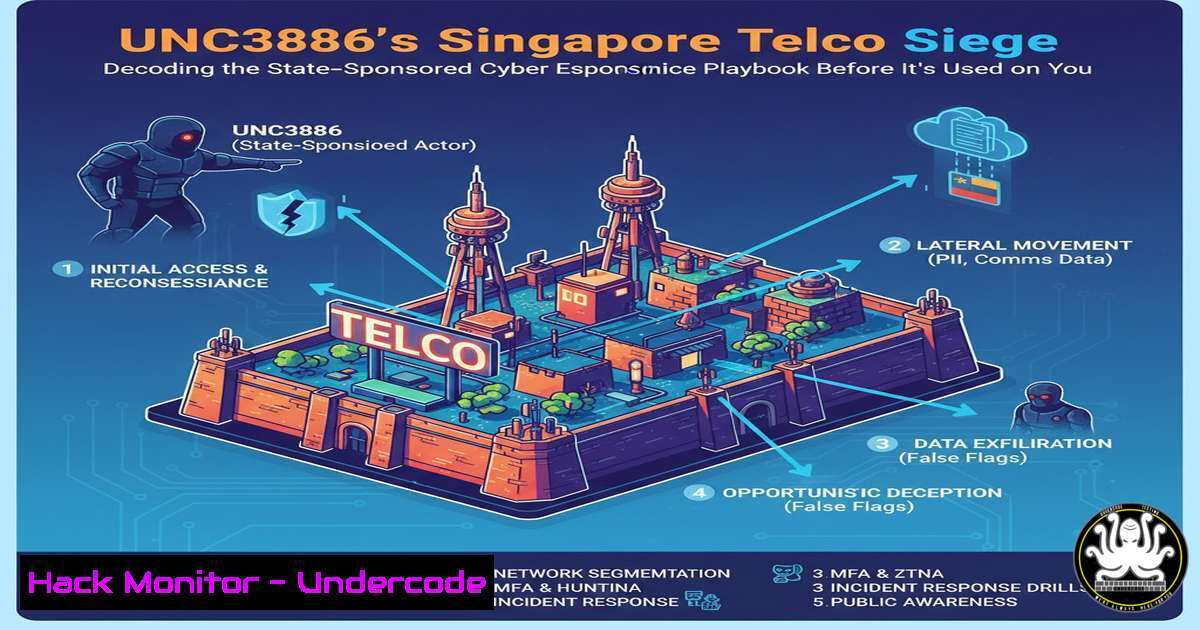
Introduction:
The recent public disclosure that Singapore’s four major telecommunications providers—Singtel, StarHub, M1, and Simba Telecom—were compromised by the advanced persistent threat (APT) group UNC3886 serves as a stark wake-up call. This was not a smash-and-grab ransomware attack but a sophisticated, long-term cyber-espionage campaign targeting critical national infrastructure. The incident underscores a pivotal shift: digital threats to operational technology (OT) and critical communication nodes now pose a risk to business continuity and national security on par with physical threats, demanding a reevaluation of defense-in-depth strategies.
Learning Objectives:
- Understand the tactics, techniques, and procedures (TTPs) of state-sponsored groups like UNC3886 targeting critical infrastructure.
- Learn practical steps for detecting covert network persistence and lateral movement within a Linux/Windows hybrid environment.
- Implement hardening measures for cloud workloads, API security, and network segmentation to mitigate similar advanced threats.
You Should Know:
1. Deconstructing UNC3886’s Initial Access and Backdoor Techniques
State-sponsored actors often start with spear-phishing or exploiting public-facing applications. Once inside, they deploy custom backdoors for persistence. A common method involves hijacking legitimate system processes or installing rootkits.
Step‑by‑step guide explaining what this does and how to use it.
To detect such tampering on Linux systems, focus on integrity checks and hidden processes.
– Check for Unauthorized Kernel Modules (Rootkits):
 List all loaded kernel modules
lsmod
 Cross-reference with known good baselines or use integrity checking tools
sudo tripwire --check
 Search for hidden processes by comparing /proc with ps output
ps aux | awk '{print $2}' | sort > /tmp/ps_pids
ls /proc | grep -E '^[0-9]+$' | sort > /tmp/proc_pids
diff /tmp/ps_pids /tmp/proc_pids
– Windows Command to Analyze Autostart Extensibility Points (ASEPs):
 Use PowerShell to comprehensively audit persistence locations
Get-CimInstance Win32_StartupCommand | Select-Object Name, command, Location
Get-ItemProperty -Path "HKLM:\Software\Microsoft\Windows\CurrentVersion\Run", "HKCU:\Software\Microsoft\Windows\CurrentVersion\Run"
2. Hunting for Lateral Movement and Credential Theft
UNC3886 likely employed techniques like Pass-the-Hash or exploited trusted relationships to move across the telco network. Detecting anomalous logins and credential access is critical.
Step‑by‑step guide explaining what this does and how to use it.
– Monitor for Network Logon Events (Windows):
Configure Windows Advanced Audit Policy to log `Logon/Logoff` events (Audit Policy sub-category: Logon). Then query security logs:
Get-WinEvent -FilterHashtable @{LogName='Security'; ID=4624, 4625} -MaxEvents 20 | Format-List TimeCreated, Message
– Detect SSH Lateral Movement (Linux):
Analyze SSH auth logs for suspicious source IPs or success patterns.
 Check for successful logins from unusual IPs
sudo grep "Accepted publickey|Accepted password" /var/log/auth.log | awk '{print $1,$2,$3,$9,$11}' | sort | uniq -c | sort -nr
 Look for failed attempts that may precede a successful breach
sudo grep "Failed password" /var/log/auth.log | awk '{print $11}' | sort | uniq -c | sort -nr | head -20
3. Securing Cloud Workloads and APIs from Espionage
Telcos heavily utilize cloud infrastructure. APTs target misconfigured containers, storage buckets, and management APIs.
Step‑by‑step guide explaining what this does and how to use it.
– Harden Kubernetes (Common in Telco Cloud):
 Run kube-bench to check for CIS benchmark compliance
docker run --rm -v /etc:/etc:ro -v /usr:/usr:ro aquasec/kube-bench:latest master
 Ensure Kubernetes API server is not exposed publicly without authentication
kubectl cluster-info | grep -E 'Kubernetes master|control plane'
 Check for overly permissive service accounts
kubectl get serviceaccounts --all-namespaces -o yaml | grep -A 5 "automountServiceAccountToken"
– Audit AWS S3 Buckets for Public Exposure:
 Use AWS CLI to list buckets and their policies
aws s3api list-buckets --query "Buckets[].Name"
aws s3api get-bucket-policy --bucket YOUR_BUCKET_NAME --output text | jq .
4. Implementing Network Segmentation for Critical Infrastructure
Prevent an initial breach in the corporate IT network from reaching critical OT systems like signaling or control planes.
Step‑by‑step guide explaining what this does and how to use it.
– Use Linux iptables/firewalld to Create Micro-Segments:
 Isolate a critical server to only accept traffic from a management jump host
sudo firewall-cmd --permanent --zone=public --add-rich-rule='rule family="ipv4" source address="192.168.1.50/32" port port="22" protocol="tcp" accept'
sudo firewall-cmd --permanent --zone=public --add-rich-rule='rule family="ipv4" source NOT address="192.168.1.0/24" drop'
sudo firewall-cmd --reload
– Windows Firewall Rule for Specific Application:
New-NetFirewallRule -DisplayName "Allow_App_From_Secure_Subnet" -Direction Inbound -Protocol TCP -LocalPort 443 -RemoteAddress 10.0.1.0/24 -Action Allow
- Proactive Threat Hunting with Endpoint Detection and Response (EDR)
Deploy and tune EDR tools to look for memory injection, living-off-the-land binaries (LoLBins), and command-and-control (C2) beacons.
Step‑by‑step guide explaining what this does and how to use it.
– Manual Hunting with Sysinternals Sysmon (Windows):
Install Sysmon with a robust configuration (like SwiftOnSecurity’s). Key queries:
 Find processes with suspicious network connections
Get-WinEvent -FilterHashtable @{LogName='Microsoft-Windows-Sysmon/Operational'; ID=3} | Where-Object {$<em>.Properties[bash].Value -notmatch "(:80|:443)$"} | Select-Object TimeCreated, @{n="Process";e={$</em>.Properties[bash].Value}}, @{n="Destination";e={$_.Properties[bash].Value}}
– Linux Hunting with Auditd for Process Execution:
 Monitor execution of critical binaries like curl, wget, ssh
sudo auditctl -a always,exit -F arch=b64 -S execve -F path=/usr/bin/curl -k suspicious_exec
sudo ausearch -k suspicious_exec | aureport -f -i
What Undercode Say:
- Critical Infrastructure is the Prime Battleground: This attack is a canonical example of modern cyber-espionage, where the goal is sustained intelligence gathering, not immediate disruption. The focus on telcos provides a vector to intercept communications and potentially pivot to downstream targets.
- Assumption of Breach is the New Baseline: Defenders must operate on the assumption that determined adversaries will bypass perimeter defenses. Security investment must pivot sharply towards stringent lateral movement controls, robust credential hygiene, and 24/7 threat hunting focused on behavioral anomalies rather than just signature-based detection.
Prediction:
The UNC3886 campaign is a precursor to a new wave of hyper-specialized APT operations targeting global supply chain chokepoints—ports, logistics hubs, and undersea cable landing stations. We predict a convergence of IT and OT attack surfaces will lead to more disruptive, multi-vector campaigns that combine espionage with latent sabotage capabilities (logic bombs, wipers). The future battleground will be the software supply chain for OT systems and the identity fabric of hybrid cloud environments, forcing a industry-wide shift towards zero-trust architectures and mandatory, regulated security baselines for all critical infrastructure operators.
▶️ Related Video (78% Match):
🎯Let’s Practice For Free:
IT/Security Reporter URL:
Reported By: Contactwilson Spores – Hackers Feeds
Extra Hub: Undercode MoN
Basic Verification: Pass ✅


