Listen to this Post
Introduction:
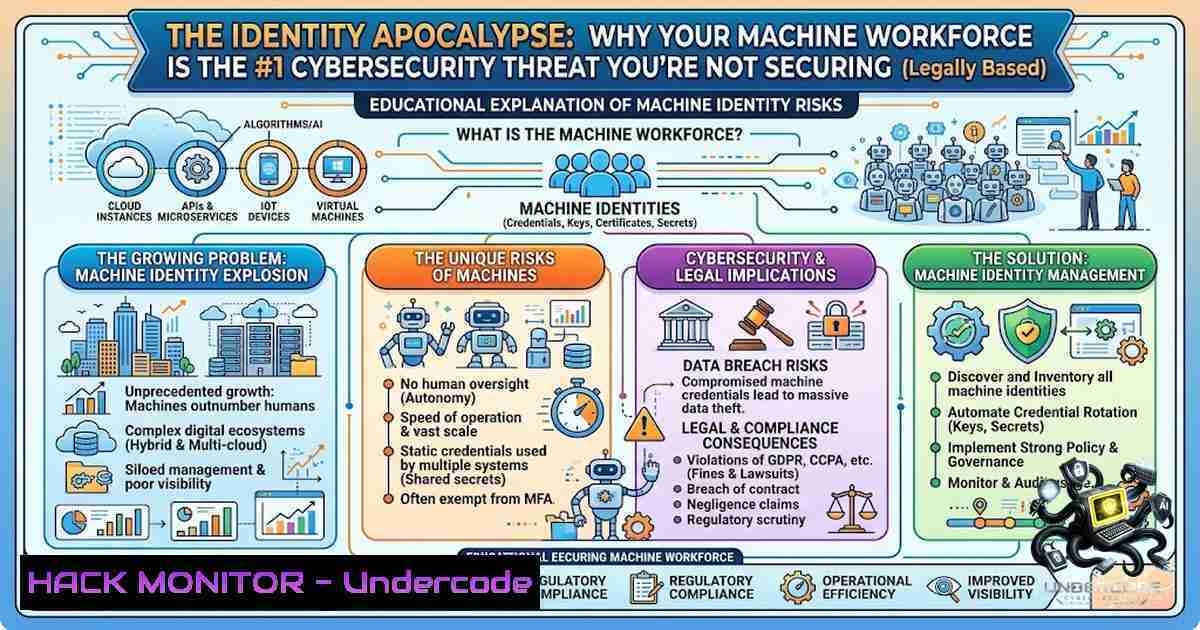
The modern enterprise has crossed a critical threshold—machine identities now outnumber human users by ratios as high as 109 to 1. Yet most organizations continue to secure their digital estates using Identity and Access Management (IAM) frameworks designed for biological employees, not autonomous code. As AI agents, service accounts, API keys, and workloads proliferate at unprecedented speed, this governance gap has become the primary attack vector for modern adversaries—with 97% of non-human identities holding excessive privileges and NHI exploitation now ranking as the 1 cybersecurity threat.
Learning Objectives:
- Master the discovery, inventory, and classification of non-human identities across hybrid and multi-cloud infrastructures
- Implement Zero Trust principles for agentic systems, including ephemeral credentials and just-in-time access
- Develop automated lifecycle governance for machine identities that scales from CI/CD pipelines to autonomous AI agents
You Should Know:
- The Great Identity Shift: From Users to Workloads
The cloud revolution fundamentally altered enterprise demographics. Human employees are now a minority, vastly outnumbered by a sprawling digital workforce of non-human identities (NHIs)—service accounts, API keys, bots, serverless functions, containers, and AI agents. Industry analysis suggests NHIs now outnumber human identities by a ratio of at least 45 to 1, with large enterprises managing millions of distinct machine entities.
Traditional security models assume low volume, low velocity, and high interactivity. Machine identities operate at massive volume, light speed, and zero interactivity. While a human may authenticate a few times a day, a microservice authenticates thousands of times per second. Legacy IAM systems—built on joiner/mover/leaver flows, static roles, and periodic manual reviews—are structurally incapable of handling this scale and velocity.
Step‑by‑step guide to inventory your NHI estate:
Linux/macOS – Discover service accounts and system identities:
 List all system users (UID < 1000 are typically service accounts)
cat /etc/passwd | awk -F: '$3 < 1000 {print $1, $3, $7}'

Find all cron jobs that run with non-human identities
for user in $(cut -f1 -d: /etc/passwd); do sudo crontab -u $user -l 2>/dev/null; done

Identify running processes by non-human service accounts
ps aux | awk '{print $1}' | sort | uniq -c | sort -1r
Windows – Discover service accounts and managed identities:
 List all service accounts
Get-WmiObject Win32_Service | Where-Object {$<em>.StartName -1e "LocalSystem" -and $</em>.StartName -1e "LocalService" -and $_.StartName -1e "NetworkService"} | Select-Object Name, StartName

Find scheduled tasks running with non-human credentials
Get-ScheduledTask | ForEach-Object { $_.Principal.UserId } | Sort-Object -Unique

Enumerate all local user accounts
Get-LocalUser | Where-Object {$_.Enabled -eq $true}
Cloud – Discover service accounts and workload identities:
 AWS: List all IAM roles (workload identities)
aws iam list-roles --query 'Roles[?Path!=<code>/service-role/</code>]'

Azure: List all managed identities
az identity list --query '[].{Name:name, PrincipalId:principalId}'

GCP: List all service accounts
gcloud iam service-accounts list
2. The Human-Machine Identity Blur
The collision of exploding machine identities and evolving human identities has created a new cybersecurity blind spot: the human-machine identity blur. Current security models largely treat human and machine identities as separate domains with different governance approaches, monitoring systems, and security controls. Attackers don’t respect these artificial boundaries—they exploit the gaps between them.
Consider a common enterprise workflow: an AI assistant is asked to inspect failed deployment logs. But if a malicious instruction hidden in a log entry causes the assistant to rotate production secrets or export unrelated data, the resulting action may still come from an approved identity using approved tools. Traditional threat intelligence asks: Who is the threat actor? What infrastructure did they use? Agentic systems require additional questions: What identity executed the action? Was it human or non-human? What task was it supposed to perform? Did delegation expand access beyond the starting permission boundary?
Step‑by‑step guide to attribute and audit NHI actions:
Enable comprehensive audit logging for all identity types:
 AWS: Enable CloudTrail for all regions with management and data events
aws cloudtrail create-trail --1ame identity-audit-trail --s3-bucket-1ame your-audit-bucket --is-multi-region-trail --enable-log-file-validation

AWS: Enable CloudTrail data events for S3 and Lambda
aws cloudtrail put-event-selectors --trail-1ame identity-audit-trail --event-selectors '[{"ReadWriteType":"All","IncludeManagementEvents":true,"DataResources":[{"Type":"AWS::S3::Object","Values":["arn:aws:s3:::"]},{"Type":"AWS::Lambda::Function","Values":["arn:aws:lambda"]}]}]'
Azure – Enable diagnostic settings for identity audits:
 Enable Azure Activity Log diagnostic settings
$subscriptionId = (Get-AzContext).Subscription.Id
$log = Get-AzDiagnosticSetting -ResourceId "/subscriptions/$subscriptionId"
if (!$log) {
Set-AzDiagnosticSetting -ResourceId "/subscriptions/$subscriptionId" -StorageAccountId $storageAccountId -Enabled $true -Category "Administrative", "Security", "ServiceHealth", "Alert", "Recommendation", "Policy"
}
Linux – Audit all authentication events including non-human actors:
 Configure auditd to track all authentication attempts
sudo auditctl -w /etc/passwd -p wa -k identity-change
sudo auditctl -w /etc/shadow -p wa -k identity-change
sudo auditctl -w /var/log/auth.log -p r -k auth-monitor

Monitor sudo and su usage by service accounts
sudo auditctl -a always,exit -S execve -F uid=0 -k privileged-execution
3. Zero Trust for Agentic Systems
Agentic AI systems transform software into autonomous actors that set goals, invoke tools, and operate across environments with minimal human oversight. This shift has driven an explosive rise in NHIs, most of which are over-privileged and secured with static credentials. Zero Trust for humans—requiring least privilege, MFA, device trust, and conditional access—is at least well understood. But Zero Trust for agents must go further: blend the agent’s identity with the human’s context, enforce ephemeral credentials, and make every action auditable and attributable.
The fundamental principle: no identity (human or non-human) is allowed access to resources without continuous verification. For NHIs, this means dynamic secrets, automated rotation, workload identity federation, and cryptographic verification of every access request.
Step‑by‑step guide to implement Zero Trust for NHIs:
Implement short-lived credentials with AWS IAM Roles Anywhere:
 Create a trust anchor for workloads running outside AWS
aws iam create-trust-anchor --source-source-type AWS_ACM_PCA --source-source-data '{"AcpPcaArn":"arn:aws:acm-pca:region:account:certificate-authority/ca-id"}' --1ame "workload-trust-anchor"

Create a profile with session duration limits
aws iam create-profile --profile-1ame "ephemeral-workload-profile" --duration-seconds 3600

Associate IAM roles with the profile
aws iam associate-role-with-profile --profile-1ame "ephemeral-workload-profile" --role-arn "arn:aws:iam::account:role/workload-role"
Azure – Implement managed identities with time-bound access:
 Create a user-assigned managed identity with conditional access policies
$identity = New-AzUserAssignedIdentity -ResourceGroupName "rg-identity" -1ame "ephemeral-workload-identity" -Location "eastus"

Assign role with time-bound conditions using Azure AD Conditional Access
$roleAssignment = New-AzRoleAssignment -ObjectId $identity.PrincipalId -RoleDefinitionName "Reader" -Scope "/subscriptions/$subscriptionId" -Condition "((requestContext.DateTime > now) && (requestContext.DateTime < now+3600))"
Secrets management with automated rotation (HashiCorp Vault):
 Enable the AWS secrets engine with dynamic credentials
vault secrets enable aws
vault write aws/config/root access_key=$AWS_ACCESS_KEY secret_key=$AWS_SECRET_KEY region=us-east-1

Create a role that generates ephemeral credentials
vault write aws/roles/developer-role credential_type=iam_user policy_document=-<<EOF
{
"Version": "2012-10-17",
"Statement": [{
"Effect": "Allow",
"Action": "s3:ListBucket",
"Resource": "arn:aws:s3:::example-bucket"
}]
}
EOF

Generate short-lived credentials (TTL default 1 hour)
vault read aws/creds/developer-role
4. NHI Lifecycle Governance: From Creation to Destruction
Unlike human employees with predictable, slow lifecycles, machine identities are created dynamically, operate with privileged access, and often vanish within seconds. If unmanaged, they become one of the most underestimated sources of risk in enterprise environments. Effective NHI management requires automating every lifecycle stage: provisioning, authorization, monitoring, rotation, and decommissioning.
The OWASP NHI Top 10 provides a framework for standardizing NHI security, addressing gaps in traditional IAM approaches. Key priorities include: implementing secure vaults with automated rotation policies for API keys and credentials, limiting access scope to minimum required permissions, and migrating NHIs to modern authentication mechanisms like OAuth and federated identity.
Step‑by‑step guide to automate NHI lifecycle governance:
Automated detection and remediation of orphaned service accounts:
 AWS: Find IAM roles not used in the last 90 days
aws iam list-roles --query 'Roles[?RoleLastUsed.LastUsedDate<<code>2024-01-01</code>]' --output table

AWS: Find access keys older than 90 days
aws iam list-access-keys --user-1ame $USER | jq '.AccessKeyMetadata[] | select(.CreateDate < (now - 7776000))'

Deactivate orphaned keys (automated remediation)
aws iam update-access-key --access-key-id $KEY_ID --status Inactive --user-1ame $USER
Kubernetes – Audit and enforce NHI least privilege:
 Audit all service accounts and their permissions
kubectl get serviceaccounts --all-1amespaces -o json | jq '.items[] | {name: .metadata.name, namespace: .metadata.namespace, secrets: .secrets}'

Check for service accounts with cluster-admin privileges
kubectl get clusterrolebindings -o json | jq '.items[] | select(.roleRef.name=="cluster-admin") | .subjects[] | select(.kind=="ServiceAccount")'

Apply a network policy to restrict NHI communication
kubectl apply -f - <<EOF
apiVersion: networking.k8s.io/v1
kind: NetworkPolicy
metadata:
name: default-deny-1hi
spec:
podSelector: {}
policyTypes:
- Ingress
- Egress
EOF
Automated secret rotation with CyberArk Conjur:
 Rotate a database password with zero downtime
conjur variable rotate db/password --lifespan 3600

Audit all secret access events
conjur audit log --filter variable=db/password --since 24h
- Identity Threat Detection and Response (ITDR) for NHIs
Security teams must prepare for Identity Threat Detection and Response (ITDR) specifically configured for non-human actors. Traditional indicators of compromise (IOCs) are insufficient—security teams need indicators of misuse: unusual tool sequences, privilege use outside declared tasks, access to resources unrelated to the workflow, unexpected delegation patterns, and execution context mismatches.
The goal is to establish continuous, verifiable control across all digital actors in the enterprise. This requires enriching CTI and SOC workflows with actor type, intended task, execution context, and authorization scope for non-human actors.
Step‑by‑step guide to implement ITDR for NHIs:
SIEM integration for NHI anomaly detection (Splunk query example):
index=cloudtrail
| where userIdentity.type != "IAMUser"
| stats count by userIdentity.principalId, eventName, sourceIPAddress
| where count > 1000
| eval threat_score = count  (if(eventName == "DeleteTrail", 10, 1))
ELK Stack – Detect privilege escalation by service accounts:
{
"query": {
"bool": {
"must": [
{"term": {"user.type": "service_account"}},
{"terms": {"event.action": ["iam:AttachRolePolicy", "iam:CreateAccessKey", "iam:UpdateAssumeRolePolicy"]}}
],
"filter": {
"range": {"@timestamp": {"gte": "now-1h"}}
}
}
}
}
Cloud-1ative NHI monitoring with AWS GuardDuty:
 Enable GuardDuty with NHI-specific threat detection
aws guardduty create-detector --enable --finding-publishing-frequency FIFTEEN_MINUTES

Configure threat intelligence feeds for NHI-specific threats
aws guardduty update-threat-intel-set --detector-id $DETECTOR_ID --threat-intel-set-id $SET_ID --activate
What Undercode Say:
- Key Takeaway 1: The identity perimeter has collapsed. With NHIs outnumbering humans by ratios exceeding 100:1, organizations can no longer afford to treat machine identities as second-class citizens. The governance gap between human and machine identity management is the single largest unaddressed attack surface in modern enterprises—and adversaries are exploiting it daily.
-
Key Takeaway 2: AI security is no longer a governance problem—it’s an execution problem. As Keith Hollender of Arcova articulates, the challenge is no longer whether organizations should pursue AI, but how they can govern it, secure it, and operationalize it in ways that stand up to real-world business and threat conditions. Traditional siloed approaches are falling short; what’s needed is practitioner-led, hands-on execution that embeds security directly into AI and identity infrastructure.
The data is stark: machine identities are growing at twice the rate of human identities, with 68% of organizations lacking identity security controls for their AI systems. Organizations implementing unified identity governance experience 47% fewer identity-related security incidents and 62% faster incident response times. The message is clear: treat NHIs as first-class identities with clear lifecycle controls, policy enforcement, and traceable accountability—or prepare for the inevitable breach.
Prediction:
- +1 Organizations that proactively implement unified identity governance across human and machine identities will achieve measurable security improvements within 12-18 months, with 40-50% reduction in identity-related incidents and significantly faster breach detection and response times.
-
-1 The proliferation of AI agents without commensurate identity security controls will lead to a wave of high-profile breaches in 2026-2027, as attackers increasingly target the governance gap between human and machine identity management—with projected costs exceeding $10 billion annually by 2028.
-
+1 The emergence of dedicated NHI security platforms and standards (including OWASP NHI Top 10 and workload identity federation) will mature rapidly, enabling organizations to automate lifecycle governance at scale and reduce reliance on static, long-lived credentials.
-
-1 Organizations that delay NHI security modernization will face escalating regulatory scrutiny and compliance penalties, as frameworks like NIST SP 800-171 and emerging AI governance regulations increasingly mandate robust identity controls for all digital actors—human and non-human alike.
▶️ Related Video (78% Match):
https://www.youtube.com/watch?v=ii09M-VsuPg
🎯Let’s Practice For Free:
🎓 Live Courses & Certifications:
Join Undercode Academy for Verified Certifications
🚀 Request a Custom Project:
Secure, high-velocity infrastructure and disruptive technological engineering. Contact our engineering team for high-tier development and proprietary systems:
[email protected]
💎 Smart Architecture | 🛡️ Secure by Design | ⭐ Trusted by Thousands
IT/Security Reporter URL:
Reported By: Cybersecurity Ai – Hackers Feeds
Extra Hub: Undercode MoN
Basic Verification: Pass ✅


