Listen to this Post
Introduction
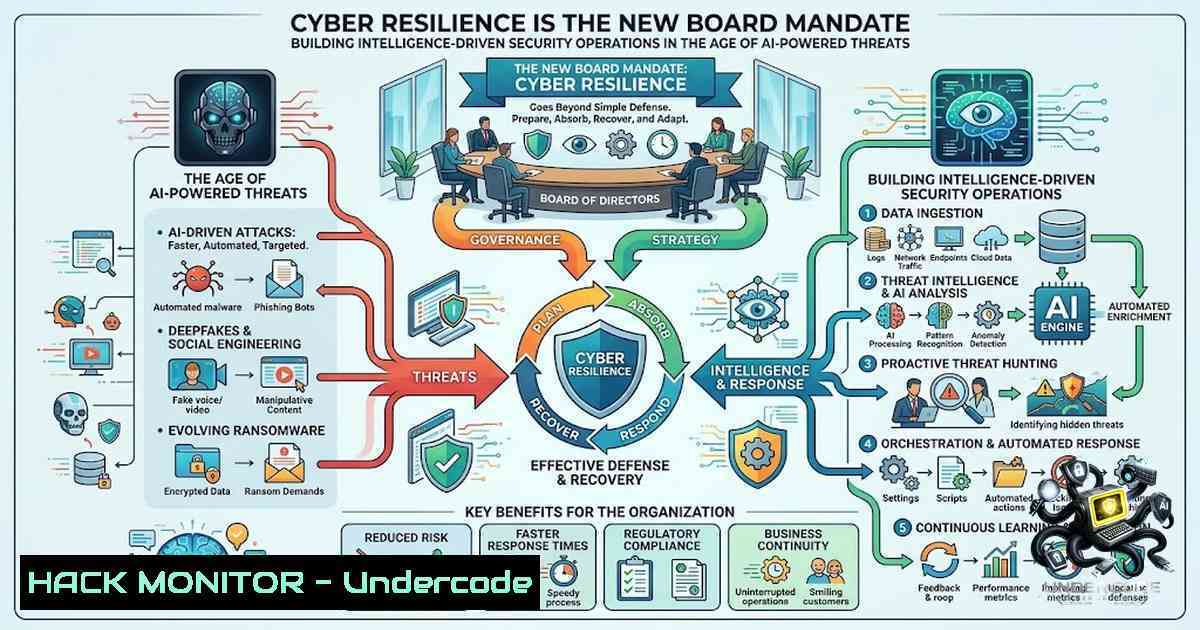
The cybersecurity landscape has undergone a fundamental structural shift. Adversaries are now leveraging artificial intelligence to compress attack timelines from weeks to hours, while traditional security controls remain built for human-speed threats. According to Accenture’s State of Cybersecurity Resilience research, 74% of CEOs worry about their organization’s ability to minimize cyberattacks, and nearly nine in 10 organizations identify AI-related vulnerabilities as the fastest-growing cyber risk. In response, cyber resilience has evolved from an IT concern to a boardroom imperative—one that demands intelligence-driven security operations capable of operating at machine speed and scale.
Learning Objectives
- Understand the architectural components and operational principles of AI-driven cybersecurity platforms, including agentic AI, security ontologies, and autonomous threat response
- Master practical implementation techniques for Zero Trust architecture, API security hardening, and cloud infrastructure protection across AWS, Azure, and GCP
- Develop hands-on skills in AI-powered threat detection, log analysis, incident response automation, and continuous security validation using open-source tools and native cloud services
You Should Know
1. Understanding Agentic AI Security Operations
The core of modern cyber resilience lies in agentic AI—autonomous systems that can pursue defined security goals by planning, making decisions, taking actions, and adapting to changing conditions. Accenture’s Cyber.AI, powered by Anthropic’s Claude model, exemplifies this paradigm shift. The platform combines a curated library of proprietary agents with Claude’s reasoning engine to synthesize security data and provide contextual insights across the entire security lifecycle.
Key Architectural Components:
- Security Ontology: A knowledge graph of thousands of typed objects—controls, gaps, threats, tools, vulnerabilities—connected with semantic relationships that compound across every engagement
- Agent Shield: Real-time governance, monitoring, and protection for autonomous AI agents, delivering identity controls, threat detection, and runtime protection
- 70+ Pre-built Connectors: Read-only integrations that unify telemetry and operational data from existing security and infrastructure tooling
Step-by-Step: Building an Agentic Security Workflow
- Deploy a Local Multi-Agent SOC Framework: Use open-source tools like Wazuh SIEM combined with local LLMs (Qwen/Llama) to create a zero-cost, multi-agent security operations center
 Install Wazuh SIEM (Ubuntu/Debian)
curl -s https://packages.wazuh.com/key/GPG-KEY-WAZUH | apt-key add -
echo "deb https://packages.wazuh.com/4.x/apt/ stable main" | tee /etc/apt/sources.list.d/wazuh.list
apt-get update && apt-get install wazuh-manager
systemctl start wazuh-manager

Configure auditd for comprehensive logging (Linux)
auditctl -e 1
auditctl -w /etc/passwd -p wa -k identity_changes
auditctl -w /etc/shadow -p wa -k identity_changes
auditctl -w /var/log/auth.log -p r -k authentication_logs
- Implement AI-Powered Log Analysis: Deploy ZeroEye or similar tools to analyze system logs with natural language explanations
 Clone and run AI-powered log analyzer
git clone https://github.com/OrnateLock/ZeroEye
cd ZeroEye
python3 zeroeye.py --log /var/log/syslog --output threat_report.json
- Orchestrate Automated Response: Configure autonomous agents to handle routine threat scenarios while security teams focus on strategic priorities
 Windows PowerShell: Automated threat detection and response
 Monitor for suspicious processes
Get-WinEvent -LogName "Security" | Where-Object { $<em>.Id -eq 4688 } |
Select-Object TimeCreated, @{N='Process';E={$</em>.Properties[bash].Value}} |
Where-Object { $_.Process -match "powershell|cmd|wscript" }

Enable PowerShell script block logging for AI-generated malware detection
Set-ItemProperty -Path "HKLM:\SOFTWARE\Policies\Microsoft\Windows\PowerShell\ScriptBlockLogging" -1ame "EnableScriptBlockLogging" -Value 1
- Implementing Zero Trust Architecture as a Foundational Defense
True cyber resilience in an AI-driven world requires embedding advanced security controls into the Digital Core. Zero Trust principles—network segmentation, continuous verification, and least-privilege access—form the foundation upon which AI-driven security operations must be built.
Step-by-Step: Zero Trust Implementation Lab
- Set Up a Zero Trust Network Lab Using Docker:
 Create dedicated Docker network for segmentation
docker network create --driver bridge --subnet 172.20.0.0/16 zero-trust-1et

Deploy SDP Controller and Gateway (Zero Trust principles)
git clone https://github.com/bunnyhp/zero-trust-1etwork-lab
cd zero-trust-1etwork-lab
docker-compose up -d
- Implement Identity-Aware Proxy (IAP) following NIST SP 800-207 and BeyondCorp principles:
 Configure mTLS-based Zero Trust proxy
git clone https://github.com/DevHatRo/zero-trust-proxy
cd zero-trust-proxy
go build -o bin/zero-trust-proxy ./cmd/zero-trust-proxy
./bin/zero-trust-proxy --config config.yaml
3. Enforce Micro-segmentation at the Kernel Level:
 Using eBPF-based ZTAP for cross-platform policy enforcement
 https://github.com/msaadshabir/ZTAP
ztap-cli policy create --1ame "production-segment" --allow "tcp/443" --deny "tcp/22"
ztap-cli enforce --policy production-segment --target "app-server-"
3. Securing the API Attack Surface
With Accenture internally securing over 500,000 APIs using Cyber.AI, API security has become a critical frontier. Organizations must enforce OWASP API Security Top 10 controls by default.
Step-by-Step: API Security Hardening
1. Scan APIs for OWASP Top 10 Vulnerabilities:
 Install and run API security scanner
npm install -g @houysengleang/apicheck
apicheck scan --target https://api.yourdomain.com --output report.html
2. Implement Rate Limiting and Input Validation:
 Nginx rate limiting for API protection
limit_req_zone $binary_remote_addr zone=api_limit:10m rate=10r/s;
location /api/ {
limit_req zone=api_limit burst=20 nodelay;
 Validate content-type and enforce JSON schema
if ($content_type !~ "application/json") { return 415; }
}
3. Deploy API Gateway with Authentication and Authorization:
 Kong Gateway configuration example
_format_version: "3.0"
services:
- name: secure-api
url: http://backend-api:8080
routes:
- name: api-route
paths:
- /api
plugins:
- name: jwt
config:
secret_is_base64: false
run_on_preflight: true
- name: rate-limiting
config:
minute: 100
hour: 1000
- Cloud Infrastructure Hardening Across AWS, Azure, and GCP
Organizations must ensure secure-by-design cloud for AI environments. Only 10% of organizations currently occupy the “Reinvention-Ready Zone,” demonstrating both robust security capabilities and integrated cyber strategy.
Step-by-Step: Multi-Cloud Security Hardening
1. Enable Core Security Services (AWS) :
 Enable AWS security services
aws guardduty create-detector --enable
aws securityhub enable-security-hub
aws cloudtrail create-trail --1ame security-trail --s3-bucket-1ame your-security-logs
aws cloudtrail start-logging --1ame security-trail
2. Azure Security Configuration:
 Azure: Enable Microsoft Defender for Cloud
az security auto-provisioning-setting update --1ame default --auto-provision "On"

Configure Azure Security Center recommendations
az security assessment-metadata list --query "[?status=='Unhealthy']"

Enable diagnostic settings for Key Vault
az monitor diagnostic-settings create --1ame "keyvault-audit" --resource /subscriptions/{sub}/resourceGroups/{rg}/providers/Microsoft.KeyVault/vaults/{vault} --logs '[{"category": "AuditEvent","enabled": true}]'
3. GCP Security Hardening:
 Enable GCP Security Command Center
gcloud services enable securitycenter.googleapis.com
gcloud scc settings create --organization=YOUR_ORG_ID

Configure VPC Service Controls for sensitive data
gcloud access-context-manager perimeters create YOUR_PERIMETER --title="Secure Perimeter" --resources=projects/YOUR_PROJECT
4. Automated Compliance Auditing Using Terraform:
 Terraform module for CIS benchmark compliance
module "aws_secure_baseline" {
source = "github.com/dmytrobazeliuk-devops/security-hardening-cloud"
enable_cloudtrail = true
enable_guardduty = true
enable_config = true
s3_bucket_encryption = "AES256"
}
5. AI Security Framework and Threat Modeling
NIST’s Cyber AI Profile (IR 8596) addresses AI and cybersecurity from three angles: securing AI systems against attack, using AI to enhance cybersecurity defenses, and defending against AI-enabled threats. Organizations must integrate AI threat modeling into risk assessments and refine detection models.
Step-by-Step: Implementing NIST AI Security Guidelines
1. Govern and Identify AI Risks:
 Inventory all AI/ML models and data pipelines
 Document model versions, data sources, and access controls
 Example: Using cli to list ML models in AWS SageMaker
aws sagemaker list-models --query "Models[].ModelName"
2. Protect AI Systems:
 Implement model poisoning protection
 Monitor training data integrity with checksums
find /data/training -type f -exec sha256sum {} \; > model_data_checksums.txt
 Regular integrity verification
sha256sum -c model_data_checksums.txt
3. Detect and Respond to AI-Specific Threats:
 Python: AI-powered anomaly detection for logs
import pandas as pd
from sklearn.ensemble import IsolationForest

Load authentication logs
logs = pd.read_csv('auth_logs.csv')
model = IsolationForest(contamination=0.01)
anomalies = model.fit_predict(logs[['login_attempts', 'failed_logins', 'time_of_day']])
 Flag anomalous behavior for investigation
6. Proactive Threat Hunting and Continuous Validation
Security teams must integrate AI threat modeling into risk assessments and build resilience against API abuse, model poisoning, and integrity compromises. AI-powered solutions improve alert triage, prioritize incidents, detect anomalies, classify vulnerabilities, automate patching, and optimize security configurations.
Step-by-Step: AI-Powered Threat Hunting
- Deploy AI Cyber Defense Copilot for real-time network monitoring:
git clone https://github.com/Zeeshanmuqaddas/AI-Cyber-Defense-Copilot
cd AI-Cyber-Defense-Copilot
python3 -m venv venv && source venv/bin/activate
pip install -r requirements.txt
python3 app.py --monitor eth0 --output reports/
2. Implement Continuous Vulnerability Scanning:
 Using CyberSecurityAIAgent for multi-agent vulnerability scanning
git clone https://github.com/PassionToCode/CyberSecurityAIAgent
cd CyberSecurityAIAgent
python3 main.py --scan-target 192.168.1.0/24 --output incident_response_plan.json
3. Hunt for AI-Generated Malware:
 Windows: Detect AI-generated PowerShell scripts (Event ID 4104)
Get-WinEvent -LogName "Microsoft-Windows-PowerShell/Operational" |
Where-Object { $<em>.Id -eq 4104 } |
Select-Object TimeCreated, @{N='Script';E={$</em>.Properties[bash].Value}} |
Where-Object { $_.Script -match "Invoke-|New-Object Net.WebClient|DownloadString" }
What Undercode Say
Key Takeaway 1: Cyber resilience has transcended IT operations to become a strategic boardroom mandate. With adversaries compressing attack timelines from weeks to hours using AI, organizations can no longer afford human-speed response cycles. The solution lies in agentic AI platforms that operate at machine speed while maintaining enterprise-grade governance and control.
Key Takeaway 2: The data speaks volumes: only 10% of organizations are truly “Reinvention-Ready” with both robust security capabilities and integrated cyber strategy. Accenture’s internal deployment of Cyber.AI demonstrates the art of the possible—scan turnaround times reduced from 3-5 days to under one hour, testing coverage increased from 10% to over 80%, and 1,600 applications plus 500,000+ APIs secured. The path forward requires embedding security by design into every AI initiative, implementing Zero Trust architecture, and continuously validating security postures through AI-driven threat hunting. Organizations that fail to adapt risk being left behind in an era where AI-powered threats evolve faster than traditional defenses can respond.
Prediction
+1 The integration of agentic AI into security operations will become standard practice within 24-36 months, with autonomous agents handling 60-70% of routine threat detection, triage, and response tasks. This will dramatically reduce Mean Time to Detect (MTTD) and Mean Time to Respond (MTTR), enabling security teams to focus on strategic threat hunting and complex incident investigation.
+1 Regulatory frameworks will increasingly mandate AI security controls, with NIST’s Cyber AI Profile and similar standards becoming compliance requirements for enterprises handling sensitive data. Organizations that proactively adopt these frameworks will gain competitive advantage through enhanced customer trust and reduced regulatory risk.
+1 The convergence of AI-powered defense and Zero Trust architecture will create a new security paradigm where continuous verification, automated remediation, and intelligence-driven operations become inseparable components of a unified resilience strategy. This will fundamentally reshape how security teams are structured and how cybersecurity investments are prioritized.
-1 The democratization of AI-powered attack tools will lower the barrier to entry for cybercriminals, leading to a surge in AI-generated malware, deepfake-based social engineering, and autonomous attack campaigns. Organizations that delay AI security adoption will face increasingly sophisticated and difficult-to-detect threats, potentially resulting in catastrophic breaches and significant business disruption.
▶️ Related Video (74% Match):
🎯Let’s Practice For Free:
🎓 Live Courses & Certifications:
Join Undercode Academy for Verified Certifications
🚀 Request a Custom Project:
Secure, high-velocity infrastructure and disruptive technological engineering. Contact our engineering team for high-tier development and proprietary systems:
[email protected]
💎 Smart Architecture | 🛡️ Secure by Design | ⭐ Trusted by Thousands
IT/Security Reporter URL:
Reported By: Staceyfons The – Hackers Feeds
Extra Hub: Undercode MoN
Basic Verification: Pass ✅


