
Listen to this Post
Introduction:
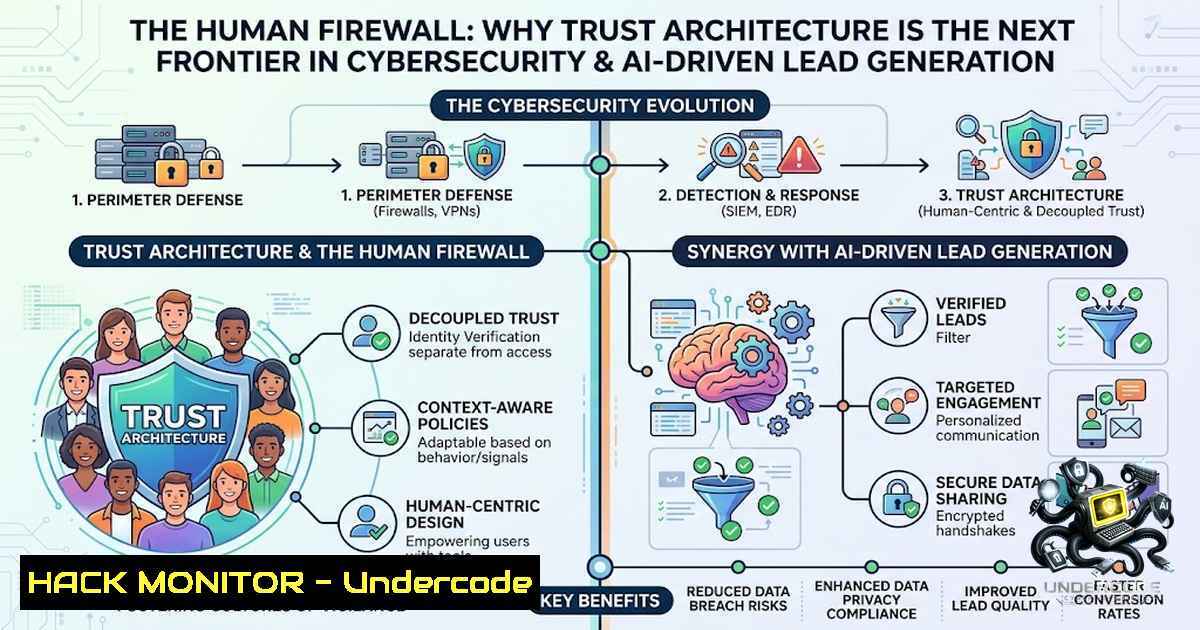
In an era where cybersecurity defenses are increasingly automated and AI-generated phishing lures are becoming indistinguishable from legitimate communication, the core vulnerability—and the ultimate defense—remains human psychology. While the industry fixates on advanced persistent threats and zero-day exploits, a parallel battle is being fought in the enterprise boardroom over access and trust. The future of security operations and business development converges on a single truth: technology provides the data, but human intuition and verified relationships authorize the action. This article deconstructs the technical and social engineering frameworks necessary to build a resilient “trust architecture” that protects against the very AI tools being used to breach it.
Learning Objectives & Secrets:
- Objective 1: Understanding the AI-Driven Threat Vector in Business Communication. Learn to identify and analyze the technical signatures of AI-generated social engineering campaigns, moving beyond generic spam filters to behavioral analysis.
- Objective 2: Implementing “Zero-Trust” for Lead Validation. A secret tip for security analysts is to apply Zero-Trust principles to external communications, treating every unsolicited AI-generated pitch or link as a potential payload until verified through out-of-band authentication.
- Objective 3: Hardening the Human API. The secret to modern defense is not just patching servers but patching processes. This involves establishing strict, secure referral verification protocols (similar to code-signing) to ensure that even trusted connections are not compromised.
You Should Know:
- Securing the Referral Chain: Verifying Human Trust with Cryptographic Assurance
The post correctly identifies the “referral” as a high-value, high-trust vector. In cybersecurity, this mirrors the “supply chain attack” vector. If a trusted contact is compromised, their referral becomes a weapon. To mitigate this, security teams must implement processes that mirror code-signing for human interactions.
– Step 1: Establish a Referral Verification Protocol. Implement a system where internal stakeholders must verify external referrals via a secondary, secure channel (e.g., an internal ticketing system or encrypted chat) rather than a single email.
– Step 2: Deploy Email Authentication Standards. Ensure your organization uses DMARC, DKIM, and SPF strictly. While these don’t stop AI-generated text, they ensure the “envelope” of the email hasn’t been spoofed, reducing the risk of domain impersonation.
– Step 3: Implement AI-Detection Tools. Use tools that analyze email headers and sentiment for markers of AI generation. Tools like `headers` analysis in Linux can be crucial.
Linux Command (Email Header Analysis):
 Analyze email headers for routing and origin
cat email_header.txt | grep -E "Received:|From:|Return-Path:|Authentication-Results:"
– Step 4: Conduct Regular “Phishing Simulations” Focused on Trusted Relationships. Simulate a compromised vendor or partner sending a malicious link. This tests the “human firewall” in the context of trust, which the post emphasizes as a key vulnerability.
- Automating the “Friction” of Trust: API Security and Access Control
The post mentions that cold outreach is becoming “louder and less effective.” In a security context, this “noise” is a DDoS attack on human attention. The technical countermeasure is to automate the validation of context.
– Step 1: Context-Aware API Gateways. Implement API gateways that not only validate tokens but also assess the context of the request. For example, a request from a new IP address for sensitive data should trigger a “human verification” step, akin to a referral check.
– Step 2: Behavioral Analytics with UEBA. Deploy User and Entity Behavior Analytics (UEBA) to establish baselines for “trusted” interactions. An AI-generated message will often have a different typing cadence or interaction pattern than a human user.
– Step 3: Code Snippet for API Rate Limiting (Python/Flask):
from flask import Flask, request, jsonify
from flask_limiter import Limiter
from flask_limiter.util import get_remote_address

app = Flask(<strong>name</strong>)
limiter = Limiter(get_remote_address, app=app, default_limits=["200 per day", "50 per hour"])

@app.route('/sensitive-data')
@limiter.limit("5 per minute")  Friction for untrusted/increased noise
def sensitive_data():
return jsonify({"data": "secure_info"})
- The “Human Moment” as a Security Control: Auditing the Pitch
The post highlights “the human moment where someone decides to trust you.” This is the ultimate authorization gate. This gate must be audited and hardened.
– Step 1: Implement a “Trust Score” Matrix. Develop an internal scoring system for external contacts based on verification level, interaction history, and referral source—similar to a risk score.
– Step 2: Use OSINT for Pre-Engagement Verification. Before a BDM engages with a lead, they should run a quick OSINT check using tools like `theHarvester` to ensure the lead’s digital footprint matches their claimed identity. This prevents impersonation.
– Step 3: Linux Command for OSINT (Domain/Email Reconnaissance):
 Use theHarvester to find email addresses/domains associated with a lead's company
theHarvester -d targetcompany.com -l 500 -b google
- Windows & Active Directory: Managing the Trust of Internal Accounts
The risk of a compromised internal account that can generate “trusted” outreach is high. This section focuses on hardening the accounts that BDM’s use to build relationships.
– Step 1: Enforce MFA for All Sales and BDM Accounts. This is non-1egotiable. All accounts must require phishing-resistant MFA (e.g., FIDO2 keys) to prevent credential theft.
– Step 2: Implement Just-in-Time (JIT) Access. BDMs should not have permanent access to sensitive internal CRM databases if they only need it for a specific verification. Use JIT access controls.
– Step 3: Windows PowerShell Command (Check for Unusual Logins):
 Get user logon events for BDM accounts to detect anomalies (run as admin)
Get-WinEvent -FilterHashtable @{LogName='Security'; ID=4624} | Where-Object {$_.Message -match "S-1-5-21-"} | Select-Object TimeCreated, Message
- Cloud Hardening: Securing the CRM and Lead Data
The “relationships” and “trust” built by BDMs are often stored in a cloud CRM (e.g., Salesforce, HubSpot). This data is a goldmine for attackers.
– Step 1: Implement Data Loss Prevention (DLP). Configure DLP policies in your cloud environment (e.g., AWS Macie) to detect and alert on the exfiltration of lead data via AI-generated or automated requests.
– Step 2: Enable Cloud Trail and Audit Logging. Monitor for API calls that are downloading large batches of lead data in a short period, which is a sign of an automated (AI) scraping bot.
– Step 3: AWS CLI Command for Audit:
 Check for anomalies in S3 bucket access patterns
aws s3api get-bucket-logging --bucket your-crm-bucket
What Undercode Say:
- Key Takeaway 1: The most effective cybersecurity control in the age of AI is the “verified referral protocol.” We must treat trust as a tangible asset that needs cryptographic validation and out-of-band verification to prevent exploitation.
- Key Takeaway 2: The “noise” of AI-generated cold outreach is a security vector. By implementing behavioral analytics and API rate limiting, we can reduce the surface area for these attacks and focus human security resources on high-fidelity, verified leads.
Analysis:
The post from Nadia Iftikhar accurately identifies a fundamental shift in B2B strategy that has direct, critical implications for cybersecurity. The “people first” approach is not just a sales tactic; it’s a defense-in-depth strategy against AI-driven social engineering. As AI becomes more sophisticated, the traditional “castle and moat” approach is failing. The new perimeter is the human relationship, which is currently a soft target. The technical implementation of Zero-Trust architecture must now extend to external human interactions. This includes mandating automated OSINT checks on new leads to verify identities and applying “least privilege” to trust—meaning you only trust a lead with the information they absolutely need, just as you would a user. The businesses that will succeed in 2026 will be those that integrate their security posture with their BDM’s relationship strategy, turning the “human moment” into a secure, auditable, and verifiable event. The convergence of sales psychology and cybersecurity is no longer optional; it is the industry’s new battleground.
Prediction:
- -1: Negative Impact on Inefficient Sales Cycles. Organizations that fail to automate the verification of “human trust” will see a significant increase in successful Business Email Compromise (BEC) attacks, with average wire fraud losses exceeding $250,000 per incident by Q4 2026.
- +1: Positive Shift in Security Investments. The demand for “Sales Security Integrations”—platforms that combine CRM data with Security Information and Event Management (SIEM) tools to verify the integrity of new leads—will skyrocket, creating a $5 billion niche market by 2027.
- +1: Rise of the “Trust Analyst.” A new hybrid role combining B2B sales strategy and threat intelligence will emerge. These analysts will be responsible for auditing “human referral chains” for signs of compromise, much like a supply chain auditor.
- -1: Increased Attack Surface on Referral Platforms. AI will be used to harvest and mimic the communication styles of trusted referrers, leading to a wave of “vishing” (voice phishing) attacks that use AI-generated voice clones to verify the “human moment,” bypassing traditional authentication.
- -1: False Sense of Security in AI Filters. While AI will be used to filter out “noise,” attackers will deploy generative adversarial networks (GANs) to create AI-generated messages that are deliberately designed to mimic human typing errors and chaotic structures, rendering simple AI-detection tools obsolete and forcing a move to behavioral baselining.
▶️ Related Video (76% Match):
🎯Let’s Practice For Free:
🎓 Live Courses & Certifications:
Join Undercode Academy for Verified Certifications
🚀 Request a Custom Project:
Secure, high-velocity infrastructure and disruptive technological engineering. Contact our engineering team for high-tier development and proprietary systems:
[email protected]
💎 Smart Architecture | 🛡️ Secure by Design | ⭐ Trusted by Thousands
IT/Security Reporter URL:
Reported By: https://lnkd.in/p/enMjYXnD – Hackers Feeds
Extra Hub: Undercode MoN
Basic Verification: Pass ✅


