Listen to this Post
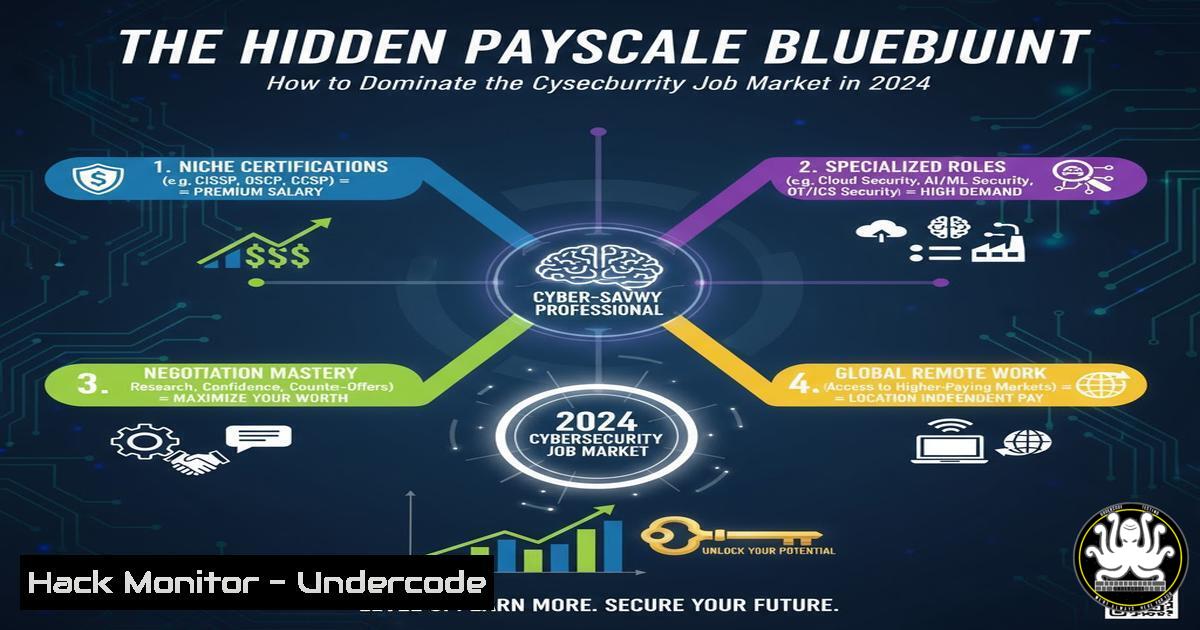
Introduction:
The cybersecurity landscape is experiencing an unprecedented talent shortage, creating a lucrative opportunity for skilled professionals. Understanding the specific roles, required technical competencies, and corresponding salary brackets is the first critical step in strategically positioning yourself for a high-impact, high-paying career. This article deconstructs the essential skills you need to master to advance from an analyst to an architect role and command the top of the pay scale.
Learning Objectives:
- Identify the key technical skills required for major cybersecurity roles such as SOC Analyst, Penetration Tester, and Cloud Security Architect.
- Master over 25 essential commands and procedures for threat detection, vulnerability assessment, and system hardening.
- Develop a strategic learning path to bridge skill gaps and target specific, high-salary cybersecurity positions.
You Should Know:
- SOC Analyst Fundamentals: Network Monitoring and Log Analysis
A Security Operations Center (SOC) Analyst is the first line of defense, requiring proficiency in log analysis and network monitoring using tools like SIEMs and command-line utilities.
`tail -f /var/log/auth.log` (Linux): Monitor SSH authentication attempts in real-time to spot brute-force attacks.
`grep “Failed password” /var/log/auth.log | awk ‘{print $11}’ | sort | uniq -c | sort -nr` (Linux): Parse authentication logs to count failed login attempts per IP address, identifying potential threat sources.
`netstat -tuln` (Linux/Windows): Display all listening ports and associated services to identify unauthorized applications.
`Get-NetTCPConnection -State Listen` (Windows PowerShell): The PowerShell equivalent to list all listening TCP ports.
`tcpdump -i eth0 -n port 53` (Linux): Capture and inspect DNS traffic on interface eth0 for signs of DNS exfiltration or communication with malicious domains.
`Wireshark` (Tool): Use the display filter `http.request.method == “POST”` to isolate and inspect form submissions which may contain exfiltrated data.
Step-by-step guide: To investigate a potential compromise, a SOC analyst would first use `netstat` or `Get-NetTCPConnection` to identify unusual outbound connections. They would then cross-reference the remote IP with threat intelligence feeds. Next, they would use `grep` on relevant log files to trace the origin of the activity within the network, such as finding the user account and source IP that initiated the malicious connection.
2. Penetration Tester’s Arsenal: Vulnerability Scanning and Exploitation
Penetration testers proactively identify and exploit security weaknesses. This requires a deep understanding of scanning tools and exploitation frameworks.
`nmap -sV -sC -O
`nmap –script vuln
`sqlmap -u “http://test.com/page.php?id=1” –batch` (Tool): Automate the process of detecting and exploiting SQL injection flaws.
`msfconsole` (Tool): Launch the Metasploit framework. Followed by `use exploit/windows/smb/ms17_010_eternalblue` to select a specific exploit module.
`searchsploit apache 2.4.49` (Linux): Quickly search the Exploit-Database for public exploits related to a specific software and version.
`nikto -h http://target.com` (Tool): Perform a comprehensive web server vulnerability scan.
Step-by-step guide: A basic penetration test begins with reconnaissance using `nmap -sV` to map the target’s attack surface. If a web server is found, `nikto` is run to find common web vulnerabilities. For a specific service version known to be vulnerable, `searchsploit` is used to find a potential exploit. This exploit is then carefully tested in a controlled environment using a framework like Metasploit to validate the vulnerability.
3. Incident Responder’s Playbook: Memory and Disk Forensics
When a breach occurs, incident responders need to capture volatile data and analyze disk images to determine the scope and root cause.
`volatility -f memory.dump imageinfo` (Tool): Analyze a memory dump to identify the correct operating system profile.
`volatility -f memory.dump –profile=Win10x64_18362 pslist` (Tool): List the running processes from a Windows memory dump at the time of acquisition.
`ftkimager /dev/sdb1 evidence_image.aff` (Linux/Tool): Create a forensically sound disk image of a source drive, ensuring data integrity with hashes.
`strings evidence_image.aff | grep -i “password”` (Linux): Extract human-readable strings from an image and search for keywords like passwords.
`autopsy` (Tool): Use the graphical interface to conduct a deep-dive timeline analysis of disk images.
`log2timeline.py plaso.dump evidence_image.aff` (Tool): Super-timeline creation tool for correlating events from various system artifacts.
Step-by-step guide: Upon securing a compromised system, the first step is to capture its memory using a tool like DumpIt or WinPmem. This memory dump is analyzed with Volatility: `pslist` reveals malicious processes, `netscan` shows network connections, and `cmdscan` may reveal the attacker’s commands. Simultaneously, a disk image is acquired with `ftkimager` for a more thorough, offline investigation.
- Cloud Security Architect: Hardening AWS S3 and IAM
Cloud security architects design secure environments, with a major focus on properly configuring identity and access management (IAM) and storage services like S3.
`aws s3api get-bucket-acl –bucket my-bucket –profile prod` (AWS CLI): Check the access control list of an S3 bucket to identify over-permissive grants.
`aws s3api get-bucket-policy –bucket my-bucket –profile prod` (AWS CLI): Retrieve the resource policy attached to an S3 bucket.
`aws iam generate-credential-report` (AWS CLI): Generate a detailed report on all IAM users and their credential status (e.g., MFA, password age).
`aws iam list-attached-user-policies –user-name Alice` (AWS CLI): List the managed policies attached to a specific IAM user.
`terraform plan` (Tool): Preview the security-impacting changes that will be made to your cloud infrastructure before applying them.
`checkov -d /path/to/terraform/code` (Tool): Static analysis tool for Terraform code to detect misconfigurations before deployment.
Step-by-step guide: To audit an AWS environment for S3 exposure, run `aws s3 ls` to list all buckets, then for each bucket, use `get-bucket-acl` and `get-bucket-policy` to review permissions. Look for principals set to `””` (everyone) or `”AWS”: “”` (all authenticated AWS users). Use `checkov` on your Terraform code to automatically flag any new S3 buckets that are defined with public-read or public-write access.
- API Security: Testing for Broken Object Level Authorization (BOLA)
APIs are a primary attack vector. BOLA, where users can access resources they shouldn’t, is a top vulnerability.
`curl -H “Authorization: Bearer
`curl -H “Authorization: Bearer
`curl -X PUT -H “Content-Type: application/json” -d ‘{“email”:”[email protected]”}’ -H “Authorization: Bearer
`Burp Suite Repeater` (Tool): Manually manipulate and re-send API requests to systematically test for IDOR and BOLA flaws.
`nikto -h http://api.target.com -C all` (Tool): Scan API endpoints for common vulnerabilities, including misconfigurations.
Step-by-step guide: To test for BOLA, first authenticate to the application as a low-privilege user (User A) and intercept a API request that includes an object ID (e.g., /users/123/orders). Using Burp Suite’s Repeater, change the object ID in the request to one belonging to another user (e.g., 456). Resend the request with the same authentication token. If the request is successful and returns User B’s data, a critical BOLA vulnerability is confirmed.
6. The Defender’s Edge: Implementing System Hardening Measures
Proactive hardening reduces the attack surface, making systems more resilient to compromise.
`sudo fail2ban-client status sshd` (Linux): Check the status of the Fail2ban jail for SSH, showing how many IPs are currently banned for brute-forcing.
`sudo ufw enable` (Linux): Enable the Uncomplicated Firewall (UFW) to enforce default-deny firewall policies.
`Get-Service -Name Spooler | Stop-Service -PassThru | Set-Service -StartupType Disabled` (Windows PowerShell): Stop and disable the vulnerable Print Spooler service on a Windows server.
`sudo auditctl -w /etc/passwd -p wa -k identity_alert` (Linux): Configure auditing to watch the `/etc/passwd` file for write or attribute changes.
`sudo ls -la /etc/shadow` (Linux): Verify that the shadow password file has permissions of `640` and is owned by root.
`selinuxenabled && echo “Enabled” || echo “Disabled”` (Linux): Check if SELinux is in enforcing mode, a critical access control mechanism.
Step-by-step guide: A basic Linux server hardening procedure involves: 1) Enabling the firewall with `ufw enable` and allowing only necessary ports (SSH). 2) Installing and configuring `fail2ban` to protect SSH. 3) Disabling unused services with systemctl disable <service_name>. 4) Setting strict permissions on critical files like /etc/shadow. 5) Ensuring SELinux is set to enforcing mode. 6) Configuring system auditing with `auditd` for critical files and directories.
What Undercode Say:
- Specialization is the New Currency. Generalist “cybersecurity” roles are plateauing. The highest pay increases are tied to deep, demonstrable expertise in niche areas like cloud security (AWS/Azure), application security (AppSec), and threat intelligence. The commands and procedures outlined here are the literal tools of these trades.
- The Hands-On Skills Gap is Your Advantage. The market is flooded with theory-heavy certifications. Professionals who can prove their skills by explaining the use of `volatility` for memory forensics, using Terraform and `checkov` for secure cloud builds, or manually exploiting a BOLA vulnerability with `curl` are the ones commanding premium salaries. The blueprint from the LinkedIn post is meaningless without the practical technical detail to back it up.
Our analysis suggests that the industry’s reliance on automated tools has created a blind spot for foundational, command-line-level understanding. The professionals who are thriving are those who can work both with high-level strategic frameworks and the low-level technical grit. The provided commands are not just tasks; they are indicators of a mature, practical security mindset that is directly tied to career advancement and compensation.
Prediction:
The convergence of AI-powered code generation and the expanding cloud attack surface will create a new class of vulnerabilities: AI-introduced misconfigurations and “shadow code.” Penetration testing will increasingly focus on probing AI models and their training data for poisoning and extraction attacks. Consequently, cybersecurity roles specializing in AI Security (AISec) and Cloud-Native Application Protection Platforms (CNAPP) will see the most dramatic pay scale increases, potentially adding a 20-30% premium over standard cloud security salaries within the next two years. The ability to write scripts to audit AI systems and harden complex cloud infrastructures will become a non-negotiable skill for top-tier security architects.
🎯Let’s Practice For Free:
IT/Security Reporter URL:
Reported By: Kaaviya Balaji – Hackers Feeds
Extra Hub: Undercode MoN
Basic Verification: Pass ✅


