Listen to this Post
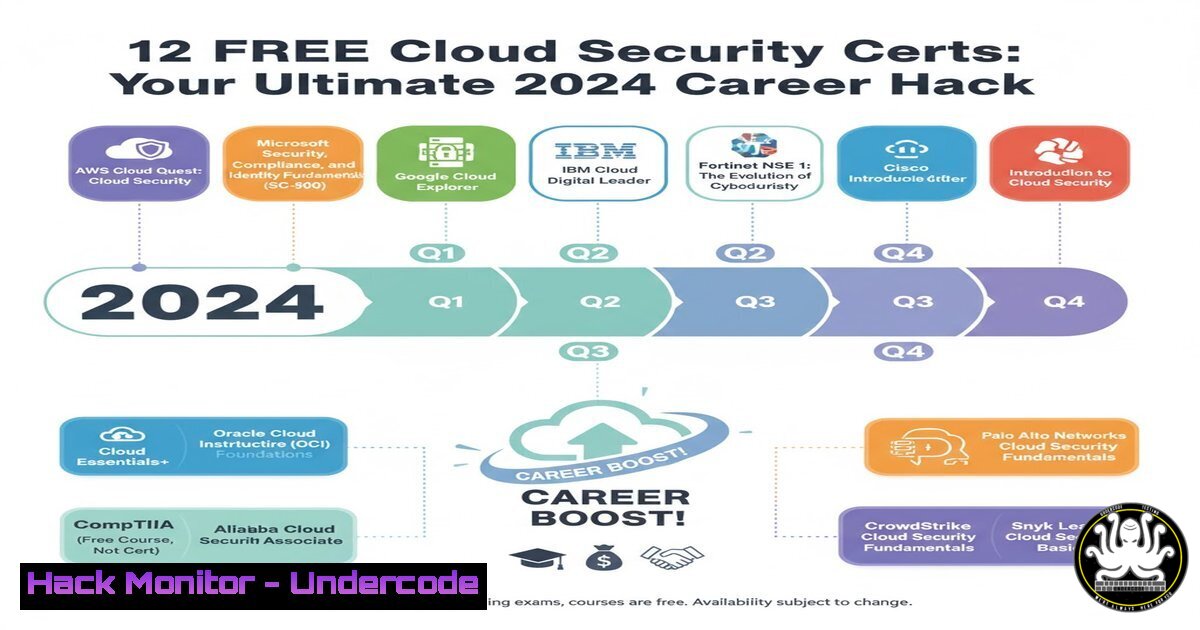
Introduction:
The cloud security skills gap represents a critical vulnerability for organizations worldwide, yet simultaneously offers unparalleled career opportunities for IT professionals. As businesses accelerate their digital transformation, the demand for skilled cloud security practitioners has skyrocketed, making certified expertise one of the most valuable commodities in the technology job market. This comprehensive guide details twelve free certification programs that provide the foundational knowledge and practical skills needed to secure cloud infrastructure across major platforms like AWS, Oracle, and Qualys.
Learning Objectives:
- Identify and access twelve free, industry-recognized cloud security certifications
- Develop practical skills for securing cloud environments across multiple service models
- Understand core cloud security concepts including IAM, container security, and cloud governance
You Should Know:
1. AWS Security Fundamentals Mastery
Verified Command/Tutorial:
 AWS CLI command to list all S3 buckets and their encryption status
aws s3api list-buckets --query 'Buckets[].Name' --output text | xargs -I {} aws s3api get-bucket-encryption --bucket {} || echo "No encryption configured"
Step-by-step guide:
This AWS CLI command sequence first retrieves all S3 bucket names in your account, then checks each bucket’s encryption configuration. The command after the pipe (|) processes each bucket name through xargs and attempts to retrieve encryption settings. If no encryption is configured, it returns an error message that we convert to a readable alert. This is crucial for security assessments as unencrypted S3 buckets represent a critical data exposure risk. Run this command with appropriate IAM permissions to quickly audit your AWS storage security posture.
2. Cloud IAM Policy Security Validation
Verified Command/Tutorial:
 AWS IAM policy simulator command
aws iam simulate-custom-policy \
--policy-input-list file://policy.json \
--action-names "s3:GetObject" "s3:PutObject" \
--resource-arns "arn:aws:s3:::example-bucket/"
Step-by-step guide:
The IAM Policy Simulator allows you to test and validate IAM policies without implementing them in production. This command tests a custom policy (defined in policy.json) against specific S3 actions on a target bucket. The output shows whether the policy would allow or deny each action, helping identify over-permissive policies before deployment. This is essential for implementing the principle of least privilege in cloud environments and preventing unauthorized access to sensitive resources.
3. Container Security Scanning Implementation
Verified Command/Tutorial:
 Trivy container vulnerability scanner
trivy image --severity HIGH,CRITICAL your-container-registry/app:latest
Step-by-step guide:
Trivy is a comprehensive open-source security scanner that detects vulnerabilities in container images. This command scans a specific container image for high and critical severity vulnerabilities only, filtering out less urgent findings. The output includes CVE IDs, severity ratings, and affected packages with available fixes. Integrate this into your CI/CD pipeline to automatically reject builds with critical vulnerabilities, significantly reducing your containerized application attack surface.
4. Cloud Security Posture Management (CSPM)
Verified Command/Tutorial:
 Prowler AWS security assessment
prowler aws --checks check31,check32,check33 --quick
Step-by-step guide:
Prowler is an open-source security tool for AWS environment assessment based on CIS benchmarks. This command runs specific checks related to cloudtrail logging (check31), S3 bucket public access (check32), and security group configurations (check33). The –quick flag speeds up execution by limiting verbose output. Regular CSPM assessments help maintain continuous compliance and identify misconfigurations that could lead to security incidents or data breaches.
5. Azure Security Center Automation
Verified Command/Tutorial:
 PowerShell command to enable Azure Security Center standard tier
Set-AzSecurityPricing -Name "VirtualMachines" -PricingTier "Standard"
Step-by-step guide:
This PowerShell command enables the standard pricing tier for Azure Security Center on virtual machines, providing advanced threat protection capabilities. The standard tier includes just-in-time VM access, adaptive application controls, and network security mapping. Execute this command through Azure Cloud Shell or your local PowerShell environment with appropriate Azure permissions. Combined with the CISA cloud security training, this provides both the knowledge and practical implementation skills for enterprise Azure security management.
6. Cloud Governance Policy Enforcement
Verified Command/Tutorial:
 Azure Policy assignment for allowed locations
az policy assignment create \
--name 'allowed-locations' \
--display-name 'Allowed locations' \
--policy '/providers/Microsoft.Authorization/policyDefinitions/e56962a6-4747-49cd-b67b-bf8b01975c4c' \
--params '{"listOfAllowedLocations":{"value":["eastus","westus"]}}'
Step-by-step guide:
This Azure CLI command creates a policy assignment that restricts resource deployments to specific geographic regions (eastus and westus in this example). Resource location control is a fundamental cloud governance requirement that helps with data sovereignty compliance and can reduce latency. After implementing this policy, any deployment attempts to unauthorized regions will be automatically blocked, enforcing your organizational cloud governance framework.
7. Kubernetes Security Context Hardening
Verified Command/Tutorial:
 Kubernetes pod security context example
apiVersion: v1
kind: Pod
metadata:
name: security-context-demo
spec:
securityContext:
runAsUser: 1000
runAsGroup: 3000
fsGroup: 2000
containers:
- name: sec-ctx-demo
image: busybox
command: [ "sh", "-c", "sleep 1h" ]
securityContext:
allowPrivilegeEscalation: false
capabilities:
drop:
- ALL
Step-by-step guide:
This Kubernetes manifest demonstrates multiple security context controls for container hardening. The pod-level security context runs the container as non-root user (UID 1000) and group (GID 3000), while the container-level security context prevents privilege escalation and drops all Linux capabilities. Apply this manifest with kubectl apply -f pod.yaml to implement these security controls. These settings significantly reduce the impact of container compromise by limiting what an attacker can do even if they breach the application.
What Undercode Say:
- The democratization of cloud security education through free certifications is fundamentally changing entry requirements for cybersecurity careers
- Practical command-line skills combined with theoretical knowledge create the most effective cloud security professionals
The availability of these free certification programs represents a strategic shift in cybersecurity education accessibility. Traditionally, expensive training and certification programs created barriers to entry, but this new model enables motivated professionals to build expertise regardless of financial constraints. However, certificates alone are insufficient—the true value emerges when professionals combine this theoretical knowledge with hands-on technical skills, particularly through command-line proficiency across multiple cloud platforms. Organizations should recognize that candidates with both certified knowledge and practical implementation abilities typically provide greater security value than those with either component alone.
Prediction:
The widespread availability of free cloud security certifications will accelerate the professionalization of cloud security roles while simultaneously raising the baseline expectation for security knowledge across all IT positions. Within two years, we predict that cloud security fundamentals will become a mandatory competency for system administrators, developers, and network engineers, not just dedicated security personnel. This knowledge democratization will force attackers to develop more sophisticated techniques, creating an ongoing arms race that drives further innovation in both defensive technologies and offensive capabilities. The organizations that successfully integrate these free learning resources into their talent development strategies will gain significant competitive advantages through improved security postures and reduced incident response times.
🎯Let’s Practice For Free:
IT/Security Reporter URL:
Reported By: Ouardi Mohamed – Hackers Feeds
Extra Hub: Undercode MoN
Basic Verification: Pass ✅


