
Listen to this Post
Introduction:
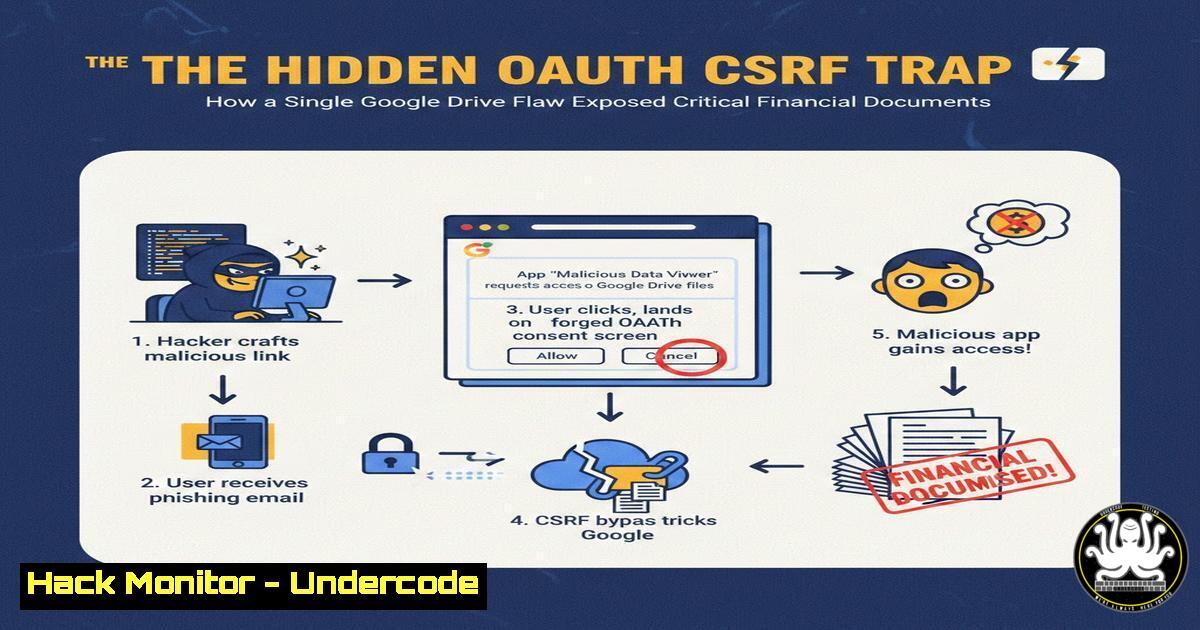
Cross-Site Request Forgery (CSRF) vulnerabilities in OAuth callback implementations represent one of the most insidious threats in modern web application security. This article dissects a real-world CSRF vulnerability discovered in Google Drive integration that allowed attackers to hijack user accounts and access sensitive financial documents, demonstrating how seemingly minor implementation oversights can lead to catastrophic data breaches.
Learning Objectives:
- Understand OAuth 2.0 callback CSRF vulnerabilities and their impact
- Implement proper CSRF protection mechanisms in OAuth flows
- Develop testing methodologies for identifying authorization flaws
You Should Know:
1. OAuth 2.0 CSRF Vulnerability Mechanics
The OAuth 2.0 authorization framework, while powerful, contains inherent CSRF risks during the callback phase. When a user initiates an OAuth flow, they’re redirected to the authorization server (Google in this case), which redirects back to the application with an authorization code. If the application doesn’t validate that the returning request corresponds to the initial authorization request, attackers can trick users into linking their accounts to attacker-controlled resources.
Step-by-step guide:
- Initiate OAuth flow to Google Drive API
- Intercept the callback request to `https://app.example.com/oauth/callback?code=AUTH_CODE&state=SERVER_STATE`
– Analyze state parameter implementation (or lack thereof)
– Craft malicious page that triggers automatic OAuth linking<!-- CSRF PoC for OAuth account linking --> <html> <body> <script> window.onload = function() { // Trigger OAuth callback with attacker's pre-obtained code window.location.href = 'https://vulnerable-app.com/oauth/callback?code=ATTACKER_AUTH_CODE'; }; </script> </body> </html>2. Exploiting Drive Integration for Data Access
Once an attacker successfully associates a victim’s account with their Google Drive, all documents “shared” with that Drive become accessible to the victim’s account context. Since the application trusts the linked Drive, it typically provides seamless access to these documents without additional authentication checks.
Step-by-step guide:
– Set up attacker-controlled Google Drive account
– Upload sensitive-looking PDF documents with financial data
– Generate OAuth authorization code for vulnerable application
– Deploy CSRF attack to link victim accounts
– Access victim’s document view history through application logsMonitor for successful exploitations tail -f /var/log/nginx/access.log | grep "document.pdf" grep "financial_report" /var/log/app/documents.log
3. Identifying CSRF Vulnerabilities in OAuth Implementations
Testing OAuth flows requires meticulous parameter analysis and state validation checks. The absence of proper state parameter implementation is the primary indicator of vulnerability.
Step-by-step guide:
– Intercept OAuth initiation request: `GET /oauth/authorize?client_id=CLIENT_ID&redirect_uri=CALLBACK_URL&response_type=code&scope=drive.readonly`
- Note if state parameter is present and validated
- Modify state parameter in callback request or remove it entirely
- Test with different user sessions to confirm CSRF vulnerability
 Python script to test state parameter validation
import requests

def test_oauth_csrf(target_url, auth_code):
 Test without state parameter
response = requests.get(f"{target_url}?code={auth_code}")
if response.status_code == 200:
print("VULNERABLE: OAuth accepts callback without state parameter")

Test with invalid state parameter
response = requests.get(f"{target_url}?code={auth_code}&state=invalid_state")
if response.status_code == 200:
print("VULNERABLE: OAuth accepts invalid state parameter")
4. Implementing Proper CSRF Protection in OAuth Flows
The state parameter serves as the primary CSRF protection mechanism in OAuth 2.0. It must be unique, unpredictable, and bound to the user’s session.
Step-by-step guide:
- Generate cryptographically secure random state values
- Store state values in session storage with expiration
- Validate state parameter on callback
- Reject requests with missing or invalid state parameters
// Secure OAuth implementation example
const crypto = require('crypto');

function generateStateParameter(session) {
const state = crypto.randomBytes(32).toString('hex');
session.oauthState = state;
session.oauthStateTimestamp = Date.now();
return state;
}

function validateStateParameter(session, state) {
const storedState = session.oauthState;
const timestamp = session.oauthStateTimestamp;

// Clear state after use
delete session.oauthState;
delete session.oauthStateTimestamp;

if (!storedState || !state) return false;
if (Date.now() - timestamp > 300000) return false; // 5 minute expiration

return crypto.timingSafeEqual(
Buffer.from(storedState),
Buffer.from(state)
);
}
5. Advanced Attack Vectors: Chaining with Other Vulnerabilities
CSRF vulnerabilities in OAuth flows can be combined with other weaknesses to create more sophisticated attack chains, including privilege escalation and persistent access.
Step-by-step guide:
- Combine with XSS to bypass state parameter protection
- Chain with open redirect vulnerabilities
- Exploit in conjunction with session fixation attacks
- Use for account takeover through primary email changes
// Advanced chaining example: XSS + OAuth CSRF

<script>
// First, steal CSRF token via XSS
var token = document.querySelector('[name=csrf-token]').content;
// Then trigger OAuth flow with legitimate-looking request
fetch('/oauth/authorize?client_id=attacker_client&state=' + token);
</script>
6. Detection and Monitoring for OAuth CSRF Attacks
Organizations must implement robust detection mechanisms to identify OAuth CSRF attack attempts and successful exploitations.
Step-by-step guide:
- Monitor for multiple account associations from single IP addresses
- Implement anomaly detection for OAuth callback patterns
- Log all state parameter validation failures
- Set up alerts for suspicious Drive linking activities
 Log analysis for detection
 Find state parameter validation failures
grep "invalid_state" /var/log/app/oauth.log
 Detect multiple account associations
SELECT user_id, COUNT() AS association_count
FROM oauth_connections
GROUP BY user_id
HAVING COUNT() > 3;
7. Hardening OAuth Implementations Across Platforms
Comprehensive OAuth security requires defense-in-depth approaches across client applications, server implementations, and cloud configurations.
Step-by-step guide:
- Implement PKCE (Proof Key for Code Exchange) for additional protection
- Configure strict redirect URI validation
- Use nonce parameter for additional security in hybrid flows
- Regularly audit OAuth scope permissions and access
 OAuth client security configuration
client:
client_id: "your_client_id"
redirect_uris:
- "https://yourapp.com/oauth/callback"
require_state: true
require_pkce: true
allowed_scopes:
- "profile"
- "email"
token_endpoint_auth_method: "client_secret_basic"
What Undercode Say:
- OAuth CSRF vulnerabilities represent critical business risks due to their potential for silent account compromise and data exfiltration
- Proper state parameter implementation remains the most effective and often overlooked defense mechanism
The discovered Google Drive CSRF vulnerability demonstrates how modern authentication protocols, when improperly implemented, can transform convenience features into significant security liabilities. Organizations must recognize that OAuth integration requires more than just plugging in SDKs—it demands thorough understanding of the specification’s security implications. The financial document exposure in this case highlights the real-world consequences of these oversights, where sensitive data becomes accessible through what appears to users as legitimate platform functionality.
Prediction:
As OAuth 2.1 and OIDC adoption increases, we’ll see a shift toward mandatory PKCE implementation and tighter redirect URI validation. However, legacy implementations and developer misunderstandings will continue to expose CSRF vulnerabilities in OAuth flows. The integration of AI-assisted code review tools may help identify these patterns earlier, but sophisticated attackers will increasingly target OAuth implementations as primary attack vectors, potentially leading to regulatory scrutiny and mandatory security certifications for applications handling sensitive data through third-party authentications.
🎯Let’s Practice For Free:
IT/Security Reporter URL:
Reported By: Joao Gomes – Hackers Feeds
Extra Hub: Undercode MoN
Basic Verification: Pass ✅


