Listen to this Post
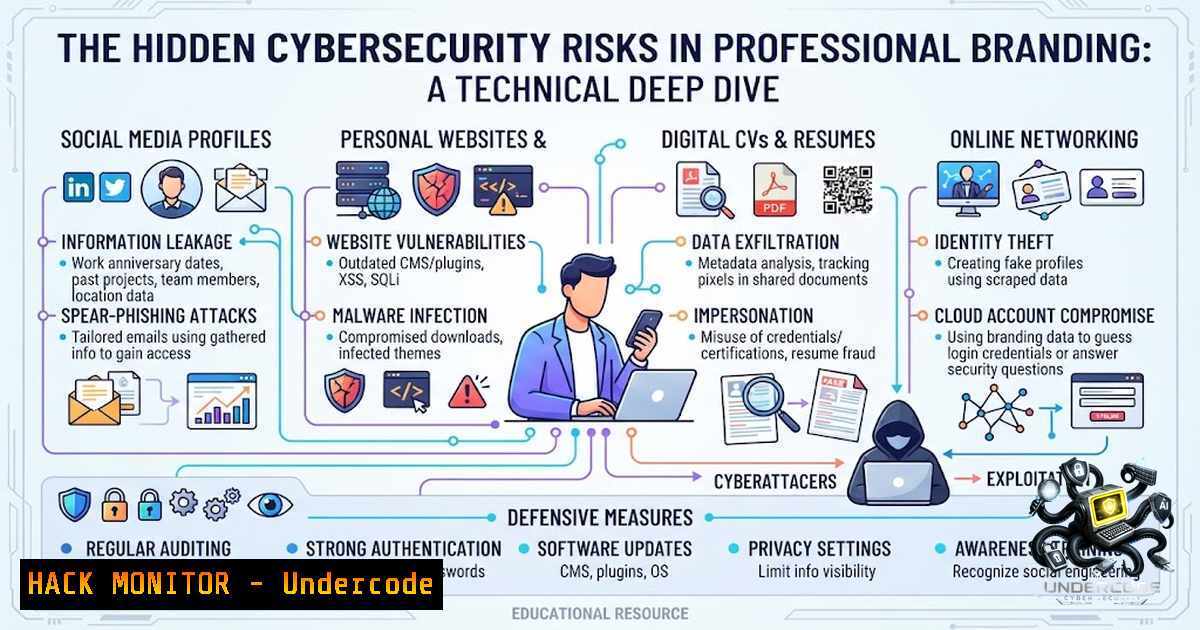
Introduction
In today’s interconnected digital ecosystem, the convergence of personal branding and cybersecurity has created an unprecedented attack surface for threat actors. As professionals increasingly share their technical expertise, certifications, and project details across platforms, they inadvertently expose critical infrastructure information that can be weaponized by malicious actors. This article examines the technical vulnerabilities inherent in professional content sharing and provides actionable security measures for individuals and organizations.
Learning Objectives
- Understand the attack vectors associated with professional social media presence and content sharing
- Master technical tools and commands for assessing and mitigating exposure risks
- Implement practical security controls across Linux, Windows, and cloud environments
You Should Know
1. OSINT Reconnaissance: What Your Profile Reveals
Professional profiles often contain technical breadcrumbs that sophisticated attackers can leverage. When professionals share details about their roles, technologies used, and certifications, they create a comprehensive OSINT (Open Source Intelligence) target. This information can be systematically collected and analyzed to craft highly targeted spear-phishing campaigns, social engineering attempts, or technical exploitation.
Step‑by‑step OSINT assessment:
1. Linux OSINT collection using TheHarvester:
theharvester -d companydomain.com -b google,bing,linkedin -l 500
This command gathers email addresses, subdomains, and employee information from public sources.
2. Windows-based reconnaissance with PowerShell:
Invoke-WebRequest -Uri "https://api.github.com/users/username/repos" | ConvertFrom-Json | Select-Object -Property name,html_url,description
Extracts repository information that might reveal internal tooling, coding patterns, or security flaws.
3. Cross-reference collected data:
cat emails.txt | while read email; do curl -s "https://haveibeenpwned.com/api/v3/breachedaccount/$email"; done
This Bash loop checks if professional emails appear in known data breaches.
Understanding the impact:
This information allows attackers to build detailed organizational maps, understand security postures, and identify potential entry points. A single exposed IP address, domain name, or software version can be the difference between security and compromise.
2. Credential Exposure and Identity Verification
The most dangerous aspect of professional content sharing is the inadvertent exposure of API keys, tokens, or credential patterns. Developers often share code snippets containing hardcoded secrets, while IT professionals might post configuration files with sensitive information.
Detection and prevention techniques:
1. Scan Git repositories for secrets using truffleHog:
trufflehog git https://github.com/username/repo.git
Identifies high-entropy strings and secrets in commit history.
- Windows command to check for exposed credential files:
dir /s secret key token credentials
Searches recursively for potentially sensitive file names.
3. Implement pre-commit hooks to prevent secret leakage:
 .git/hooks/pre-commit
!/bin/sh
. /path/to/venv/bin/activate
pre-commit run --all-files
Automates secret scanning before code is committed.
Mitigation strategy:
Implement a comprehensive secret detection pipeline using tools like Gitleaks, detect-secrets, or custom regex patterns. Rotate any exposed credentials immediately and implement fine-grained permission models using the principle of least privilege.
3. Social Engineering Resistance and Verification
Attackers don’t always need technical vulnerabilities; they exploit human trust built through professional networks. The “Undercode” effect—where technical confidence breeds social vulnerability—requires systematic verification protocols.
Building social engineering resistance:
1. Implement multi-factor authentication (MFA) verification:
 Linux OTP generation for authentication
oathtool --totp -b YOUR_SECRET_KEY
2. Windows PowerShell script to verify caller legitimacy:
function Test-CallerIdentity {
param([bash]$EmployeeID)
 Internal API check
Invoke-RestMethod -Uri "https://internalapi.company.com/employees/$EmployeeID" -Method Get
}
This validates internal requests against central identity management.
3. Cloud security configuration for IAM policies:
{
"Version": "2012-10-17",
"Statement": [
{
"Effect": "Deny",
"Action": "iam:",
"Resource": "",
"Condition": {
"IpAddress": {
"aws:SourceIp": ["trusted_ip_range"]
}
}
}
]
}
Restricts privileged actions to verified networks and endpoints.
Practical application:
Establish “break-glass” procedures for emergency access while maintaining auditability. Implement JIT (Just-In-Time) access systems that require secondary verification, mimicking the verification process used by security professionals.
4. API and Endpoint Security in Digital Presence
Professional content often links to personal websites, APIs, or hosted applications. Each exposed endpoint represents a potential attack vector requiring thorough security assessment and hardening.
Hardening API exposure:
1. API endpoint vulnerability scanning with Nikto:
nikto -h https://personalwebsite.com/api/v1/ -ssl
2. Windows nslookup and DNS recon:
nslookup -type=MX personalwebsite.com
nslookup -type=TXT personalwebsite.com
Identifies DNS records that might reveal internal infrastructure.
3. Cloud API gateway configuration hardening:
 AWS API Gateway rate limiting
paths:
/api/v1/resource:
x-amazon-apigateway-rate-limit:
rate: 1000
burst: 500
x-amazon-apigateway-throttling:
rateLimit: 100
burstLimit: 20
Prevents DDoS and brute-force attacks on exposed APIs.
Advanced security measures:
Implement WAF (Web Application Firewall) rules to block malicious requests. Use IP reputation lists and implement fail2ban or similar automated response systems:
 Fail2ban configuration for SSH protection
sudo fail2ban-client set sshd banip ATTACKER_IP
5. Cloud Infrastructure and Data Leakage
Professionals discussing cloud transformations, migrations, or architectures often reveal critical infrastructure details that can be exploited. Misconfigured S3 buckets, exposed EC2 instances, or publicly accessible databases represent significant risks.
Cloud security auditing:
- AWS CLI command to list S3 bucket permissions:
aws s3api get-bucket-acl --bucket your-bucket-1ame
2. Azure CLI command to check NSG rules:
az network nsg rule list --1sg-1ame YourNSG --resource-group YourRG
3. GCP command to inspect IAM policies:
gcloud projects get-iam-policy your-project-id
Mitigation framework:
Conduct regular security posture assessments using cloud-1ative tools like AWS Trusted Advisor, Azure Security Center, or GCP Security Command Center. Implement continuous compliance monitoring:
 OpenSCAP security auditing
sudo oscap xccdf eval --profile xccdf_org.ssgproject.content_profile_cis --results /tmp/audit.xml /usr/share/openscap/scap/ssg/ssg-centos7-xccdf.xml
6. AI and Machine Learning Model Security
As professionals increasingly share AI/ML projects, model inversion attacks, data poisoning, and prompt injection become realistic threats. The training data, architectures, or inference endpoints shared in professional content can be leveraged for adversarial attacks.
AI security hardening:
1. Implement input validation for inference endpoints:
import re
def sanitize_input(input_text):
 Remove potentially malicious patterns
clean_text = re.sub(r'[^a-zA-Z0-9\s]', '', input_text)
return clean_text
2. Model watermarking for ownership verification:
import hashlib
def generate_watermark(model_params):
return hashlib.sha256(str(model_params).encode()).hexdigest()
3. Differential privacy implementation:
import diffprivlib as dp
dp_model = dp.GaussianNB(epsilon=1.0)
Best practices:
Never expose raw model outputs without appropriate filtering. Implement rate limiting, input validation, and output sanitization. Consider adversarial training to improve model resilience:
from cleverhans.attacks import FastGradientMethod
 Implement adversarial training loop
7. Supply Chain and Third-Party Risk
Professional networks often include endorsements of tools, frameworks, or services. These recommendations create supply chain trust that malicious actors can exploit by poisoning legitimate packages or creating convincing impersonations.
Supply chain verification:
1. Verify package integrity:
sha256sum package.tar.gz
 Compare with official checksum
2. Dependency scanning with OWASP dependency-check:
dependency-check --scan /path/to/project --format JSON
3. Implement SBOM generation:
syft dir:/path/to/project -o json > sbom.json
Continuous monitoring:
Implement automated vulnerability scanning integrated into CI/CD pipelines. Regularly update and audit dependencies:
 Update npm packages
npm audit fix --force
 Python package scanning
pip-audit --requirement requirements.txt
What Undercode Say
- Key Takeaway 1: Professional branding creates extensive OSINT opportunities requiring technical countermeasures and continuous monitoring across Linux, Windows, and cloud environments.
- Key Takeaway 2: Social engineering remains the most effective attack vector, necessitating technical verification protocols, automated detection, and systematic security awareness training.
- Key Takeaway 3: Comprehensive cloud security posture management, combined with API hardening and secret detection, forms the bedrock of modern cybersecurity defense.
Analysis:
The intersection of professional content sharing and cybersecurity requires a paradigm shift from “what can I share” to “what should I protect.” Organizations must implement zero-trust architectures, continuous monitoring, and automated security controls. Individual professionals need to understand that their digital footprint directly impacts organizational security. The responsibility extends beyond personal vigilance to institutional security frameworks.
Implementation roadmap:
Begin with comprehensive OSINT assessments of team profiles, implement automated secret detection in CI/CD pipelines, deploy cloud security posture management, and establish incident response protocols. Regular security audits, employee training, and collaborative threat intelligence sharing create a robust defense ecosystem.
Prediction
+1 Increasing adoption of AI-powered defense mechanisms will enable real-time threat detection and automated response, significantly reducing manual security intervention requirements.
-P Social engineering attacks will become more sophisticated, leveraging generative AI to create highly convincing personalized attacks targeting professional networks.
+1 Zero-trust architecture implementation will become standardized, with continuous verification systems becoming mandatory regulatory requirements.
-P Supply chain attacks will increase as attackers target dependencies and third-party services recommended in professional content.
+1 Cloud-1ative security tools will evolve to provide granular visibility and control over exposed infrastructure elements.
-1 Deepfake technology advancement will challenge traditional verification methods, requiring new authentication frameworks.
+1 Professional collaboration platforms will integrate security features such as automated PII redaction and content risk scoring.
-P The skills gap in cybersecurity will widen as attack surfaces expand faster than workforce training programs.
+1 Multi-layered defense strategies incorporating AI, automation, and human oversight will become the industry standard.
-1 Regulatory compliance complexity will increase, creating additional burdens on security teams while potentially creating new vulnerabilities.
▶️ Related Video (86% Match):
🎯Let’s Practice For Free:
🎓 Live Courses & Certifications:
Join Undercode Academy for Verified Certifications
🚀 Request a Custom Project:
Secure, high-velocity infrastructure and disruptive technological engineering. Contact our engineering team for high-tier development and proprietary systems:
[email protected]
💎 Smart Architecture | 🛡️ Secure by Design | ⭐ Trusted by Thousands
IT/Security Reporter URL:
Reported By: Fahad Naseer2004 – Hackers Feeds
Extra Hub: Undercode MoN
Basic Verification: Pass ✅


