Listen to this Post
Introduction:
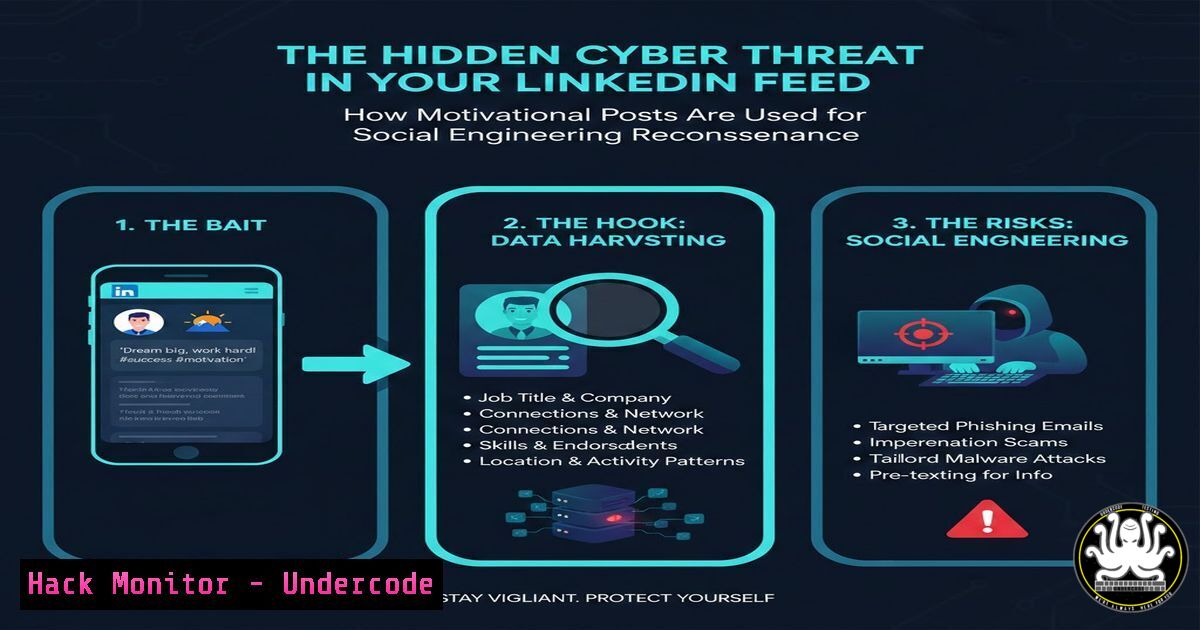
While LinkedIn is a platform for professional networking and inspiration, the very nature of its personal, motivational posts creates a goldmine for threat actors. Cybersecurity professionals are now identifying a concerning trend where hackers use seemingly benign content to build detailed profiles for sophisticated social engineering and spear-phishing campaigns. This article deconstructs the digital footprint left by a typical motivational post and its engagement, outlining the actionable intelligence an attacker can extract and how to defend against it.
Learning Objectives:
- Understand how public social media engagement feeds adversary reconnaissance.
- Learn to identify and minimize personal and organizational data leakage on professional networks.
- Implement technical controls and user training to mitigate social engineering risks derived from OSINT (Open-Source Intelligence).
You Should Know:
- Profile Scraping & Connection Analysis: The Foundation of an Attack
The initial post and the list of engaged users (e.g., “Sachin S.”, “AI & Tech Content Creator”) provide a target list. Attackers use automated tools to scrape this data, establishing connections and organizational hierarchies.
Step-by-Step Guide:
An attacker would use OSINT tools to enrich the scraped data. A simple Python script with the `requests` and `BeautifulSoup` libraries can mimic this initial scraping, though more advanced tools are used in real attacks.
import requests
from bs4 import BeautifulSoup
 Example pseudocode structure for educational purposes
 This highlights how public page data can be programmatically accessed
target_post_url = "linkedin.com/feed/update/..."
headers = {'User-Agent': 'Mozilla/5.0'}
response = requests.get(target_post_url, headers=headers)
soup = BeautifulSoup(response.content, 'html.parser')
 Extract engagers' profile links and names
engagers = soup.find_all('span', class_='engager-name-class')  Class name example
for engager in engagers:
print(f"Potential Target: {engager.text}")
What this does: This conceptual code demonstrates how public-facing engagement data can be collected. Attackers use this to build a target list for connection requests, making a later spear-phishing email appear to come from a “familiar” face within your network circle.
- Keyword & Role Extraction for Phishing Lure Crafting
The post’s hashtags (motivation, entrepreneurship, success) and commenters’ self-declared roles (“AI & Tech Content Creator,” “Marketing Influencer”) reveal professional interests and pain points.
Step-by-Step Guide:
Attackers use keyword clustering to tailor phishing lures. A security analyst can use similar techniques defensively in a SIEM (Security Information and Event Management) system to flag suspicious emails containing these harvested keywords.
 Example: Using log analysis (like in Splunk or ELK) to hunt for phishing themes
index=email_logs "subject"
| search "subject=AI OR subject=Growth Hacking OR subject=Collaboration"  Keywords from comments
| stats count by sender_address, subject
| where count > 5  Flag senders mass-mailing these themes
What this does: This Splunk-like query helps a blue team identify if a wave of incoming emails is using themes recently popularized in your organization’s social media sphere, indicating a potential coordinated phishing campaign.
3. Organizational Mapping via Employee Connections
Commenters like “Medical Student” and “MBBS (MD)” near professionals from tech companies can reveal unexpected organizational ties or supply chain relationships, which are lucrative attack vectors.
Step-by-Step Guide:
Tools like Maltego or even LinkedIn’s own advanced search can map these connections. Defensively, organizations should conduct periodic social media audits.
 Internal command for security teams to initiate an audit (conceptual)
sudo ./social_media_audit.sh --platform linkedin --company "YourCompanyName" --output findings.csv
What this does: A hypothetical internal tool would flag employees who may be oversharing project details or inadvertently revealing partnerships, allowing for proactive security awareness training.
4. Tone & Sentiment Analysis for Impersonation
The post’s grateful, forward-looking tone (“gratitude,” “hope,” “excitement”) is a behavioral signature. Attackers can analyze an individual’s posting history to clone their communication style in a compromised email exchange.
Step-by-Step Guide:
Advanced phishing kits now incorporate basic AI sentiment analysis. A defensive measure is to implement email header analysis and DMARC/DKIM/SPF to detect impersonation, regardless of tone.
 Windows PowerShell command to check email headers for authenticity
Get-MessageTrace -SenderAddress "[email protected]" | Format-List Received, MessageId, FromIP, ToIP, Subject
 Look for discrepancies in the FromIP vs your company's legitimate mail server IPs.
What this does: This command helps trace the path of an email purportedly from a high-value target (like a CEO), checking if it actually originated from your organization’s trusted mail infrastructure.
5. Timing & Availability Inference
The 10-hour post timestamp and rapid commenting indicate an active online community. Attackers infer best times to send emails (likely during or after this active window) for higher open rates or to launch a phone-based vishing attack when targets are engaged online.
Step-by-Step Guide:
Security awareness training must include guidance on “time-of-click” awareness. Encourage employees to use a password manager that won’t auto-fill credentials on phishing sites, regardless of when the email arrives.
 No technical command can fix human timing. Training is key.
 Simulate a phishing campaign during your organization's "peak LinkedIn activity" time to test vigilance.
What this does: Proactive phishing simulations tailored to your team’s online habits provide the most effective training, revealing vulnerabilities tied to routine behavior.
What Undercode Say:
- Your Public Engagement is Your Attack Surface. Every like, comment, and connection on a public or semi-public post adds data points to a dossier that can be used against you and your network. The most profound threats often stem from the voluntary data we consider harmless.
- Security is a Cultural Practice, Not Just a Technical Control. While firewalls and endpoint protection are crucial, the human layer—shaped by habits on social platforms—is the primary frontier. Defending it requires continuous, engaging education that makes employees conscious of their digital shadow.
Analysis: The professional norm of engaging with inspirational content creates a paradox: it builds community while simultaneously eroding collective security. The hacker’s advantage lies in the predictability and richness of this voluntarily shared data. The defense, therefore, is not retreat but disciplined mindfulness. Organizations must shift security training to cover the “why” behind policies, demonstrating how a simple comment can be the first step in a complex attack chain. The future of cyber defense hinges on integrating privacy-centric behavior into professional culture as seamlessly as networking itself.
Prediction:
In the next 2-3 years, we will see a surge in AI-driven social engineering attacks that leverage real-time analysis of social media feeds, including sentiment, network dynamics, and event participation. Attack tools will automatically generate hyper-personalized phishing lures within minutes of a target posting online, making traditional, signature-based email security nearly obsolete. Defense will pivot towards AI-powered anomaly detection in communication patterns and mandatory “digital hygiene” audits for employees in high-risk roles, treating social media profiles as extensions of the corporate security perimeter.
▶️ Related Video (74% Match):
🎯Let’s Practice For Free:
IT/Security Reporter URL:
Reported By: Abdulnasirahmedshaikh Quote – Hackers Feeds
Extra Hub: Undercode MoN
Basic Verification: Pass ✅


