
Listen to this Post
Introduction:
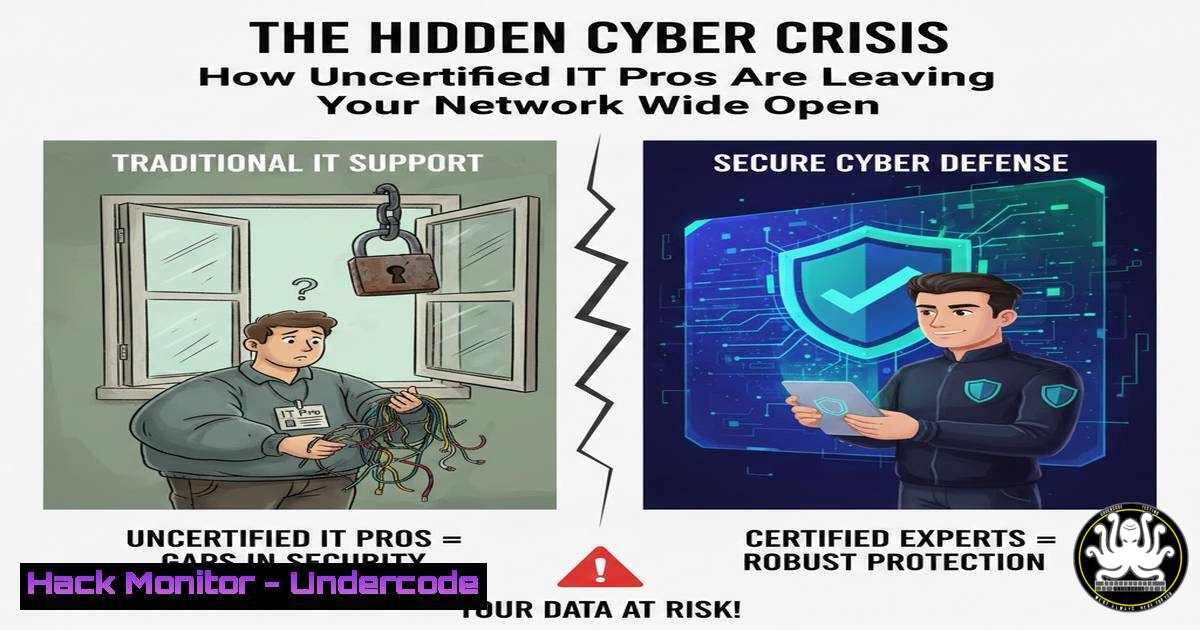
In an era where cyber threats evolve daily, the gap between theoretical knowledge and hands-on, validated skill has become the weakest link in organizational defense. The role of professional certification juries, as highlighted by industry experts, is no longer administrative but a critical frontline in verifying the operational competence that directly prevents breaches. This article deconstructs the essential, certified skills every secure operation requires.
Learning Objectives:
- Understand the critical link between professionally validated skills and tangible security postures.
- Learn the core technical objectives of key infrastructure and NetOps certifications.
- Gain actionable command-line and configuration tutorials to emulate the skills these certifications rigorously test.
You Should Know:
- Validating the “Technicien Supérieur Systèmes et Réseaux”: Beyond Basic Connectivity
This title validates the foundational layer of IT infrastructure. A certified professional doesn’t just connect cables; they architect resilient, observable networks. The core skill is moving from simple ping tests to proactive performance and security baselining.
Step‑by‑step guide:
Objective: Establish a network baseline and detect anomalous traffic using open-source tools.
Step 1: Interface Configuration & Monitoring (Linux). Begin by configuring a persistent interface and capturing a traffic sample.
 Configure IP address temporarily
sudo ip addr add 192.168.1.10/24 dev eth0
 Capture 100 packets to a file for analysis
sudo tcpdump -i eth0 -c 100 -w baseline_capture.pcap
Step 2: Analyze with `tshark` (Wireshark CLI). Analyze the capture for protocols and conversations, which is critical for spotting unauthorized services.
 List top talkers by packet count
tshark -r baseline_capture.pcap -z conv,ip
 Filter for HTTP traffic specifically
tshark -r baseline_capture.pcap -Y http
Step 3: Implement Continuous Monitoring with iftop. Use real-time bandwidth monitoring to identify unexpected data flows.
 Install iftop
sudo apt install iftop  Debian/Ubuntu
 Run to see live connections and bandwidth usage
sudo iftop -i eth0
2. The “Administrateur d’Infrastructures Sécurisées” Blueprint: Hardening 101
This certification demands skills in hardening systems against exploitation. It’s about moving from a default install to a defensible posture through configuration.
Step‑by‑step guide:
Objective: Harden a Linux server by enforcing the principle of least privilege and auditing for misconfigurations.
Step 1: SSH Hardening. Modify the SSH daemon configuration to disable weak authentication methods.
 Edit the SSH server configuration file
sudo nano /etc/ssh/sshd_config
 Set or change the following lines:
PermitRootLogin no
PasswordAuthentication no
PubkeyAuthentication yes
 Restart the service
sudo systemctl restart sshd
Step 2: Audit SUID/GUID Binaries. Find binaries with elevated privileges that could be exploited.
 Find all SUID files
find / -type f -perm /4000 2>/dev/null
 Find all GUID files
find / -type f -perm /2000 2>/dev/null
 Research any unfamiliar binaries to determine if they need SUID/GUID
Step 3: Configure and Audit with auditd. Install and configure the Linux audit framework to track critical files and security events.
 Install auditd
sudo apt install auditd audispd-plugins
 Add a watch rule for the /etc/passwd file
sudo auditctl -w /etc/passwd -p wa -k identity_file_change
 View the audit log for your key
sudo ausearch -k identity_file_change
- NetOps in Action: Automation for Security and Compliance
The NetOps (Network Operations) title emphasizes automation, agility, and infrastructure-as-code, which are vital for consistent, repeatable, and auditable security configurations.
Step‑by‑step guide:
Objective: Use Ansible, a core NetOps tool, to automatically enforce a secure firewall policy across multiple servers.
Step 1: Create an Ansible Inventory. Define the hosts to manage.
 inventory.yml
webservers:
hosts:
web01:
ansible_host: 192.168.1.20
web02:
ansible_host: 192.168.1.21
Step 2: Create a Security Playbook. Write a playbook to configure `ufw` (Uncomplicated Firewall) on Ubuntu hosts.
 firewall.yml

<ul>
<li>name: Harden SSH and open web ports
hosts: webservers
become: yes
tasks:</li>
<li>name: Ensure UFW is installed
apt:
name: ufw
state: present</li>
<li>name: Deny all incoming by default
ufw:
direction: incoming
policy: deny
state: enabled</li>
<li>name: Allow SSH on port 22
ufw:
rule: allow
port: '22'
proto: tcp</li>
<li>name: Allow HTTP/HTTPS
ufw:
rule: allow
port: '80,443'
proto: tcp
Step 3: Execute the Playbook. Run the automation to apply the policy uniformly.
ansible-playbook -i inventory.yml firewall.yml
- From Audit to Action: Simulating Real-World Attack Paths
Jury evaluation requires understanding how theoretical weaknesses translate to exploitation. This involves basic penetration testing methodologies to validate defenses.
Step‑by‑step guide:
Objective: Conduct an authorized vulnerability scan and analyze a common finding.
Step 1: Network Discovery with nmap. Identify live hosts and open services.
 Basic ping sweep
nmap -sn 192.168.1.0/24
 Service and version detection on a target
nmap -sV -sC 192.168.1.20
Step 2: Vulnerability Scanning with `openvas` or nessus. Use a dedicated vulnerability scanner (setup omitted for brevity) to find CVEs.
Step 3: Analyze & Mitigate a Finding. Example: Mitigating a weak TLS cipher finding in an Apache config.
 In /etc/apache2/mods-enabled/ssl.conf
 Disable weak protocols and ciphers
SSLProtocol all -SSLv3 -TLSv1 -TLSv1.1
SSLCipherSuite HIGH:!aNULL:!MD5:!RC4:!3DES
5. The Human Firewall: Building Operational Security Procedures
The highest-level certifications assess the ability to build processes, not just configure tools. This involves creating runbooks and incident response playbooks.
Step‑by‑step guide:
Objective: Create a simple incident response checklist for a suspected compromise.
Step 1: Isolation. Document the first command to isolate a host from the network without powering it off (to preserve memory).
 Linux: Block all inbound/outbound traffic on the host
sudo iptables -P INPUT DROP
sudo iptables -P OUTPUT DROP
sudo iptables -P FORWARD DROP
Step 2: Evidence Collection. Outline commands for triage data collection.
 Collect network connections, processes, and user logins
netstat -tulnap > netstat.txt
ps aux > ps.txt
last > last_logins.txt
 Create a memory dump (if tools are installed)
sudo fmem > /tmp/memory.dump
Step 3: Communication & Escalation. Define the stakeholders (legal, PR, management) to notify per the organization’s policy.
What Undercode Say:
- Certifications Are Your First Line of Defense: Professionally validated skills are not a checkbox; they are a verifiable control that reduces the probability of misconfiguration, a leading cause of breaches. The jury process described ensures these certifications reflect the ability to perform, not just recall.
- The Skill Gap is an Exploit Vector: Attackers target operational weaknesses, not just software vulnerabilities. A workforce certified to the standards of “Administrateur d’Infrastructures Sécurisées” or “NetOps” closes the gaps that automated exploits cannot find—poor architecture, weak hardening, and slow response.
The rigorous, jury-based evaluation of these professional titles represents a systemic shift towards provable competence. It directly combats the “paper-certification” problem, where theoretical knowledge fails under operational pressure. For organizations, prioritizing hires with these validated titles is a strategic risk-mitigation effort. The future of cybersecurity defense lies less in chasing the latest silver-bullet tool and more in institutionalizing this level of grounded, auditable expertise across the entire IT workforce.
Prediction:
The formalization and expansion of state-sanctioned professional certification juries, as championed by industry leaders, will create a measurable divide in organizational resilience within 3-5 years. Companies that leverage this pool of validated talent will demonstrate significantly lower mean times to detect (MTTD) and respond (MTTR) to incidents. This will make “certified workforce percentage” a key metric in cyber insurance underwriting and due diligence questionnaires, turning human skill validation into a tangible financial and security asset. The hacker’s playground will increasingly become the domain of organizations that ignore this shift towards proven, operational skill.
▶️ Related Video (80% Match):
🎯Let’s Practice For Free:
IT/Security Reporter URL:
Reported By: Thomassautier Samhan – Hackers Feeds
Extra Hub: Undercode MoN
Basic Verification: Pass ✅


