Listen to this Post
Introduction:
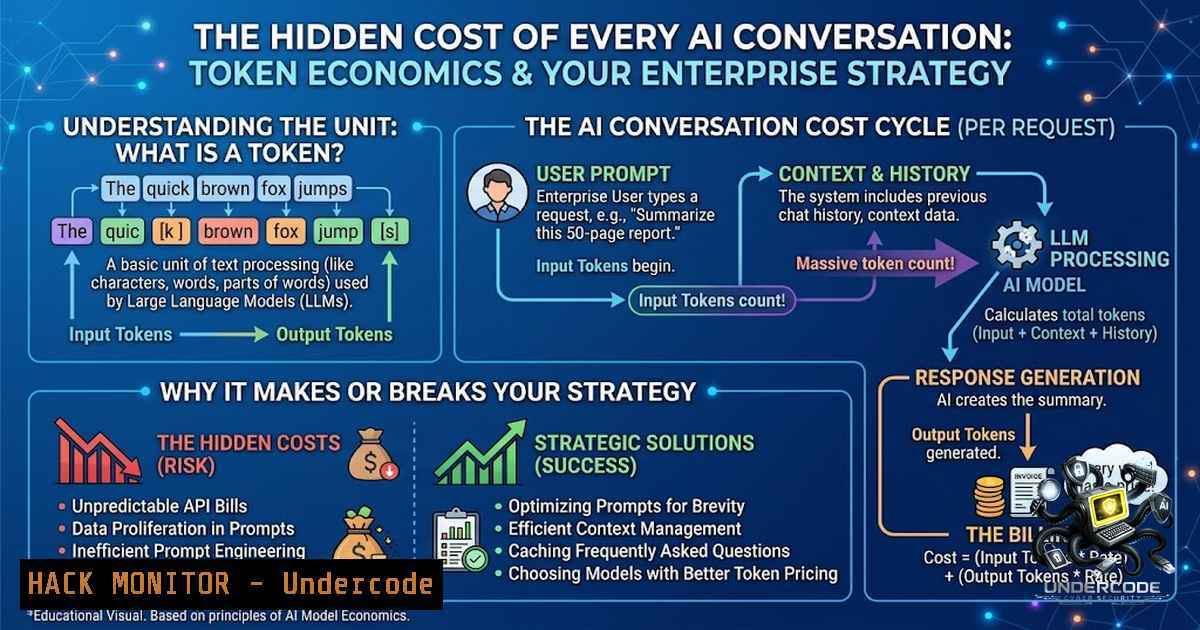
Every time you prompt an LLM, you’re not paying for words—you’re paying for tokens. Tokens are the real currency of AI, and the better you understand token economics, the better you can optimize cost, latency, and performance. As Agentic AI and enterprise copilots become mainstream, token economics is becoming as important as cloud economics was a decade ago.
Learning Objectives:
- Understand what tokens are and how they drive LLM costs across major providers like OpenAI, Anthropic, and Google
- Master practical token optimization techniques including prompt compression, semantic caching, and model routing
- Learn to implement monitoring and cost-tracking systems to treat token consumption as an engineering metric
You Should Know:
1. Token Economics: The Currency of AI
Every LLM interaction consumes two types of tokens: input tokens (what you send to the model) and output tokens (what the model generates back). Pricing varies dramatically across providers and models. As of 2026, input prices span a 50x range from $0.10 to $5.00 per million tokens.
| Model | Provider | Input ($/1M tokens) | Output ($/1M tokens) | Context Window |
|-|-||-|-|
| Claude Opus 4.5 | Anthropic | $5.00 | $25.00 | 200K |
| GPT-4.1 | OpenAI | $2.00 | $8.00 | 1M |
| Gemini 2.5 Pro | Google | $1.25 | $10.00 | 1M |
| Claude Sonnet 4.5 | Anthropic | $3.00 | $15.00 | 200K |
| DeepSeek V3 | DeepSeek | $0.25 | $1.10 | 128K |
| Mistral Small 3.2 | Mistral | $0.06 | $0.18 | 128K |
The gap between the cheapest and most expensive models can be 750x or more. A single Claude Opus conversation with full 200K context costs $4.50—run that 100 times a day and you’re spending $13,500/month on one workflow. This is why token optimization isn’t optional; it’s essential.
2. Prompt Compression: Less Is More
Prompt compression techniques can dramatically reduce token consumption without sacrificing quality. Recent research has shown that RL-guided compression methods can improve task performance by 8%–189% while satisfying the same compression rate requirements.
Practical Prompt Compression Techniques:
Hard Prompt Methods (human-readable):
- Token Pruning: Remove redundant or low-information tokens from prompts
- Heuristic Rewriting: Manually or algorithmically shorten prompts while preserving meaning
- LLM-based Summarization: Use a smaller, cheaper model to summarize context before sending to a larger model
Soft Prompt Methods (model-internal):
- Use learnable continuous vectors that are more token-efficient than natural language
- Parameter-Efficient Fine-Tuning (PEFT) approaches reduce the token footprint
Quick Wins for Prompt Compression:
 Example: Using a lightweight model to compress context before sending to expensive model
import openai

def compress_context(long_context, max_tokens=500):
response = openai.chat.completions.create(
model="gpt-4o-mini",  Cheap model for compression
messages=[
{"role": "system", "content": "Summarize the following text concisely while preserving key information:"},
{"role": "user", "content": long_context}
],
max_tokens=max_tokens
)
return response.choices[bash].message.content

Then use the compressed context with your premium model
compressed = compress_context(user_document)
final_response = openai.chat.completions.create(
model="gpt-4o",  Expensive model only for final reasoning
messages=[{"role": "user", "content": compressed}]
)
- Semantic Caching: Never Pay Twice for the Same Question
Traditional caching works on exact matches—if you ask the exact same question, you get a cached response. But semantic caching takes this further: it understands meaning. When one employee asks “What is the company policy on parental leave?” and another asks “Tell me about our rules for taking time off after having a baby,” semantic caching recognizes these as the same question and serves the cached response.
Implementation with RAG Cache:
RAG Cache sits between your application and LLM providers, implementing a two-tier cache:
User Query → Exact Match (Redis) → Semantic Match (Qdrant) → LLM (if needed)
↓ ↓ ↓ ↓
~1ms ~1ms ~450ms ~8,500ms
Setup Commands:
 Clone and set up RAG Cache
git clone <your-repo>
cd "Rag cache"
python3.11 -m venv venv
source venv/bin/activate
pip install -r requirements.txt

Configure environment
cp .env.example .env
 Edit .env and add your OPENAI_API_KEY

Start Redis & Qdrant
docker-compose up -d redis qdrant

Run the application
uvicorn app.main:app --host 0.0.0.0 --port 8000

Health check
curl http://localhost:8000/health
API Usage:
 First request (cache miss) - ~8.5 seconds
curl -X POST http://localhost:8000/api/v1/query \
-H "Content-Type: application/json" \
-d '{"query": "What is machine learning?", "use_cache": true}'

Exact match (Redis) - ~1ms, 7,723x faster
curl -X POST http://localhost:8000/api/v1/query \
-H "Content-Type: application/json" \
-d '{"query": "What is machine learning?", "use_cache": true}'

Semantic match (Qdrant) - ~450ms
curl -X POST http://localhost:8000/api/v1/query \
-H "Content-Type: application/json" \
-d '{"query": "Can you explain machine learning?", "use_cache": true}'
Results show semantic caching can reduce API costs by up to 80% and latency from 8.5 seconds to 1ms. Even better, prompt caching from Anthropic and OpenAI can reduce repeated input costs by ~90%.
- Model Routing: The Right Model for the Right Task
Not every query needs a $25/million-token model. Intelligent model routing can cut costs by 43.9% while maintaining quality parity with the strongest models. Research shows routing systems can achieve 97.25% of GPT-4’s quality at just 24.18% of the cost.
How Model Routing Works:
A lightweight classifier predicts query complexity and routes to the smallest model that can satisfy the quality threshold. This approach maintains 90.5% accuracy regardless of target LLM provider.
Implementation Example (Python):
class LLMRouter:
def <strong>init</strong>(self):
self.models = {
'haiku': {'cost_per_1M': 1.00, 'capability': 'low'},
'sonnet': {'cost_per_1M': 3.00, 'capability': 'medium'},
'opus': {'cost_per_1M': 5.00, 'capability': 'high'}
}

def route_query(self, query, complexity_score):
if complexity_score < 0.3:
return self.call_model('haiku', query)  $1/M tokens
elif complexity_score < 0.7:
return self.call_model('sonnet', query)  $3/M tokens
else:
return self.call_model('opus', query)  $5/M tokens
5. Token Monitoring: Measure What Matters
“You can’t optimize what you don’t measure.” Leading AI teams treat token consumption like any other engineering metric. Tools like LLM Token Tracker provide automatic tracking across OpenAI, Claude, and Gemini APIs.
JavaScript/Node.js Implementation:
const { TokenTracker } = require('llm-token-tracker');
const OpenAI = require('openai');

const tracker = new TokenTracker({ currency: 'USD' });
const openai = tracker.wrap(new OpenAI({ apiKey: process.env.OPENAI_API_KEY }));

// Tracking happens automatically
const response = await openai.chat.completions.create({
model: "gpt-3.5-turbo",
messages: [{ role: "user", content: "Hello!" }]
});

console.log(response._tokenUsage);
// { tokens: 125, cost: 0.0002, model: "gpt-3.5-turbo" }
For enterprise monitoring, Grafana Cloud’s Anthropic integration pulls usage data directly from the Usage and Cost API, converting it into Prometheus-format metrics with pre-built dashboards:
 Prometheus metrics generated:
gen_ai_cost{workspace_id, model, service_tier}
gen_ai_usage_tokens_total{workspace_id, model, token_type, service_tier}
6. Context Engineering: The Overlooked Cost Driver
The biggest cost driver in LLM applications isn’t the model’s output—it’s the context. Each tool call in a coding agent re-sends the full conversation history, often 10K-100K tokens per call. A typical Claude Code session with Opus runs 20-50 tool calls, costing $3-15 per session.
Context Optimization Strategies:
- Minimize unnecessary context: Only include relevant information
- Cache reusable prompts: System prompts and frequent context should be cached
- Structure prompts instead of making them longer: Use structured formats that reduce token bloat
- Choose the right model for the task: Don’t use Opus for tasks Haiku can handle
- Use RAG intelligently: Retrieve only relevant chunks, not entire documents
7. Advanced: KV Cache Compression
For deep optimization, KV cache compression techniques like ClusterAttn can reduce memory usage by 10%–65%, resulting in latency reduction of 12%–23% and throughput increase of 2.6–4.8 times with nearly no accuracy loss. SemShareKV takes this further by reusing KV cache across semantically similar prompts using locality-sensitive hashing (LSH).
What Undercode Say:
- Token efficiency is not just about cost—it’s about scale. Teams that generate maximum intelligence per token will build AI systems that scale both technically and economically. The future belongs to those who treat token consumption as a first-class engineering metric alongside latency, accuracy, and reliability.
-
Business value per token matters more than cost per token. The real optimization challenge is finding the minimum sufficient context for each task while preserving accuracy, traceability, and appropriate human oversight. Enterprise AI success comes from better system design—techniques like RAG, semantic caching, context pruning, model routing, and structured outputs can significantly reduce token usage while improving response quality.
Prediction:
-
+1 Token economics will become a standard part of every AI engineer’s toolkit, just as cloud cost optimization is for DevOps engineers. Training programs and certifications in token optimization will emerge by 2027.
-
+1 The gap between token-efficient and token-wasteful AI teams will widen dramatically. Teams that master semantic caching, model routing, and prompt compression will achieve 5-10x cost advantages over competitors.
-
-1 Organizations that fail to implement token monitoring and optimization will face spiraling AI costs that undermine their ROI. Without proper governance, AI spend will become the new “shadow IT” problem of the 2020s.
-
+1 Context engineering will emerge as a distinct discipline within AI engineering, with dedicated roles focused on optimizing the balance between cost, quality, latency, and scalability.
-
+1 The commoditization of LLM inference will accelerate, with budget-tier models dropping below $0.075 per million input tokens, making AI accessible to smaller teams while premium models command higher prices for specialized capabilities.
▶️ Related Video (72% Match):
https://www.youtube.com/watch?v=1eo3ty-SnPU
🎯Let’s Practice For Free:
🎓 Live Courses & Certifications:
Join Undercode Academy for Verified Certifications
🚀 Request a Custom Project:
Secure, high-velocity infrastructure and disruptive technological engineering. Contact our engineering team for high-tier development and proprietary systems:
[email protected]
💎 Smart Architecture | 🛡️ Secure by Design | ⭐ Trusted by Thousands
IT/Security Reporter URL:
Reported By: Murari Ramuka – Hackers Feeds
Extra Hub: Undercode MoN
Basic Verification: Pass ✅


