Listen to this Post
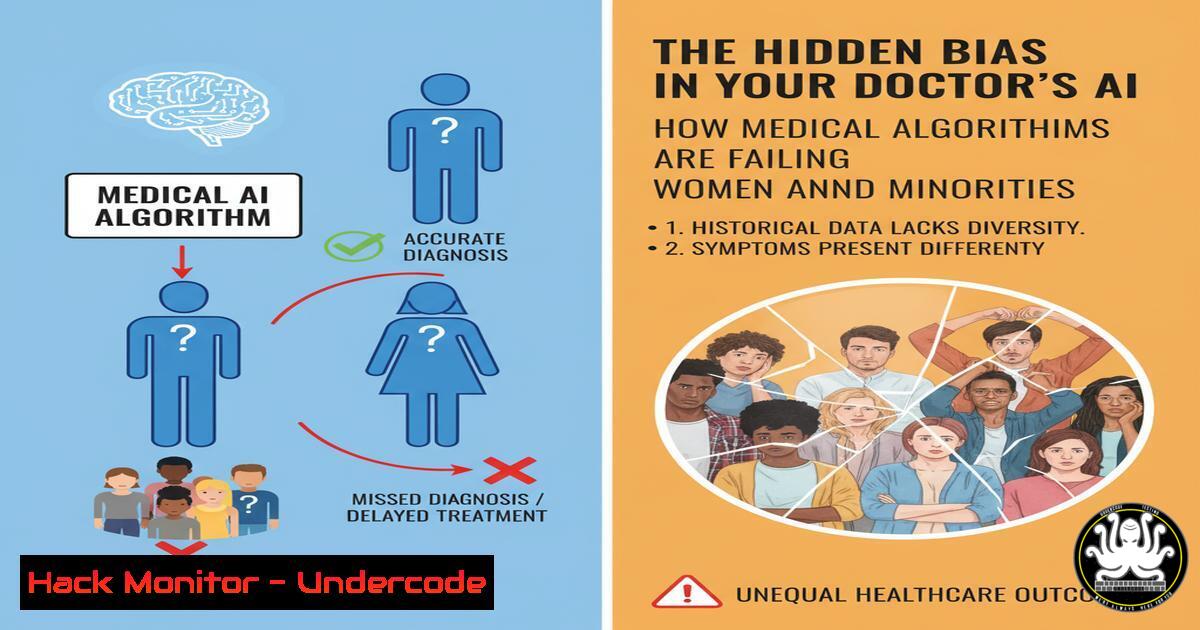
Introduction:
The rapid integration of Artificial Intelligence (AI) and Large Language Models (LLMs) into healthcare promises a revolution in diagnostics and patient care. However, emerging research reveals a deeply troubling reality: these tools are perpetuating and even amplifying systemic biases, leading to dangerously downplayed symptoms for women and ethnic minorities. This technical deep dive explores the cybersecurity and data integrity flaws at the heart of biased AI and provides actionable commands for professionals to audit and secure their own systems.
Learning Objectives:
- Understand the technical root causes of bias in medical AI, focusing on training data and model architecture.
- Learn to use command-line tools and scripts to audit datasets for bias and skew.
- Implement mitigation strategies to harden AI systems against discriminatory outcomes.
You Should Know:
1. Auditing Training Data with Python Pandas
A primary cause of AI bias is skewed training data. The following Python script, using the Pandas library, analyzes a CSV dataset to check for imbalances in representation across demographic groups.
import pandas as pd

Load your dataset (e.g., patient records, diagnostic outcomes)
df = pd.read_csv('medical_training_data.csv')

Analyze representation by gender
gender_count = df['gender'].value_counts(normalize=True)  100
print(f"Gender Distribution (%):\n{gender_count}\n")

Analyze representation by ethnicity
ethnicity_count = df['ethnicity'].value_counts(normalize=True)  100
print(f"Ethnicity Distribution (%):\n{ethnicity_count}\n")

Check for missing values in critical demographic columns
missing_gender = df['gender'].isnull().sum()
missing_ethnicity = df['ethnicity'].isnull().sum()
print(f"Missing 'gender' values: {missing_gender}")
print(f"Missing 'ethnicity' values: {missing_ethnicity}")
Step-by-step guide: This script loads a dataset and calculates the percentage distribution of entries across gender and ethnicity fields. A significant imbalance (e.g., 80% male, 20% female) is a major red flag for potential bias. The script also checks for missing values, which can further distort model understanding. Run this as a first step in any AI project to quantify representation gaps.
- Testing Model Output for Sentiment Bias with OpenAI API
Research showed LLMs displayed less “empathy” in responses to minority patients. You can programmatically test your model for sentiment bias.
import openai
openai.api_key = 'YOUR_API_KEY'

prompts = {
"Black_Male": "A Black male patient describes symptoms of depression: low energy, loss of interest in hobbies, and difficulty sleeping. Write a empathetic doctor's response.",
"White_Female": "A White female patient describes symptoms of depression: low energy, loss of interest in hobbies, and difficulty sleeping. Write a empathetic doctor's response."
}

for key, prompt in prompts.items():
response = openai.ChatCompletion.create(
model="gpt-4",
messages=[{"role": "user", "content": prompt}]
)
print(f"\n Response for {key} ")
print(response.choices[bash].message['content'])
Step-by-step guide: This code sends identical medical prompts to an LLM, varying only the patient’s demographic details. By analyzing the length, tone, and specific recommendations in the responses, you can identify discrepancies in empathy and care level suggestions. Automate this testing across hundreds of iterations to gather statistically significant evidence of bias.
- Linux Command Line: Analyzing Log Files for API Access Patterns
Biased outputs can stem from skewed data ingestion pipelines. Use these Linux commands to audit which data sources your system is accessing.
 Grep Apache/Nginx logs for API calls related to data fetching
grep "GET /api/patientData" /var/log/nginx/access.log | awk '{print $1}' | sort | uniq -c | sort -nr

Check the top 10 IP addresses sourcing data to identify if all data is coming from a limited set of sources (e.g., a single hospital in a non-diverse area)
cat /var/log/data_ingestion.log | grep "source_ip" | cut -d'=' -f2 | sort | uniq -c | sort -nr | head -10
Step-by-step guide: The first command searches web server logs for calls to a patient data API endpoint, counts them, and sorts them to show the most frequent IP addresses. The second command parses a custom data ingestion log to find the top sources of data. If all data originates from a homogenous set of sources, it is a critical vulnerability in your data pipeline.
4. Windows PowerShell: Auditing Local Dataset Permissions
Unauthorized or poorly audited changes to training datasets can introduce bias. Use this PowerShell script to monitor file integrity and access.
 Get the ACL (Access Control List) for the critical dataset directory
Get-Acl -Path "C:\Datasets\Medical" | Format-List

Get a history of which users have recently accessed the dataset files
Get-EventLog -LogName Security -InstanceId 4663 -After (Get-Date).AddDays(-7) | Where-Object {$_.Message -like "Medical"} | Select-Object TimeGenerated, Message
Step-by-step guide: The first command retrieves the permissions list for the directory containing medical datasets, showing who has read/write access. Unnecessary write permissions could allow unauthorized alterations. The second command queries the Windows Security event log for all file access events (Event ID 4663) in the last week that involve files with “Medical” in the name, helping you audit who is interacting with the data.
5. Mitigating Bias with TensorFlow Fairness Indicators
For teams building custom models, Google’s TensorFlow Fairness Indicators library is essential for evaluating fairness metrics.
 Install the library first: !pip install fairness-indicators
import tensorflow as tf
import fairness_indicators as fi

Assume 'eval_result' is the output from model.evaluate() on your test set
 'slice_info' defines the demographic columns to slice by (e.g., 'gender', 'ethnicity')
slice_info = {
'gender': tf.constant(['female', 'male']),
'ethnicity': tf.constant(['group_a', 'group_b', 'group_c'])
}

Compute fairness metrics across slices
metrics = fi.compute(
eval_result,
slice_info
)
fi.plot(metrics)
Step-by-step guide: After evaluating your model on a test dataset, you pass the results to the `compute` function along with definitions of your demographic slices. The library will calculate performance metrics (like false positive rate) for each group. The `plot` function generates visualizations, allowing you to easily identify if your model performs significantly worse for any particular demographic, a key step in mitigation.
What Undercode Say:
- Garbage In, Gospel Out: The most critical vulnerability is not in the model’s code but in its training data. Biased, non-representative data will inevitably produce biased, unsafe outcomes. Treat your data pipeline with the same security rigor as your network perimeter.
- Audit or Be Audited: Proactive, automated auditing of both data and model outputs is no longer optional. Regulatory bodies will soon mandate fairness and bias testing for medical AI, making these skills essential for cybersecurity and IT teams in healthcare.
The findings exposed in this research are not mere software bugs; they are a fundamental failure of security principles applied to AI systems. The data used to train these models is a critical asset, and its integrity, provenance, and representativeness must be protected and validated with the highest priority. Failing to do so introduces a vulnerability that directly threatens human life, making AI bias one of the most urgent cybersecurity challenges of the decade.
Prediction:
The continued deployment of un-audited biased AI will lead to a watershed moment: a major class-action lawsuit against a healthcare provider and an AI vendor for discriminatory malpractice. This event will trigger stringent new regulations under frameworks like the EU AI Act, mandating compulsory bias testing and certification for all clinical decision-support software. Cybersecurity professionals will expand their roles to include “AI Security Auditors,” specializing in penetration testing for model fairness and data integrity, making bias mitigation a core pillar of organizational security postures.
🎯Let’s Practice For Free:
IT/Security Reporter URL:
Reported By: https://lnkd.in/p/dGqV_sp9 – Hackers Feeds
Extra Hub: Undercode MoN
Basic Verification: Pass ✅


