Listen to this Post
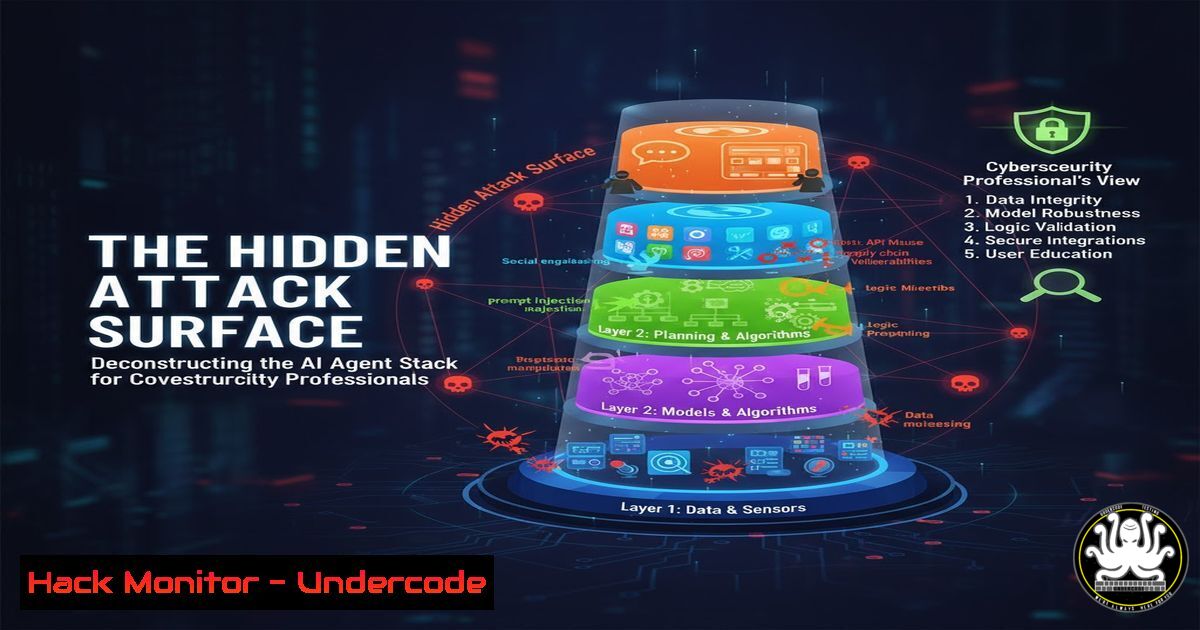
Introduction:
The rise of autonomous AI agents represents a paradigm shift in technology, but their complex, multi-layered architecture introduces a vast and novel attack surface. Understanding the AI Agent Stack is no longer just an engineering concern; it is a critical imperative for cybersecurity professionals tasked with defending these intelligent systems. This article deconstructs each layer of this “Operating System of Agentic AI” from a security perspective, revealing the inherent vulnerabilities and providing actionable commands to harden these systems.
Learning Objectives:
- Identify critical vulnerabilities across the five-layer AI Agent Stack (L1-L7).
- Implement verified security commands and configurations to harden AI agent infrastructure.
- Develop a proactive defense strategy for autonomous AI systems based on modular intelligence principles.
You Should Know:
- Securing the Foundation Layer (L1): LLM and Compute Integrity
The Foundation Layer, powered by LLMs and GPUs, is the bedrock of agent intelligence and a primary target for poisoning and extraction attacks.
Verified Command: LLM Guard – Input Scanning
`python -m pip install llm-guard`
from llm_guard import scan_output
from llm_guard.vault import Vault

scanned_output, results_valid, results_score = scan_output(
prompt="User query here",
output="LLM's raw response here",
scanners=[...]  e.g., Toxicity(), Sensitive()]
)
if not all(results_valid.values()):
print(f"Blocked output due to: {results_score}")
Step-by-Step Guide: This Python code snippet uses the `llm-guard` library to scan LLM inputs and outputs for malicious content, toxicity, and sensitive data leaks. After installation, you configure scanners (like Toxicity, Sensitive, Secret) and run all LLM communication through the `scan_output` function. It returns a sanitized output, a validation boolean, and a risk score, allowing you to block or log potentially dangerous agent interactions.
Verified Command: GPU Process Monitoring
`nvidia-smi –query-gpu=timestamp,name,utilization.gpu,utilization.memory –format=csv -l 5`
Step-by-Step Guide: This command continuously monitors GPU utilization every 5 seconds, which is critical for detecting cryptojacking malware or resource exhaustion attacks on your AI compute infrastructure. Anomalously high GPU usage when the agent is idle could indicate a compromised container or a malicious parallel process siphoning expensive computational resources.
- Hardening the Execution Layer (L2): Container and Orchestration Security
The Execution Layer, using runtimes like LangGraph, is where the agent’s actions are carried out, making secure isolation paramount.
Verified Command: Docker Container Hardening
`docker run –cap-drop=ALL –read-only –security-opt=”no-new-privileges:true” -it my_ai_agent`
Step-by-Step Guide: This command launches an AI agent container in a highly restricted state. `–cap-drop=ALL` removes all Linux capabilities, `–read-only` runs the filesystem as immutable to prevent persistent malware, and `–security-opt` prevents the process from escalating privileges. This significantly reduces the attack surface if the agent’s execution is compromised.
Verified Command: Kubernetes Network Policy
apiVersion: networking.k8s.io/v1
kind: NetworkPolicy
metadata:
name: ai-agent-deny-egress
spec:
podSelector:
matchLabels:
app: ai-agent
policyTypes:
- Egress
egress:
- to:
- namespaceSelector:
matchLabels:
name: langgraph-runtime
Step-by-Step Guide: This Kubernetes Network Policy applies to pods labeled app: ai-agent. It implements a default-deny egress policy, only allowing outbound traffic to resources in a namespace labeled name: langgraph-runtime. This contains a compromised agent, preventing it from exfiltrating data to arbitrary external IP addresses.
- Fortifying the Infrastructure Layer (L3): Securing Agent Communication
This layer handles inter-agent communication (A2A) and is vulnerable to man-in-the-middle (MitM) and token hijacking attacks.
Verified Command: Inspecting mTLS with OpenSSL
`openssl s_client -connect agent-orchestrator:8443 -cert agent-cert.pem -key agent-key.pem -CAfile ca.pem`
Step-by-Step Guide: This command tests mutual TLS (mTLS) connectivity between agents. It verifies that the client (agent) presents a valid certificate (agent-cert.pem) and key, and trusts the Certificate Authority (ca.pem). Enforcing mTLS for all A2A and A2E (Agent-to-Environment) communication is essential to prevent impersonation and eavesdropping.
Verified Command: JWToken Validation & Inspection
`echo $JWT | cut -d “.” -f 2 | base64 -d | jq`
Step-by-Step Guide: This bash one-liner decodes and pretty-prints the payload of a JWT used for agent context tokens. Security teams should script this to automatically validate token signatures (using a library, not manually), check expiration (exp), and verify the issuer (iss) to prevent token replay attacks and ensure that only authorized agents can participate in communication.
- Defending the Agent Layer (L4): Memory, Tools, and Feedback Loops
The Agent Layer’s autonomy—through memory, tool usage, and learning—is a double-edged sword, creating risks of prompt injection, tool misuse, and corrupted learning.Verified Command: YARA Rule for Prompt Injection Patterns
`rule Prompt_Injection_Attempt { strings: $a = /ignore.previous|previous.instructions/ nocase $b = /system.prompt/ nocase condition: any of them }`
Step-by-Step Guide: This YARA rule can be deployed on network monitoring tools or within the agent’s input processing logic to detect common prompt injection phrases. It looks for case-insensitive matches of strings like “ignore previous instructions” or “system prompt,” which are hallmarks of an attempt to hijack the agent’s reasoning process.
Verified Command: Sandboxed Python Tool Execution
import restrictedpython
code = """tool_function(data)"""  Untrusted tool code from agent
try:
byte_code = restrictedpython.compile_restricted(code)
exec(byte_code)
except SyntaxError as e:
print(f"Potentially dangerous tool code blocked: {e}")
Step-by-Step Guide: When an AI agent needs to execute a dynamically generated tool (e.g., a Python function), never use a standard exec(). This snippet uses the `restrictedpython` library to compile and execute the code within a sandbox that prohibits access to dangerous modules like `os` or sys, mitigating the risk of remote code execution.
- Securing the Application Layer (L5-L7): Reasoning and Knowledge Access
The top layers handle complex reasoning (ReAct, ReWOO) and knowledge retrieval (RAG), which are susceptible to data poisoning and logic manipulation.Verified Command: RAG Pipeline Integrity Check with `ragas`
`pip install ragas`
`python -m ragas.evaluate –dataset your_rag_dataset –metrics answer_relevancy context_precision`
Step-by-Step Guide: The `ragas` library evaluates the quality and security of your Retrieval-Augmented Generation pipeline. A sudden drop in metrics like `answer_relevancy` or `context_precision` could indicate that your knowledge base has been poisoned with malicious or misleading data, causing the agent to generate incorrect or compromised reasoning.
Verified Command: AWS S3 Bucket Policy for RAG Vector Stores
{
"Version": "2012-10-17",
"Statement": [{
"Effect": "Deny",
"Principal": "",
"Action": "s3:",
"Resource": "arn:aws:s3:::your-rag-vector-store/",
"Condition": {"Bool": {"aws:SecureTransport": false}}
}]
}
Step-by-Step Guide: This AWS S3 bucket policy enforces that all access to the bucket storing your RAG system’s vector embeddings must use SSL/TLS (SecureTransport). This prevents attackers from sniffing or tampering with the agent’s core knowledge base during transit, a critical step in protecting the integrity of the agent’s planning and reasoning capabilities.
What Undercode Say:
- The Stack is the Attack Surface. Each layer of the AI Agent Stack, from L1 to L7, introduces unique vulnerabilities that traditional security tools are blind to. Defense must be equally layered and integrated.
- Modularity is a Security Feature. The recommended strategy of “building modular intelligence” is not just for agility; it’s for containment. A security breach in an agent’s memory module should not automatically lead to a compromise of its tool-use execution environment.
The conversation around AI agents is dominated by their capabilities, but the security implications are profound. An attacker doesn’t need to break cryptography when they can poison the RAG knowledge base (L5) to manipulate reasoning, hijack a tool call (L4) via prompt injection, or exfiltrate sensitive context tokens (L3). The tight coupling between layers, as noted in the comments, creates a cascade risk. Our analysis indicates that the primary threat is not a single exploit, but a “kill chain” that moves laterally through this stack. Security must evolve from protecting a perimeter to governing intelligent, autonomous processes.
Prediction:
Within the next 18-24 months, we will witness the first major cyber incident caused by a compromised AI agent, likely originating from a poisoned foundation model or a exploited tool-use vulnerability. This will trigger a industry-wide shift towards “Agent Security Posture Management” (ASPM) tools, designed specifically to continuously assess, monitor, and enforce security policies across the entire AI Agent Stack, treating the agent’s reasoning and actions as a new, critical asset class to defend.
🎯Let’s Practice For Free:
IT/Security Reporter URL:
Reported By: Greg Coquillo – Hackers Feeds
Extra Hub: Undercode MoN
Basic Verification: Pass ✅


