
Listen to this Post
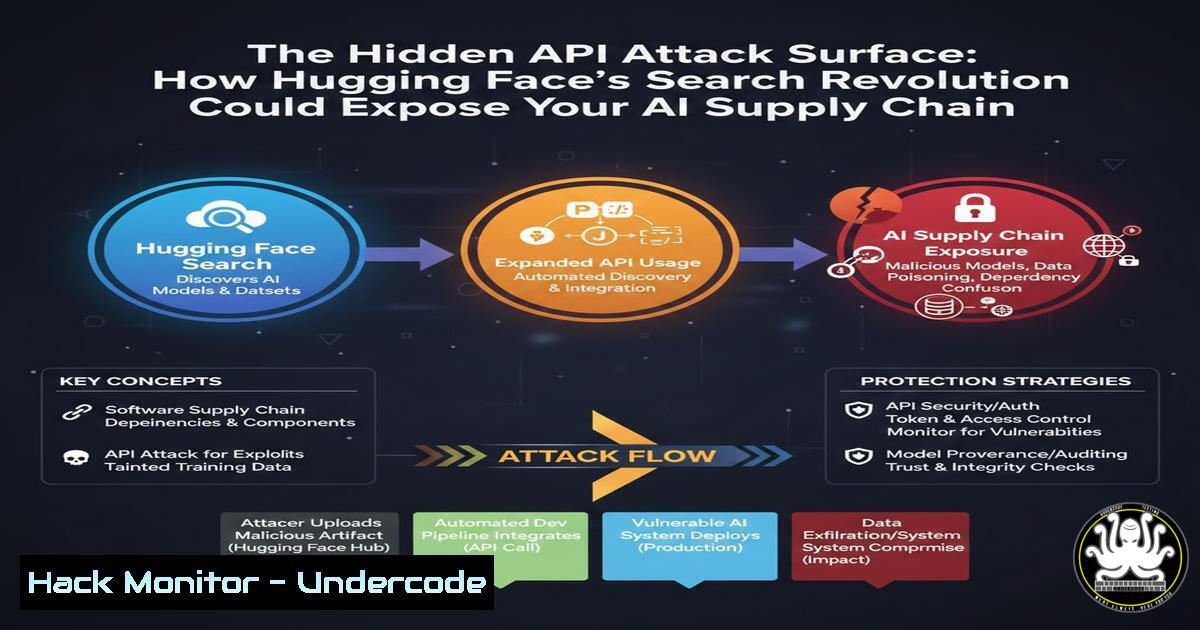
Introduction:
The recent upgrade to Hugging Face’s model hub search functionality represents a paradigm shift in AI asset discovery, enabling granular filtering by organization, user, and repository. While this empowers developers and AI agents with unprecedented precision, it also creates a new, automated attack surface for threat actors to map, profile, and potentially compromise AI/ML supply chains at scale. This article deconstructs the technical implications, demonstrating both the power of the new API and the critical security hardening required to mitigate associated risks.
Learning Objectives:
- Understand the technical capabilities and API endpoints of Hugging Face’s enhanced search.
- Learn how to programmatically map an organization’s AI assets and identify potential exposure points.
- Implement security controls and monitoring to protect against AI supply chain enumeration and targeted attacks.
You Should Know:
- Deconstructing the New Search API: From User Feature to Reconnaissance Tool
The update programmatically exposes search filters via the Hugging Face Hub API. This allows for the systematic enumeration of all models, datasets, and spaces belonging to a specific entity.
Step‑by‑step guide:
First, install the necessary Python library and configure your environment.
 Install/update the huggingface_hub library
pip install --upgrade huggingface_hub
Next, use Python to query for all models from a specific organization, such as a company or research lab.
from huggingface_hub import HfApi, ModelFilter

api = HfApi()
 Filter models by the 'facebook' organization
models = api.list_models(
filter=ModelFilter(author="facebook"),
sort="downloads",
direction=-1
)
for model in models[:5]:  List top 5 by downloads
print(f"Model: {model.id} | Downloads: {model.downloads}")
This script lists the most popular models from the target organization, providing an attacker with a priority list of high-value assets to probe for vulnerabilities.
2. Advanced Enumeration: Stacking Filters for Targeted Intelligence
The true power for both developers and attackers lies in stacking multiple filters—combining author, task, language, and more—to create a highly focused target list.
Step‑by‑step guide:
An adversary can combine filters to find, for example, all text-generation models from a specific user that were recently updated, as these might be in active development and potentially less hardened.
from huggingface_hub import HfApi, ModelFilter
from datetime import datetime, timedelta

api = HfApi()
 Calculate date 7 days ago
last_week = (datetime.now() - timedelta(days=7)).isoformat()

filter_obj = ModelFilter(
author="specific_username",
task="text-generation",
lastModified=last_week
)
recent_models = api.list_models(filter=filter_obj)
for model in recent_models:
print(f"Recent Target: {model.id} | Last Modified: {model.lastModified}")
 An attacker would now inspect model card, configuration files, and inference code
3. The Agent Threat: Automated Supply Chain Mapping
The post explicitly mentions this is “even better for agents.” Malicious automation can now systematically crawl Hugging Face, building a complete graph of organizational assets, dependencies, and contributors with minimal effort.
Step‑by‑step guide (Linux-based crawling script):
!/bin/bash
 Example: Basic shell script to catalog all repos for a list of orgs
ORG_LIST=("org1" "org2" "org3")
for ORG in "${ORG_LIST[@]}"; do
echo "[] Enumerating: $ORG"
 Use the hf_hub_download helper or direct API calls
python3 -c "
from huggingface_hub import HfApi
api = HfApi()
items = api.list_models(author='$ORG')
for i in items:
print(i.id)
" > "reports/${ORG}_models.txt"
done
This kind of automation allows for persistent monitoring of an opponent’s AI asset deployment.
4. Critical Security Misconfigurations to Hunt For
The discovered models and spaces must be inspected for common security flaws. Two primary targets are Inference API widgets and Spaces with custom code.
Step‑by‑step guide: Inspecting a Space’s configuration:
- Navigate to any Hugging Face Space (e.g., `https://huggingface.co/spaces/username/space_name`).
- Review the `README.md` for embedded secrets or dangerous instructions.
- Click “Files” to inspect the
app.py,requirements.txt, and any configuration files.
4. Look for:
Hardcoded secrets (API keys, tokens) in code or environment variables.
Unsanitized user input passed to `subprocess` or `eval()` functions.Outdated or vulnerable packages listed in
requirements.txt.
5. Hardening Your Organization’s AI Footprint
Proactive defense is required. Implement these controls to reduce your attack surface.
Step‑by‑step guide:
Audit & Inventory: Regularly run the enumeration scripts against your own organization to know what is exposed. Use the Hugging Face API with a valid token.
from huggingface_hub import HfApi
api = HfApi(token="hf_your_token_here")  Use a token with read access
Model Card Security: Treat model cards as public documentation. Never include example commands with secret keys or internal URLs.
Space Security: For Spaces, use Hugging Face’s secret management for credentials. Sanitize all user inputs and run the container with the least necessary privileges. Regularly update dependencies.
Monitoring: Set up alerts for unusual access patterns to your organization’s Hugging Face profile or repositories using available logs.
6. API Security: Token Management and Rate Limiting
The API is the core of this feature. Protecting your tokens and understanding rate limits is crucial for both legitimate use and defense.
Step‑by‑step guide (Windows Command Line):
 Setting your HF token as an environment variable (User variable)
setx HF_TOKEN "your_token_here"
 Verify it's set (may require new command prompt)
echo %HF_TOKEN%
Always use the principle of least privilege. Prefer tokens with `read` scope only for enumeration tasks. Monitor your API usage in the Hugging Face account settings to detect unauthorized use.
- The Shared URL Blind Spot: Information Leakage via Bookmarks
The “share them via URL” feature can inadvertently leak search strategies or reveal which models/internal projects an organization is focusing on, if such URLs are publicly shared.
Mitigation Step‑by‑step guide:
- Awareness: Train developers that shared search URLs are public. A URL like `https://huggingface.co/models?author=mycompany&search=bert&sort=downloads` reveals your company’s interest in BERT models.
- Policy: Establish internal policies for sharing such links. Use internal communication channels for sensitive collections.
- Alternative: For internal curation, consider using the official `huggingface_hub` library to maintain private lists programmatically instead of relying on browser bookmarks.
What Undercode Say:
- The Democratization of Discovery is a Double-Edged Sword. The same features that accelerate ethical AI development also lower the barrier for sophisticated reconnaissance, enabling targeted attacks against the AI pipeline with surgical precision.
- Your AI Model Hub is Now a Critical Asset in Your Attack Surface. It must be inventoried, hardened, and monitored with the same rigor as your cloud infrastructure or code repositories. Ignoring it creates a shadow IT risk for machine learning.
This evolution marks a shift from opportunistic attacks on random AI models to systematic, intelligence-driven campaigns. Organizations with valuable models or data will find themselves profiled. The future will see increased automated scanning for vulnerabilities in Spaces, poisoned model uploads targeting specific companies found via these filters, and phishing campaigns tailored to individual AI researchers identified through their repositories. The integration of AI agents into this ecosystem will only accelerate the pace of both innovation and exploitation.
Prediction:
Within the next 12-18 months, we will witness the first major supply chain attack propagated through a compromised Hugging Face model or Space, directly targeted at an organization identified and profiled using these advanced search and API capabilities. This will trigger a maturation of AI supply chain security tools, leading to the rise of specialized “AI Asset Management” and “Model Vulnerability Scanning” platforms, integrating with tools like Wiz or Tenable, to provide continuous assessment of this new attack surface.
▶️ Related Video (76% Match):
🎯Let’s Practice For Free:
IT/Security Reporter URL:
Reported By: Mishig Updated – Hackers Feeds
Extra Hub: Undercode MoN
Basic Verification: Pass ✅


