
Listen to this Post
Introduction:
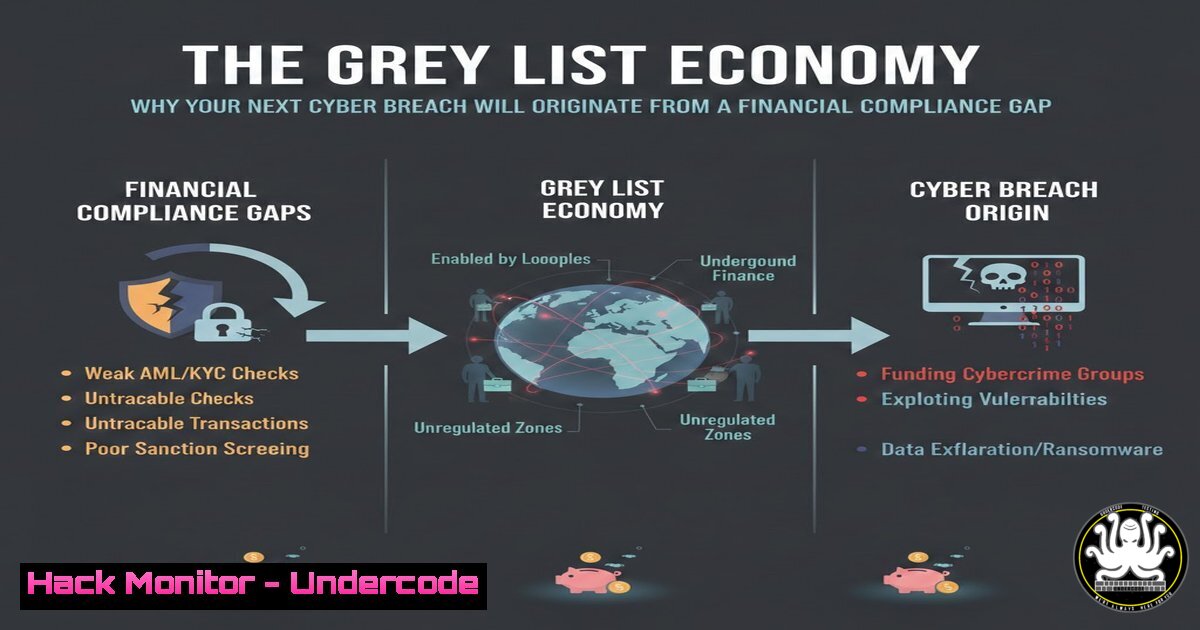
While cybersecurity teams are busy patching Log4j and configuring firewalls, a more insidious threat is quietly bypassing technical controls: the financial geography of risk. When the FATF (GAFI) places a country on its “grey list,” it signals more than just lax banking regulations—it signals a high-probability environment for supply chain infiltration, financial espionage, and sanctions evasion. For security professionals, understanding the “Listes Grises” is no longer a compliance checkbox; it is a critical component of threat modeling, as illicit financial flows are often the delivery mechanism for advanced persistent threats (APTs) and ransomware payments.
Learning Objectives:
- Understand the correlation between FATF grey lists and increased cyber risk vectors in third-country transactions.
- Learn to identify “plausible deniability” financial flows as indicators of compromise (IoCs) for supply chain attacks.
- Master the technical tools and commands (Linux/Windows) to audit vendor connections from high-risk jurisdictions.
- Develop a framework for mapping financial crime scenarios to specific cybersecurity defense mechanisms.
You Should Know:
- Mapping the “Grey List” to Your Network Perimeter (The Reconnaissance Phase)
The initial stage of any sophisticated attack involving third-country risk is financial reconnaissance. Attackers exploit jurisdictions with weak Anti-Money Laundering (AML) controls to mask the funding of their operations. For a defender, this means that a sudden increase in legitimate-looking transactions from a grey-listed country (e.g., Myanmar or Iran) to a subsidiary or vendor could be the precursor to a network intrusion.
Step‑by‑step guide: Auditing Vendor Financial Origins
To determine if your supply chain is a conduit for risk, you must cross-reference network traffic with business transaction data.
– Linux Command (Threat Intelligence Lookup): Use `whois` and `geoiplookup` to verify the physical location of vendor servers.
 Install geoip-bin if needed: sudo apt-get install geoip-bin
geoiplookup 192.0.2.45
 Output might show: GeoIP Country Edition: (Myanmar)
whois 192.0.2.45 | grep -i country
– Windows Command (PowerShell): Use PowerShell to trace the route and identify network hops that terminate in high-risk jurisdictions.
Test-NetConnection vendor-portal.com -TraceRoute | Select-Object -ExpandProperty TraceRoute | ForEach-Object { Resolve-DnsName -Name $_.ToString() -ErrorAction SilentlyContinue }
– Tool Configuration (Shodan): Use Shodan CLI to scan for exposed vendor assets in specific countries.
shodan search --limit 10 --fields ip_str,port,org "country:IR port:3389" Checks for exposed RDP in Iran
This process reveals if your business logic (paying a vendor) is connected to a geographic location known for sanctions evasion.
- Simulating “Plausible Flows”: Financial Fraud and Data Exfiltration
As Sandra Aubert notes, “Le financement du terrorisme passe rarement par une opération spectaculaire. Il passe par des flux plausibles.” In cybersecurity, these “plausible flows” are often masked as API calls to payment gateways or small, frequent transactions to hide data exfiltration or ransomware testing.
Step‑by‑step guide: Detecting Anomalous Financial API Traffic
- API Security Check: Inspect API payloads for data types that shouldn’t be there (e.g., PII embedded in payment fields).
Simple Python script to inspect API logs for suspicious payload sizes to grey-list countries import json log_entry = {"destination": "MM", "payload_size": 15000, "endpoint": "/api/payment"} if log_entry["destination"] in ["MM", "IR", "KP"] and log_entry["payload_size"] > 10000: print(f"Alert: Large payload to {log_entry['destination']}. Possible data exfiltration.") - Windows Log Analysis (Event Viewer): If a financial transaction triggers a PowerShell script (common in PoS malware), check for Process Creation logs (Event ID 4688).
Get-WinEvent -FilterHashtable @{LogName='Security'; ID=4688} | Where-Object {$<em>.Message -like "powershell" -and $</em>.Message -like "encodedcommand"} | Format-ListThis mimics how an attacker might use a compromised payment terminal to stage data before sending it to a jurisdiction with weak extradition treaties.
3. The “Ingérence Économique” Scenario: Supply Chain Infiltration
The post highlights “infiltration supply chain” as a key risk. This involves an attacker using a front company in a grey-list country to acquire a small, vulnerable supplier. Once inside that supplier’s network, they pivot into the primary target’s network via VPN or EDI connections.
Step‑by‑step guide: Hardening Third-Party Connections
- Linux (iptables): Restrict incoming traffic from vendor subnets to specific ports only.
Allow vendor access ONLY to the SFTP port, block everything else
iptables -A INPUT -s VENDOR_IP_RANGE -p tcp --dport 22 -j ACCEPT
iptables -A INPUT -s VENDOR_IP_RANGE -j DROP
- Cloud Hardening (AWS S3): Audit your S3 buckets to ensure no “Vendor” buckets are publicly readable, a common oversight when dealing with high-pressure international partnerships.
aws s3api get-bucket-acl --bucket vendor-exchange-bucket | grep -i "uri.allusers"
- Windows Firewall: Use Advanced Security rules to restrict domain controllers from communicating with non-domain machines in high-risk zones.
New-NetFirewallRule -DisplayName "Block Grey List Countries" -Direction Outbound -RemoteAddress "192.0.2.0/24" -Action Block
4. Exploitation/Mitigation: KYC as an Attack Vector
Know Your Customer (KYC) data is a goldmine. Attackers targeting the “risk of economic interference” will attempt to steal KYC documents (passports, utility bills) from companies dealing with grey-list entities. This data is then used for identity theft or corporate espionage.
Step‑by‑step guide: Securing KYC Repositories
- Linux File Integrity Monitoring: Use `AIDE` (Advanced Intrusion Detection Environment) to monitor directories where KYC docs are stored.
Initialize AIDE database
aide --init
Move database to read-only location
mv /var/lib/aide/aide.db.new.gz /var/lib/aide/aide.db.gz
Check for changes daily
aide --check
- Database Security (SQL): Implement Data Loss Prevention (DLP) at the DB level. Create a honeypot file with fake credentials to alert on access.
-- Create a fake table to trap attackers
CREATE TABLE honeypot_kyc (full_name TEXT, ssn TEXT, passport_number TEXT);
INSERT INTO honeypot_kyc VALUES ('John Doe', '000-00-0000', 'FAKEPASSPORT123');
-- Monitor logs for any SELECT queries on this table
- Predictive Defense: The “6-7% Investment Drop” as a Security Metric
The post mentions that grey-list inclusion can impact a country’s investment by 6-7%. Security teams can use this economic data as a “canary in the coal mine.” A sudden divestment from a partner country might indicate upcoming instability, leading to desperate actors (insider threats) selling data, or neglected security infrastructure becoming vulnerable.
Step‑by‑step guide: Automating Threat Feeds with Economic Indicators
- Linux Automation (Cron & Curl): Pull daily lists of updated sanctions from the EU or OFAC and automatically block related IP ranges.
/bin/bash
wget -q https://example.com/sanctioned_ips.txt -O /tmp/sanctions.txt
while read ip; do
iptables -A INPUT -s $ip -j DROP
done < /tmp/sanctions.txt
- Splunk Query: Correlate financial transaction logs with IDS alerts.
index=firewall src_country=MM OR src_country=IR | stats count by src_ip, dest_port | where count > 100
If you see a spike in connections from a grey-list country, it is time to initiate incident response, regardless of whether the traffic is “business-related.”
What Undercode Say:
- The Perimeter is Economic, Not Just Digital: The traditional network perimeter has dissolved. Your new boundary is defined by the Anti-Money Laundering (AML) compliance of your vendors. If a vendor operates in a jurisdiction with weak financial oversight, they are technically a weak link in your security chain.
- Threat Hunting Requires Financial Acumen: Cybersecurity analysts must now hunt for “financial anomalies” (unusual payment sizes, strange routing numbers, new accounts in grey-list countries) with the same rigor as they hunt for malware hashes. The initial access vector for the next major breach will likely be a compromised financial transaction, not a phishing email.
Prediction:
In the next 18 months, we will see the emergence of “Financial Geography Security” as a distinct sub-domain of cybersecurity. Major breaches will be traced back, not to a zero-day exploit, but to a failure to audit a vendor in a FATF grey-list jurisdiction. Security teams will begin hiring financial crime experts to sit alongside SOC analysts, and automated tools will begin ingesting real-time sanctions lists to dynamically adjust firewall policies, effectively merging the disciplines of AML and Infosec into a unified defense against economic warfare.
▶️ Related Video (76% Match):
🎯Let’s Practice For Free:
IT/Security Reporter URL:
Reported By: Sandra Aubert – Hackers Feeds
Extra Hub: Undercode MoN
Basic Verification: Pass ✅


