
Listen to this Post
Introduction:
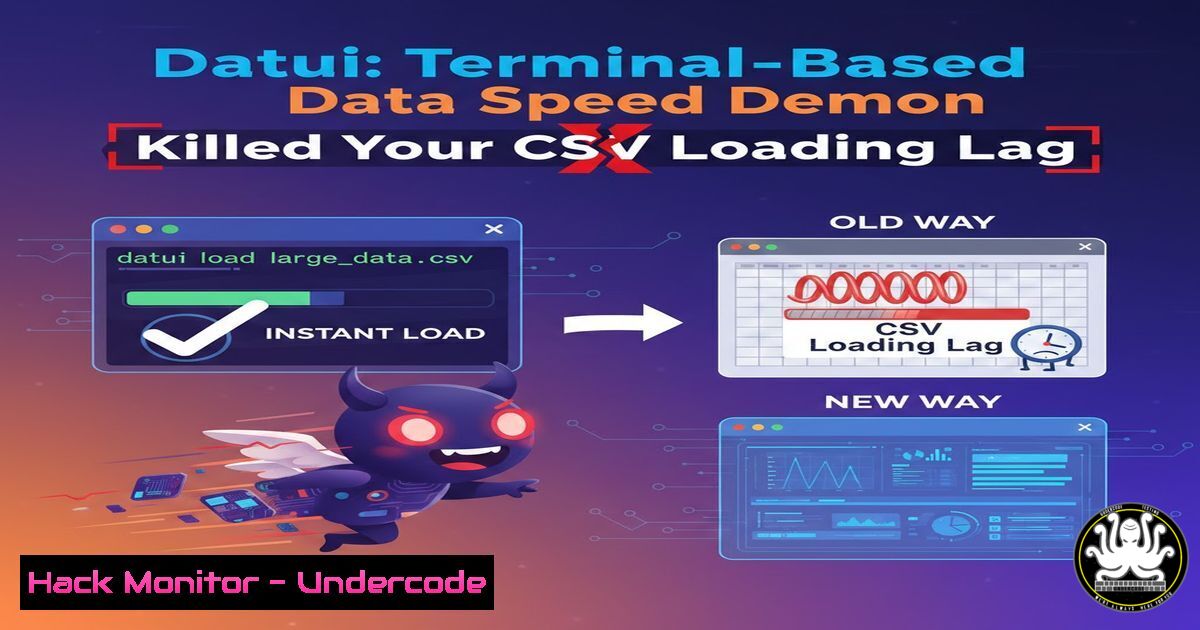
In the high-stakes world of cybersecurity analysis, time is the one resource you cannot afford to waste. Analysts frequently find themselves bottlenecked not by a lack of data, but by the sheer friction of accessing it. Waiting for bloated SIEM exports or multi-gigabyte CSV files to load in traditional notebooks or spreadsheet software creates critical delays in incident response. Enter Datui, a terminal interface built on Polars streaming that allows security professionals to explore massive datasets instantly, leveraging the speed of the command line to perform fuzzy searches, SQL queries, and visualizations without the overhead of a graphical interface.
Learning Objectives:
- Understand how to leverage Datui for rapid triage of large security datasets (logs, SIEM exports).
- Master the installation and navigation of a terminal-based data exploration tool.
- Learn to perform complex data manipulation (filtering, grouping, pivoting) and SQL queries on local and remote data sources.
- Identify practical use cases for Datui in resource-constrained environments and incident response scenarios.
You Should Know:
- Installation and First Launch: Getting Datui on Your System
The post highlights Datui as a tool for environments where you “just want to understand what you have in front of you.” Installation is straightforward, utilizing common package managers or direct binary downloads, making it ideal for deployment on locked-down security appliances or personal analysis VMs.
Step‑by‑step guide:
For a Linux analysis machine (like a Ubuntu/Debian instance used for forensic analysis), you can typically grab the latest release from the provided GitHub link. Assuming it’s available via Cargo (Rust package manager) or as a binary:
 If using Cargo (common in dev environments)
cargo install datui

Alternatively, download the latest Linux binary directly
 (Check the releases page on the GitHub link: https://github.com/yourusername/datui)
wget https://github.com/yourusername/datui/releases/latest/download/datui-linux-amd64 -O datui
chmod +x datui
sudo mv datui /usr/local/bin/

Launch the tool against a sample log file
datui /var/log/auth.log
For Windows analysts using PowerShell or WSL:
 If using WSL, follow the Linux steps above.
 If using a native Windows binary, download the .exe and run it from CMD or PowerShell.
.\datui.exe C:\Security\Logs\firewall_logs.csv
- Loading Massive Datasets: Local, S3, and HTTP Sources
The core pain point Datui solves is the inability to open large files. Whether you have a 10GB pcap export in CSV format or a Parquet file from a cloud data lake, Datui uses streaming to load it instantly.
Step‑by‑step guide:
Imagine you have a massive Apache log file that you suspect contains malicious traffic patterns.
 Load a local CSV file (common for SIEM exports)
datui siem_export_april_2026.csv

Load a remote file directly from an S3 bucket (useful for cloud forensics)
datui s3://my-security-bucket/logs/2026/02/23/cloudtrail_logs.json

Load via HTTP (e.g., from a temporary share or a web server)
datui https://internal.analysis.server/large_export.parquet
- Rapid Analysis with Fuzzy Search and Vim‑Style Navigation
Once loaded, the interface mimics the efficiency of a text editor. This is crucial when you are hunting for an IOC (Indicator of Compromise) like a specific IP address or user agent string across millions of lines.
Step‑by‑step guide:
You are looking for any access from a suspicious IP (10.0.0.55) in a large auth log.
1. Open the file: `datui /var/log/auth.log`
- Use the Vim-style navigation (
jfor down, `k` for up, `gg` to go to top, `G` to go to bottom) to scroll through the data structure.
3. Press `/` to initiate a fuzzy search.
- Type the IP:
10.0.0.55. Datui will instantly filter the dataset to show only rows containing that IP, even if the column structure is messy.
4. Leveraging SQL for Complex Threat Hunting
For analysts more comfortable with query languages, Datui embeds SQL capabilities directly into the terminal. This allows you to aggregate data on the fly—for example, counting the number of failed login attempts per source IP without exporting to a database.
Step‑by‑step guide:
Analyzing a Windows Security log exported to CSV (security_events.csv).
datui security_events.csv
Once inside the terminal interface, you can invoke the SQL mode (the command might be `:sql` or a specific keybind, check the tool’s help with :help).
-- Count failed logins (Event ID 4625) grouped by source IP
SELECT Source_Network_Address, COUNT() as Failed_Attempts
FROM security_events
WHERE Event_ID = 4625
GROUP BY Source_Network_Address
ORDER BY Failed_Attempts DESC;
5. Generating CLI Graphs for Visual Pattern Recognition
Sometimes, a visual spike in data tells you more than raw numbers. Datui can render graphs directly in the terminal, allowing you to spot DDoS attempts or brute-force patterns at a glance.
Step‑by‑step guide:
You want to see the frequency of log entries over time to identify an anomaly.
1. Load your dataset: `datui firewall_traffic.csv`
- Use the “group by” and charting feature. This might be a specific command like `:chart` followed by the parameters (e.g., time-based grouping).
- The terminal will render a bar chart or line graph showing traffic volume per hour.
- If a pattern is identified, you can export the raw data slice using filters and then use a standard tool like `scp` to move it for deeper analysis.
What Undercode Say:
- Key Takeaway 1: Speed is a Security Control. Datui effectively removes the latency between the analyst and the evidence. By leveraging Polars streaming, it turns “dead time” waiting for data loads into active analysis, directly accelerating Mean Time to Respond (MTTR).
- Key Takeaway 2: CLI Mastery Remains Essential. This tool underscores that in high-pressure or resource-constrained environments (like a SOC analyst’s jump box or a live forensic acquisition), the terminal remains the most versatile and powerful interface. It provides the efficiency of a database without the setup time, making it a perfect “swiss army knife” for data triage.
Analysis: Datui represents a broader shift in security tooling toward lightweight, composable utilities that respect the analyst’s workflow. While SIEMs and notebooks are excellent for deep-dive correlation and visualization, they are overkill for the initial triage phase. Datui fills this niche perfectly, allowing an analyst to quickly verify a hypothesis (“Is this IP in the logs?”) or scope an incident (“How many systems were affected?”) in seconds. Its support for remote sources like S3 also aligns perfectly with modern cloud-native security architectures, where data is often distributed.
Prediction:
We will see a rise in “terminal-native” data tools designed specifically for incident response. As data volumes grow exponentially, the “lightweight explorer” category (like Datui, VisiData, and xsv) will become as fundamental to a security analyst’s toolkit as `grep` and jq. Expect deeper integrations with cloud SIEM APIs, allowing analysts to stream hot data directly into these tools for real-time threat hunting without the latency of a web dashboard.
▶️ Related Video (82% Match):
🎯Let’s Practice For Free:
IT/Security Reporter URL:
Reported By: Laurent Biagiotti – Hackers Feeds
Extra Hub: Undercode MoN
Basic Verification: Pass ✅


