Listen to this Post
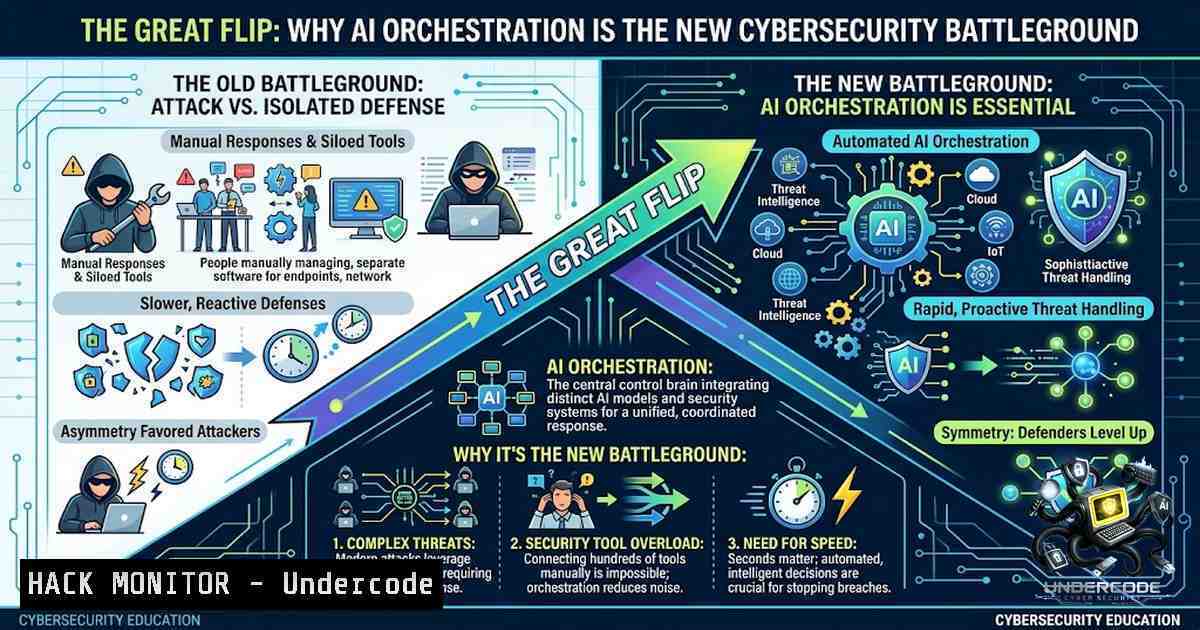
Introduction:
The software development lifecycle has undergone a tectonic shift. What was once a discipline dominated by syntax mastery and algorithmic implementation has evolved into a strategic exercise in system orchestration and problem definition. For cybersecurity professionals, this transformation is not merely an operational change; it is a fundamental redefinition of the threat landscape, where the “code” is no longer the primary asset, but rather the “intent” and “context” that drive it.
Learning Objectives:
- Understand the paradigm shift from manual coding to AI-driven orchestration and its implications for security architecture.
- Identify the new attack surfaces introduced by AI agents, large language models (LLMs), and automated pipelines.
- Master the configuration of security controls for CI/CD, API gateways, and cloud-1ative environments to protect AI-generated code.
You Should Know:
1. The 80/20 Rule Reversed: Orchestration Over Syntax
In 2016, the industry focused on writing efficient, secure code. Today, AI models handle the bulk of boilerplate generation, error correction, and even complex algorithm implementation. The security professional’s role has shifted to “orchestration”—ensuring that the AI’s output is integrated safely into the broader ecosystem. The risk is no longer just buffer overflows in C++; it is now prompt injection flaws and insecure pipeline configurations.
Step‑by‑step guide to auditing your AI‑generated code workflow:
- Step 1: Map your AI touchpoints. Identify where developers use tools like GitHub Copilot or ChatGPT to generate code.
- Step 2: Establish a “human-in-the-loop” policy. Critical security functions (authentication, authorization, cryptography) should never be blindly committed without a security review.
- Step 3: Implement Static Application Security Testing (SAST) integrated directly into your CI/CD pipeline to scan AI-generated code.
- Step 4: Use `grep` and `regex` to search for known insecure patterns in generated files. For Linux: `grep -r “eval(” ./src/` or
grep -r "password =" ./src/. For Windows PowerShell:Select-String -Path .\src\.py -Pattern "eval\(".
- Securing the AI Supply Chain (Model and Prompt Security)
The code is output, but the model is the brain. If the model is poisoned or the prompt is hijacked, the resulting code becomes a “Trojan Horse” deployed directly to production. This section covers the hardening of the ML lifecycle.
Step‑by‑step guide to secure your model registry and prompts:
– Step 1: Restrict network access to your MLflow or Hugging Face model registries to only trusted IPs (e.g., via cloud firewalls).
– Step 2: Validate model provenance. Use digital signatures or checksums (e.g., shasum -a 256 model.bin) to ensure the model hasn’t been tampered with.
– Step 3: Implement a Prompt Security Layer. Sanitize user inputs before they reach the LLM. Use libraries like `langchain` to define defensive prompts.
– Step 4: Monitor logs for “prompt injection” attempts. Set up alerts in your SIEM for unexpected model outputs (e.g., “Ignore previous instructions”).
– Step 5: For Windows environments, ensure Group Policy Objects (GPOs) restrict the execution of unknown scripts that might be generated by AI tools.
- Infrastructure as Code (IaC) Hardening: Terraform and CloudFormation
Since AI is generating infrastructure configurations alongside application code, the blast radius of a misconfiguration has exploded. A single AI-suggested Terraform script could expose an S3 bucket or an RDS database if not validated.
Step‑by‑step guide to validate infrastructure generated by AI:
- Step 1: Use `terraform fmt -check` in Linux to ensure code formatting consistency.
- Step 2: Integrate `terraform validate` and `checkov` or `tfsec` to scan for AWS, Azure, and GCP misconfigurations. Command:
checkov -d ./terraform/. - Step 3: Implement Sentinel (HashiCorp) or OPA (Open Policy Agent) to enforce security policies programmatically.
- Step 4: Review IAM policies specifically. AI often generates over-permissive roles. Ensure Least Privilege is explicitly coded.
- Step 5: In Windows, use PowerShell to parse CloudFormation templates:
Get-Content template.json | ConvertFrom-Json.
- API Security in the Age of AI Agents
AI is increasingly used to build APIs, but also to consume them. If a developer uses AI to create a REST endpoint, it might lack proper rate limiting or input validation. More critically, AI agents are now “browsing” the web—this introduces OWASP API Top 10 risks like Broken Object Level Authorization (BOLA) and Excessive Data Exposure.
Step‑by‑step guide to harden APIs in an AI-driven build process:
– Step 1: Use OpenAPI/Swagger to enforce schema validation for all incoming requests.
– Step 2: Implement “Strict Transport Security” and enforce TLS 1.3. For Linux: openssl s_client -connect api.example.com:443 -tls1_3.
– Step 3: Use a Web Application Firewall (WAF) or API Gateway (e.g., Kong, AWS API Gateway) to block malicious payloads.
– Step 4: Rate Limiting is critical. Code example for NGINX: limit_req zone=one burst=10 nodelay;.
– Step 5: For Windows IIS, configure request filtering to limit URL lengths and query strings to prevent buffer overflows generated by adversarial AI requests.
5. Logging and Monitoring for Anomalous AI Behavior
Traditional EDR (Endpoint Detection and Response) rules look for known attack signatures. However, when AI is generating code dynamically, the behavior is unpredictable. We need to shift to anomaly detection.
Step‑by‑step guide to configure anomaly detection in your environment:
– Step 1: Aggregate logs from all AI endpoints (IDE plugins, internal chat interfaces) into a central syslog server.
– Step 2: Use `auditd` on Linux to track file system writes. AI generated code should follow a pattern. Alert if files are written to `/etc/` or `/var/www/html/` directly.
– Step 3: In Windows, use PowerShell to enable “Process Tracking” in the Security Event Log (auditpol /set /subcategory:"Process Creation" /success:enable /failure:enable).
– Step 4: Configure your SIEM to monitor the frequency of “critical” code commits. If a developer commits security-sensitive code between 2 AM and 4 AM, flag it for review.
6. Incident Response for AI-Generated Code
When a breach occurs, the root cause may be an AI hallucination that created a backdoor. Incident response must now include checking the “training data” and the “prompt history” as part of the evidence chain.
Step‑by‑step guide to respond to an incident suspected of AI origin:
– Step 1: Isolate the affected system. Log the exact prompt used to generate the vulnerable code.
– Step 2: Run a full port scan to see if the AI opened hidden ports. Command: `nmap -p- -T4 192.168.1.100` (Linux).
– Step 3: Check for established outbound connections. `netstat -tulpn` on Linux; `netstat -ano` on Windows.
– Step 4: Rollback to the previous stable build in the CI/CD pipeline.
– Step 5: Update the “AI Usage Policy” to ban the specific prompt technique used to generate the vulnerability.
What Undercode Say:
- Key Takeaway 1: The Human is the Honeypot. The shift to AI orchestration means that attackers will increasingly target the developer using the AI tool, not just the server. Credential phishing and Social Engineering will become the primary vectors to compromise the pipeline.
- Key Takeaway 2: Trust but Verify. The notion of “Zero Trust” must now apply to the AI model itself. We cannot assume the model is benevolent; we must verify its output through rigorous, automated security testing frameworks like OWASP’s Top 10 for LLMs.
- Analysis: The industry is entering an era where “Judgment” is the primary skill. Security professionals must cease to be gatekeepers and become “guardrail architects.” We are moving from inspecting lines of code to defining the logical boundaries within which the AI operates. The threat is no longer just code syntax; it is the logic and context generated by external data sources. The security landscape is now a battle for the “embedded context” rather than the bit-level instruction. We must treat AI as an untrusted third-party vendor, even when it runs locally. The CI/CD pipeline is the new DMZ, and the IDE is the battlefield. The trend suggests that Security teams will need to hire more “AI Misuse Analysts” than “Code Reviewers” in the next two years.
Prediction:
+1 Enhanced Security Tools: The rise of AI-driven DevSecOps will lead to a new generation of “Self-Healing” pipelines where security controls are automatically generated alongside the code, reducing the barrier to entry for secure coding.
-P Sophisticated AI Worms: We will likely see the first major worm that spreads via AI-generated code being pulled from a compromised model registry, leading to supply chain attacks at scale.
+1 Agile Threat Modeling: The speed of AI will force security teams to adopt agile threat modeling, moving away from heavy documentation to dynamic risk scoring based on real-time code commits.
-1 Erosion of Manual Skills: The reliance on AI for code generation may lead to a loss of low-level security knowledge among junior engineers, creating a dependency on models that may fail during critical incident response situations.
▶️ Related Video (86% Match):
🎯Let’s Practice For Free:
🎓 Live Courses & Certifications:
Join Undercode Academy for Verified Certifications
🚀 Request a Custom Project:
Secure, high-velocity infrastructure and disruptive technological engineering. Contact our engineering team for high-tier development and proprietary systems:
[email protected]
💎 Smart Architecture | 🛡️ Secure by Design | ⭐ Trusted by Thousands
IT/Security Reporter URL:
Reported By: Danielefracchiolla In – Hackers Feeds
Extra Hub: Undercode MoN
Basic Verification: Pass ✅


