Listen to this Post
Introduction
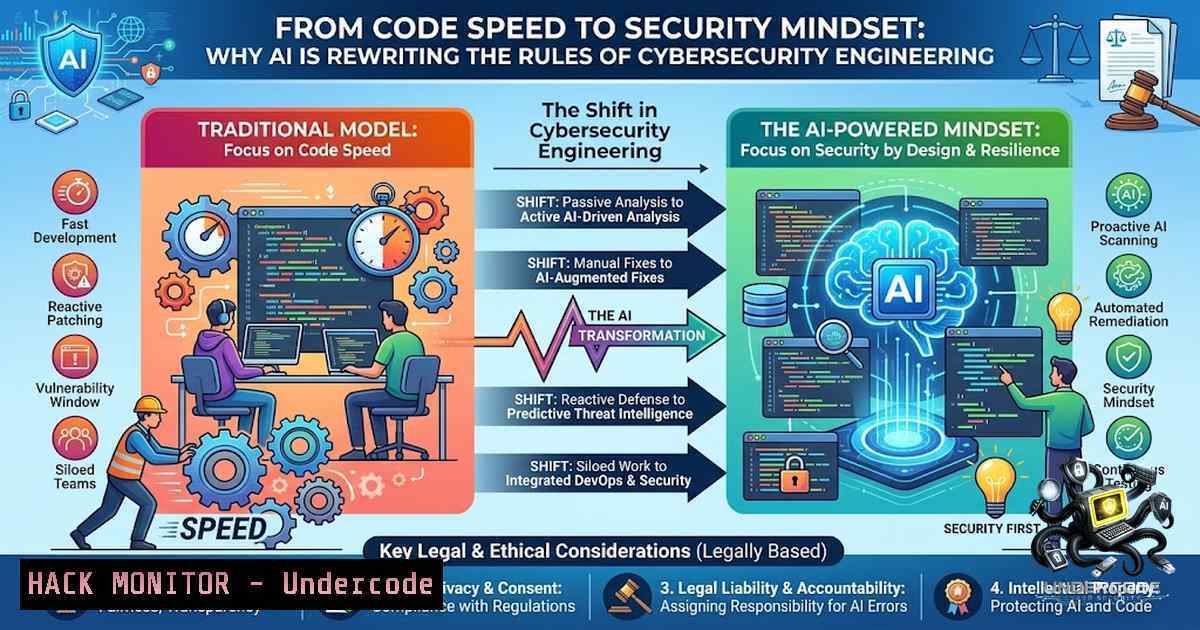
The software development landscape is undergoing a seismic shift. With AI assistants now capable of generating functional code in seconds, the traditional metric of developer productivity—lines of code written per hour—has become largely obsolete. As Vladyslav Dobrodii, a Software Developer, recently observed, the ability to ask the right questions, understand business problems, recognize architectural trade-offs, and say no to unnecessary complexity now outweighs raw coding speed【7†L4-L10】. For cybersecurity professionals, this evolution carries profound implications: if AI can write code, it can also write vulnerable code, and the human role is shifting from code producer to security strategist.
This article explores how the rise of AI in software development is transforming cybersecurity practices, from secure coding and threat modeling to DevSecOps automation and cloud hardening. We’ll examine the technical skills that truly matter in the AI era, provide hands-on commands and configurations, and outline a roadmap for security engineers to stay ahead of the curve.
Learning Objectives
- Understand how AI-powered coding tools introduce new security risks and require a shift from code-volume metrics to architectural and security thinking.
- Master practical Linux and Windows commands for securing AI development environments, containers, and cloud deployments.
- Learn to implement DevSecOps pipelines with AI-assisted security scanning, static analysis, and runtime protection.
- Develop threat modeling skills to identify vulnerabilities in AI-generated code and automated systems.
- Acquire hands-on techniques for hardening APIs, cloud infrastructure, and supply chains against AI-augmented attacks.
You Should Know
1. The AI-Generated Code Security Paradox
AI coding assistants like GitHub Copilot, Amazon CodeWhisperer, and ChatGPT can accelerate development dramatically, but they also amplify security debt. Studies have shown that AI-generated code frequently contains vulnerabilities—from SQL injection and cross-site scripting to insecure deserialization and hardcoded credentials—because the models are trained on public codebases that include insecure patterns【7†L4-L5】.
Step‑by‑step guide to securing AI-generated code:
- Implement pre-commit hooks that run static analysis on all AI-suggested code. For example, use `pre-commit` with `bandit` for Python:
Install pre-commit and bandit
pip install pre-commit bandit
Create .pre-commit-config.yaml
cat > .pre-commit-config.yaml << EOF
repos:</li>
</ol>

- repo: https://github.com/PyCQA/bandit
rev: 1.7.5
hooks:
- id: bandit
args: ["-r", "."]
EOF
 Install the hook
pre-commit install
- Enforce secure coding guidelines via linting rules. For JavaScript/TypeScript, use ESLint with security plugins:
npm install -D eslint eslint-plugin-security Add to .eslintrc.js module.exports = { plugins: ['security'], rules: { 'security/detect-unsafe-regex': 'error', 'security/detect-1on-literal-require': 'error', 'security/detect-object-injection': 'warn' } }; -
Mandate human code review for all AI-generated blocks, with a specific focus on input validation, authentication, and cryptographic operations. Never trust AI output blindly—treat it as a junior developer’s first draft.
-
Use dependency scanning to catch vulnerable libraries that AI might suggest. Tools like
npm audit,pip-audit, or `OWASP Dependency-Check` should run in CI/CD:For Python projects pip install pip-audit pip-audit --requirement requirements.txt --format json > audit_results.json For Node.js npm audit --json > npm_audit.json
-
Establish a “security champion” role within each team to review AI-assisted pull requests and maintain a vulnerability knowledge base.
2. Hardening the AI Development Pipeline
The development environment itself is a prime attack vector. AI tools often require internet access, API keys, and access to source code—creating a rich target for supply chain attacks and credential theft.
Step‑by‑step guide to hardening your AI development pipeline:
- Secure API keys and tokens used by AI assistants. Never store them in code or environment variables that persist in logs. Use a secrets manager like HashiCorp Vault or AWS Secrets Manager:
Linux: Store and retrieve a secret with Vault
vault kv put secret/copilot api_key=sk-xxxxxxxx
vault kv get -field=api_key secret/copilot

Windows (PowerShell): Use Azure Key Vault
$secret = Get-AzKeyVaultSecret -VaultName "my-vault" -1ame "copilot-key"
$secretValue = $secret.SecretValueText
-
Restrict network egress from development containers to only allow necessary AI endpoints. Use iptables or Windows Firewall:
Linux: Allow only GitHub Copilot endpoints
sudo iptables -A OUTPUT -d api.github.com -j ACCEPT
sudo iptables -A OUTPUT -d copilot-proxy.githubusercontent.com -j ACCEPT
sudo iptables -A OUTPUT -j DROP  Default deny

Windows (PowerShell Admin): Block all outbound except specific IPs
New-1etFirewallRule -DisplayName "Block All Outbound" -Direction Outbound -Action Block
New-1etFirewallRule -DisplayName "Allow Copilot" -Direction Outbound -RemoteAddress 140.82.112.0/20 -Action Allow
-
Implement container image scanning for AI development environments. Use Trivy or Grype to scan for vulnerabilities before deployment:
Scan a Docker image for vulnerabilities
trivy image my-ai-dev-image:latest --severity HIGH,CRITICAL --format table

Integrate into CI/CD
trivy fs --severity HIGH,CRITICAL --exit-code 1 /path/to/source
-
Enable audit logging for all AI tool usage. Monitor who is using which AI features and what code is being generated:
Linux: Audit Copilot CLI usage
sudo auditctl -w /usr/bin/copilot -p x -k ai-tool-usage
sudo ausearch -k ai-tool-usage --format text
-
Rotate credentials regularly and use short-lived tokens. Implement a policy where AI tool API keys expire every 24 hours and are automatically refreshed via OIDC.
3. AI-Augmented Threat Modeling and Architecture Review
As Dobrodii notes, understanding architectural trade-offs is now a competitive advantage【7†L7-L8】. Threat modeling—the practice of identifying potential attack vectors in system design—is becoming more critical than ever, especially when AI generates large swaths of code that may obscure security boundaries.
Step‑by‑step guide to AI-enhanced threat modeling:
- Use the STRIDE framework (Spoofing, Tampering, Repudiation, Information Disclosure, Denial of Service, Elevation of Privilege) to systematically evaluate AI-generated components. Create a threat model document for each microservice:
Threat Model: User Authentication Service
Assets: User credentials, session tokens, MFA secrets
Threat: AI-generated login endpoint may bypass rate limiting
Mitigation: Implement rate limiting with Redis
-
Leverage AI to assist threat modeling by feeding system architecture diagrams into LLMs and asking: “What are the top 5 security threats in this architecture?” Always verify AI suggestions against OWASP Top 10 and your organization’s threat library.
-
Create data flow diagrams (DFDs) for all AI-integrated systems. Identify trust boundaries where AI-generated code interacts with external systems:
Use PlantUML to document DFDs
cat > threat_model.puml << EOF
@startuml
!define RECTANGLE class
RECTANT "User" as U
RECTANT "AI Service" as AI
RECTANT "Database" as DB
U --> AI : HTTP Request
AI --> DB : SQL Query
@enduml
-
Run automated threat modeling tools like OWASP Threat Dragon or Microsoft Threat Modeling Tool to generate threat lists based on your architecture diagrams.
-
Conduct regular “architecture review sprints” where the team revisits AI-generated components and questions assumptions. As Dobrodii emphasizes, saying “no” to unnecessary complexity is a key skill—and that includes rejecting AI suggestions that introduce needless attack surfaces【7†L9】.
4. Securing AI APIs and Cloud Deployments
AI models are often exposed via REST or gRPC APIs, making them prime targets for injection attacks, prompt injection, and denial-of-service. Cloud deployments add another layer of complexity with IAM misconfigurations and exposed storage.
Step‑by‑step guide to securing AI APIs and cloud infrastructure:
- Implement API gateways with WAF (Web Application Firewall) to filter malicious inputs. For AWS, use AWS WAF with rate-based rules:
AWS CLI: Create a rate-based rule for AI API aws wafv2 create-rule-group --1ame AI-API-RateLimit --scope REGIONAL \ --capacity 100 --visibility-config SampledRequestsEnabled=true,CloudWatchMetricsEnabled=true,MetricName=AIAPIRate Add rate limit rule (100 requests per 5 minutes per IP) aws wafv2 create-web-acl --1ame AI-API-WAF --scope REGIONAL \ --default-action Block={} \ --rules file://rate_limit_rule.json -
Harden containerized AI workloads with security contexts and seccomp profiles. For Kubernetes:
pod-security.yaml
apiVersion: v1
kind: Pod
metadata:
name: ai-inference
spec:
securityContext:
runAsNonRoot: true
runAsUser: 1000
capabilities:
drop: ["ALL"]
containers:</p></li>
</ol>

<p>- name: model
image: my-ai-model:latest
securityContext:
allowPrivilegeEscalation: false
readOnlyRootFilesystem: true
- Use mutual TLS (mTLS) for service-to-service communication between AI components. With Istio:
Enable mTLS for AI namespace
kubectl apply -f - << EOF
apiVersion: security.istio.io/v1beta1
kind: PeerAuthentication
metadata:
name: default
namespace: ai-services
spec:
mtls:
mode: STRICT
EOF
-
Monitor AI API logs for anomalous patterns like excessive token usage or unusual input lengths. Use ELK stack or Splunk:
Linux: Tail and filter AI API logs
tail -f /var/log/ai-api/access.log | grep -E "(429|403|500)" | while read line; do
echo "$(date) - ALERT: $line" >> /var/log/ai-security-alerts.log
done
-
Implement prompt injection defenses by sanitizing user inputs before passing them to LLMs. Use a validation layer:
Python: Basic prompt sanitization
import re
def sanitize_prompt(user_input):
Block system prompt overrides
if re.search(r"(?i)(system:|ignore previous|you are now)", user_input):
raise ValueError("Suspicious prompt pattern detected")
Truncate to prevent token bombing
return user_input[:2000]
5. DevSecOps Automation for AI-Generated Code
The shift-left movement—integrating security earlier in the development lifecycle—is now essential when AI accelerates coding. Automating security checks in CI/CD pipelines ensures that vulnerabilities are caught before they reach production.
Step‑by‑step guide to building a DevSecOps pipeline for AI-assisted development:
- Integrate SAST (Static Application Security Testing) into your GitHub Actions or GitLab CI:
.github/workflows/sast.yml
name: SAST Scan
on: [push, pull_request]
jobs:
sast:
runs-on: ubuntu-latest
steps:</li>
</ol>

- uses: actions/checkout@v3
- name: Run Semgrep
run: |
pip install semgrep
semgrep --config p/owasp-top-ten --config p/security-audit --json > sast_results.json
- name: Fail on critical findings
run: |
jq -e '.results[] | select(.severity == "ERROR")' sast_results.json && exit 1 || exit 0
- Add DAST (Dynamic Application Security Testing) for running instances. Use OWASP ZAP:
Docker: Run ZAP baseline scan against staging
docker run -t owasp/zap2docker-stable zap-baseline.py \
-t https://staging.ai-app.example.com \
-r zap_report.html \
-z "-config globalexcludeurl.url_list.url.regex='^./static/.'"
-
Implement software composition analysis (SCA) to track AI-suggested dependencies:
Use OWASP Dependency-Check
dependency-check --scan . --format HTML --out report.html
Fail build if any vulnerability with CVSS > 7.0 is found
dependency-check --scan . --failOnCVSS 7.0
-
Automate infrastructure-as-code (IaC) scanning for Terraform and CloudFormation:
Install checkov
pip install checkov
checkov -d ./terraform --framework terraform --quiet
-
Set up a security dashboard that aggregates findings from all tools and tracks remediation trends over time. Use DefectDojo or an ELK-based custom solution.
-
The Human Element: Security Training in the AI Era
As AI handles more coding tasks, the human role shifts to higher-order thinking: architecture, risk assessment, and ethical decision-making【7†L11-L12】. Security training must evolve accordingly.
Step‑by‑step guide to building an AI-era security training program:
- Conduct regular “red team vs. AI” exercises where security engineers try to trick AI coding assistants into generating vulnerable code, then practice fixing it.
-
Create a “vulnerable AI code” lab using platforms like OWASP WebGoat or Damn Vulnerable Web Application (DVWA), but with AI-generated examples. Challenge teams to find and patch flaws.
-
Teach prompt engineering for security—how to ask AI for secure code by specifying constraints:
Prompt template: "Generate a Python function that validates user email input. Use parameterized queries to prevent SQL injection. Include rate limiting. Do not use eval() or exec()."
-
Mandate annual secure coding training with a focus on AI-specific risks: prompt injection, training data poisoning, model inversion, and adversarial attacks.
-
Establish a community of practice where developers share AI-generated security incidents and lessons learned. As Dobrodii’s post implies, the ability to ask the right questions is a skill that must be cultivated collectively【7†L6】.
What Undercode Say
-
Key Takeaway 1: AI is not replacing security engineers; it’s redefining the role. The future belongs to those who can think critically about architecture, risk, and business impact—not those who simply generate code faster. Security professionals must evolve from “code reviewers” to “system guardians.”
-
Key Takeaway 2: Automation is your ally, but only if you build the right feedback loops. Static analysis, dependency scanning, and threat modeling tools are essential, but they require human oversight to interpret findings and make strategic decisions. The most effective security teams are those that combine AI-assisted tooling with deep domain expertise.
Analysis: The shift that Dobrodii describes is already visible in the cybersecurity job market. Job postings for “AppSec Engineer” increasingly emphasize threat modeling, architecture review, and risk communication over pure coding speed. At the same time, the rise of AI-powered attack tools means defenders must think like adversaries—anticipating how AI could be used to automate reconnaissance, generate phishing lures, or exploit zero-day vulnerabilities. The organizations that invest in upskilling their teams to “think security-first” will have a decisive advantage. Conversely, those that cling to outdated metrics—like lines of code or number of vulnerabilities fixed—will fall behind. The real competitive advantage is not in writing more code, but in writing smarter, more secure code, and knowing when not to write code at all.
Prediction
- +1 The demand for “AI Security Engineers” will grow exponentially over the next three years, with salaries outpacing traditional software engineering roles as organizations scramble to secure their AI pipelines.
-
+1 DevSecOps tools will increasingly incorporate AI-powered vulnerability prediction, automatically flagging high-risk code sections before they even reach human reviewers, reducing mean time to remediation by 40-60%.
-
-1 The commoditization of coding via AI will lead to a “security debt crisis” in the short term, as junior developers over-rely on AI assistants without understanding the underlying security implications, resulting in a spike in breaches originating from AI-generated code.
-
+1 Threat modeling will become a core competency taught alongside programming in computer science curricula, as educators recognize that architectural thinking is more durable than syntax knowledge in an AI-augmented world.
-
-1 Organizations that fail to update their hiring and training practices will face a talent gap, struggling to find engineers who can balance AI-assisted productivity with security rigor, leading to increased outsourcing and vendor lock-in.
-
+1 Regulatory bodies like NIST and ENISA will publish AI-specific security frameworks by 2027, providing clear guidelines that will drive standardization and best practices across the industry.
-
+1 The open-source community will develop AI-powered security co-pilots that not only detect vulnerabilities but also suggest and automatically apply fixes, fundamentally changing the patch management lifecycle.
▶️ Related Video (78% Match):
https://www.youtube.com/watch?v=-PAVAOg07AA
🎯Let’s Practice For Free:
🎓 Live Courses & Certifications:
Join Undercode Academy for Verified Certifications
🚀 Request a Custom Project:
Secure, high-velocity infrastructure and disruptive technological engineering. Contact our engineering team for high-tier development and proprietary systems:
[email protected]
💎 Smart Architecture | 🛡️ Secure by Design | ⭐ Trusted by ThousandsIT/Security Reporter URL:
Reported By: Dladislav Over – Hackers Feeds
Extra Hub: Undercode MoN
Basic Verification: Pass ✅🔐JOIN OUR CYBER WORLD [ CVE News • HackMonitor • UndercodeNews ]
📢 Follow UndercodeTesting & Stay Tuned:
- Add DAST (Dynamic Application Security Testing) for running instances. Use OWASP ZAP:
- Use mutual TLS (mTLS) for service-to-service communication between AI components. With Istio:
- Enforce secure coding guidelines via linting rules. For JavaScript/TypeScript, use ESLint with security plugins:


