
Listen to this Post
Introduction:
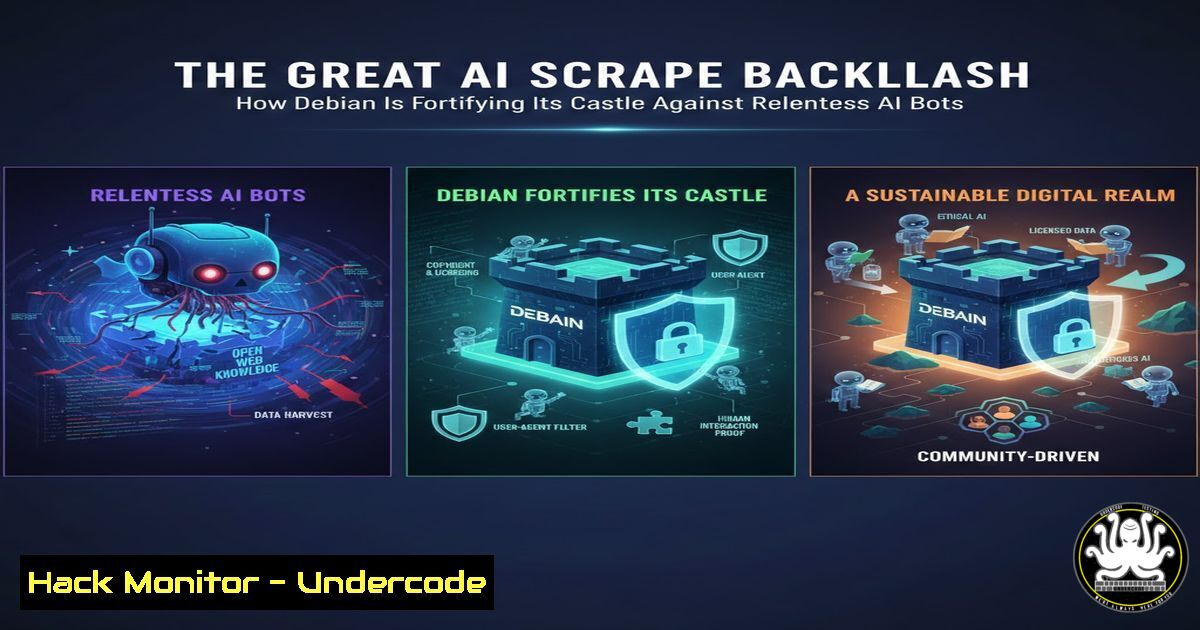
The open-source ecosystem is under a new form of digital siege. As large language models (LLMs) and AI companies hunger for training data, their automated scraping bots are overwhelming project infrastructure, consuming bandwidth, and raising ethical questions. In a pivotal move, the Debian Project, one of the world’s most foundational Linux distributions, is implementing stringent technical and policy measures to defend its infrastructure from these insatiable AI data collectors. This marks a critical shift in how open-source communities protect their resources and maintain integrity in the age of AI.
Learning Objectives:
- Understand the technical impact of AI scraping bots on open-source infrastructure.
- Learn to implement defensive measures like advanced `robots.txt` directives, rate limiting, and WAF rules.
- Develop a DevSecOps framework for integrating AI-generated code review and security scanning.
You Should Know:
- Hardening Web Presence with Enhanced robots.txt and Metadata
AI scrapers often ignore conventional politeness standards. Debian’s response includes deploying explicit, stricter `robots.txt` directives and website metadata to legally and technically discourage unauthorized scraping.
Step-by-step guide:
First, audit your current `robots.txt` file located at your web root. Then, enhance it with specific disallow rules for common scraping paths and user agents.
 View current robots.txt
cat /var/www/html/robots.txt

Append AI scraper disallows (using a text editor like nano)
sudo nano /var/www/html/robots.txt
Add directives targeting known AI scraper patterns:
User-agent: GPTBot
Disallow: /

User-agent: Claude-Web
Disallow: /

User-agent: CCBot
Disallow: /

Disallow access to API endpoints and repository data
Disallow: /api/
Disallow: /git/
Disallow: /packages/raw/
Additionally, embed metadata in your HTML `
` to signal your policy:<meta name="robots" content="noai, noimageai"> <meta name="author" content="Your Project" data-copilot="ignore">
2. Implementing Aggressive Rate Limiting on Web Servers
To prevent bots from hammering your servers, implement connection and request rate limiting at the web server level. This throttles excessive traffic from single IPs.
Step-by-step guide for Nginx on Debian:
Edit your site’s Nginx configuration.
sudo nano /etc/nginx/sites-available/your-site
Within the `server` or `location /` block, add rate limiting rules:
limit_req_zone $binary_remote_addr zone=scraper:10m rate=1r/s;

server {
location / {
limit_req zone=scraper burst=5 nodelay;
 ... other directives ...
}

Especially protect dynamic and data-intensive endpoints
location /api/ {
limit_req zone=scraper burst=3 nodelay;
}
location /git/ {
auth_basic "Restricted";
auth_basic_user_file /etc/nginx/.htpasswd;
limit_req zone=scraper burst=2 nodelay;
}
}
Test the configuration and reload:
sudo nginx -t
sudo systemctl reload nginx
For Apache, use `mod_evasive` or `mod_ratelimit`.
- Configuring Web Application Firewall (WAF) Rules for Bot Mitigation
A WAF can identify and block malicious or excessive bot traffic based on patterns, user-agents, and behavioral analysis.
Step-by-step guide using ModSecurity with OWASP Core Rule Set (CRS) on Debian:
Install and configure ModSecurity.
sudo apt install libapache2-mod-security2 modsecurity-crs -y
sudo cp /etc/modsecurity/modsecurity.conf-recommended /etc/modsecurity/modsecurity.conf
sudo nano /etc/modsecurity/modsecurity.conf
Set `SecRuleEngine` to On. Now, integrate bot mitigation rules. Edit the CRS configuration file (/etc/modsecurity/crs/crs-setup.conf) and uncomment or add rules related to scraping and bad bots. A key rule is to check for anomalous request rates. You can also create a custom rule to block known AI scraper user-agents:
sudo nano /etc/modsecurity/rules/local.conf
Add:
SecRule REQUEST_HEADERS:User-Agent "@pm GPTBot Claude-Web CCBot ai-bot" \
"id:1000,deny,status:403,msg:'Blocked AI Scraper Bot'"
Restart Apache to apply the rules: sudo systemctl restart apache2.
- Integrating Code Security Scanning into the DevSecOps Pipeline
With the rise of AI-generated code contributions, automating security reviews is non-negotiable. Integrate Static Application Security Testing (SAST) and software composition analysis (SCA) tools directly into your repository’s CI/CD pipeline.
Step-by-step guide for a Debian packaging Git repository using GitHub Actions:
Create a `.github/workflows/security-scan.yml` file.
name: Security Scan
on: [push, pull_request]
jobs:
scan:
runs-on: ubuntu-latest
steps:
- uses: actions/checkout@v4
- name: Run SAST with Bandit (for Python)
run: |
pip install bandit
bandit -r . -f json -o bandit-report.json || true
- name: Run SCA with OWASP Dependency-Check
uses: dependency-check/Dependency-Check_Action@main
with:
project: 'Debian-Package-Component'
path: '.'
format: 'HTML'
args: '--disableYarnAudit --disableNodeJS'
- name: Upload reports
uses: actions/upload-artifact@v4
with:
name: security-reports
path: |
bandit-report.json
dependency-check-report.html
This automated gate helps ensure AI-suggested code does not introduce vulnerabilities or license compliance issues before merging.
- Enforcing Strict Access Control and Authentication for Data Repositories
Protect your core assets—source code and package repositories—by moving beyond anonymous access. Implement mandatory authentication for `git` operations and package downloads for non-public endpoints.
Step-by-step guide for Git repository (using gitolite on Debian):
Install and setup gitolite to manage SSH key-based access.
sudo apt install gitolite3
sudo adduser --system --shell /bin/bash --group git
sudo su - git
gl-setup /tmp/admin.pub  Use your public SSH key
Clone the admin repo to configure repositories and users:
git clone git@localhost:gitolite-admin
cd gitolite-admin
Edit `conf/gitolite.conf` to enforce authentication and permissions:
repo @all
R = daemon  Allow anonymous read only for truly public repos
RW+ = admin  Only admins can push

repo proprietary-code
- = daemon  Deny all anonymous access
RW+ = core_team
Push the configuration back: git add . && git commit -m "Enforce auth" && git push. This ensures controlled access to critical assets.
What Undercode Say:
- Open Source is Not a Free-For-All: The Debian move underscores that “open” does not equate to “unregulated resource consumption.” Infrastructure sustainability requires active defense against parasitic traffic, even from seemingly legitimate AI actors.
- Proactive Policy is a Security Imperative: Technical hardening must be paired with clear, enforceable policies. Debian’s stance of “encadrement” (framing) the use of AI tools sets a legal and ethical baseline, transforming a technical nuisance into a manageable risk with defined boundaries.
Analysis: Debian’s defensive posture is a bellwether for the entire open-source community. It highlights a fundamental clash between the data-hungry, capital-driven AI industry and the volunteer-driven, resource-constrained open-source model. Technically, it pushes sysadmins beyond basic firewall rules into the realm of behavioral analysis and legal signaling via robots.txt. This isn’t just about blocking bots; it’s about asserting sovereignty over digital commons. The integration of strict DevSecOps practices reflects an understanding that the threat isn’t only external data extraction but also internal quality degradation from unchecked AI-generated code.
Prediction:
This incident foreshadows a broader “Scrape Wars” phase where major open-source foundations and software repositories will universally adopt similar, coordinated defensive postures. We will see the development of standardized, machine-readable `robots.txt` extensions specifically for AI (e.g., AI-agent: disallow). Legally, it will fuel arguments for stricter data ownership and usage rights in training datasets, potentially leading to licensing changes in major projects (e.g., GPL modifications addressing AI training). AI companies will be forced to shift from indiscriminate scraping to formal data licensing agreements and voluntary contribution models to maintain access to high-quality, curated open-source code, fundamentally altering the data supply chain for the next generation of AI models.
▶️ Related Video (78% Match):
🎯Let’s Practice For Free:
IT/Security Reporter URL:
Reported By: Debian Linux – Hackers Feeds
Extra Hub: Undercode MoN
Basic Verification: Pass ✅


