
Listen to this Post
Introduction:
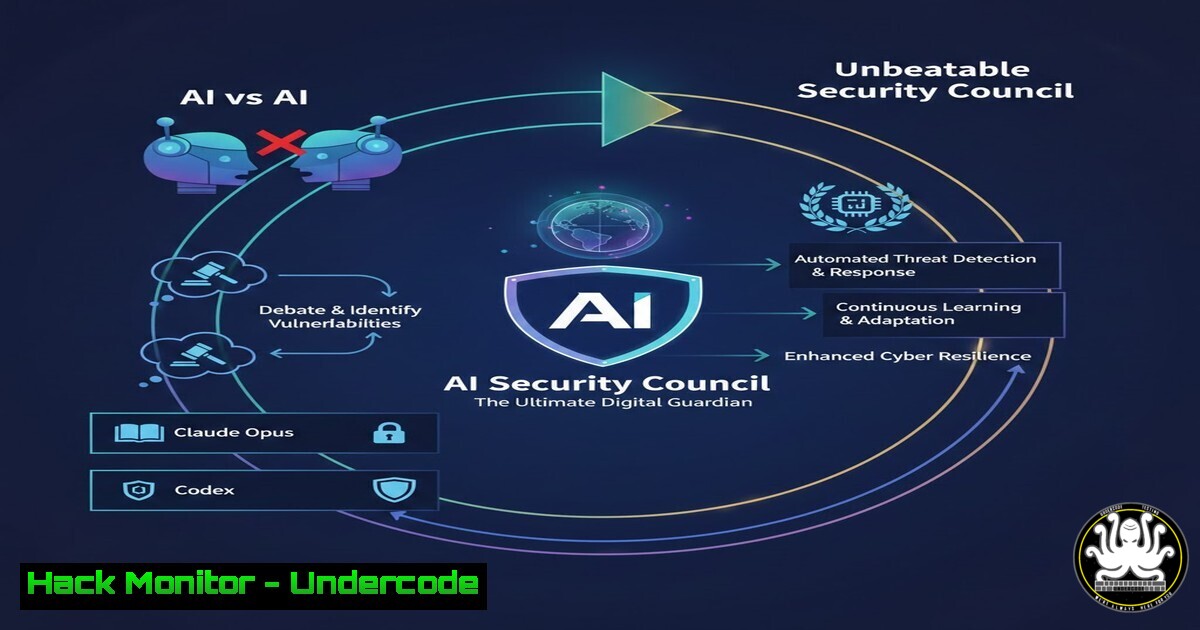
The frontier of AI-assisted cybersecurity is no longer about relying on a single model for analysis or code generation. A sophisticated new technique is emerging where top-tier models like Anthropic’s Claude Opus and OpenAI’s Codex are orchestrated to debate each other, creating a robust “security council” that dramatically reduces errors and blind spots. This method, often implemented via a Model Context Protocol (MCP) server, leverages adversarial reasoning to harden code, dissect vulnerabilities, and validate security policies, pushing the boundaries of automated security assurance.
Learning Objectives:
- Understand the architecture and security benefits of orchestrating multiple LLMs in an adversarial debate format.
- Learn to configure a basic Model Context Protocol (MCP) server to run Claude Opus and Codex concurrently for security tasks.
- Apply the “AI Council” methodology to practical cybersecurity workflows: secure code review, threat modeling analysis, and exploit mitigation verification.
You Should Know:
- Architecting Your AI Security Council: The MCP Backbone
The core of this technique is the Model Context Protocol (MCP), which standardizes how applications connect to and utilize different LLMs and tools. Instead of querying one model, you configure an MCP server to manage multiple models, allowing them to share context and respond to a central orchestrator that frames a debate.
Step-by-step guide:
- Set Up Your MCP Environment: You’ll need a server capable of running containers and managing API keys for both Anthropic and OpenAI.
Clone a basic MCP server example
git clone https://github.com/modelcontextprotocol/servers.git
cd servers/mcp-ai-debate-basic
- Configure Model Endpoints: Create a configuration file (
config.yaml) specifying the models and their APIs.config.yaml models: claude: provider: "anthropic" model: "claude-3-opus-20240229" api_key_env: "ANTHROPIC_API_KEY" codex: provider: "openai" model: "code-davinci-002" Or a relevant successor model api_key_env: "OPENAI_API_KEY"
- Implement the Debate Orchestrator: Write a simple orchestrator script (
debate_orchestrator.py) that poses a security question, gets responses from both models, and then prompts each to critique the other’s answer.debate_orchestrator.py - Basic structure import os from mcp import Client</li> </ol> async def security_debate(prompt): client = Client(config_path="./config.yaml") Get initial answers claude_resp = await client.call_model("claude", prompt) codex_resp = await client.call_model("codex", prompt) Cross-examination phase critique_prompt = f"Critique this security analysis for flaws, oversights, or incorrect assumptions: {codex_resp}" claude_critique = await client.call_model("claude", critique_prompt) Synthesize final answer final_prompt = f"Given the original problem: {prompt} and the critique: {claude_critique}, provide a final, hardened answer." final_answer = await client.call_model("codex", final_prompt) return final_answer2. Weaponizing Debate for Secure Code Review
Manual code review is tedious. A single AI can miss context-specific vulnerabilities. An AI council turns code review into a dynamic audit. You submit a
git diff; the models independently analyze it, then debate the risks.Step-by-step guide:
- Capture Code Changes: Use git to generate a diff of the pending changes.
git diff HEAD~1 --patch > security_review.patch
- Craft the Security Review The orchestrator sends this patch to both models with a tailored prompt.
SECURITY_REVIEW_PROMPT="Act as a senior application security engineer. Analyze the following code diff for security vulnerabilities. Categorize any finding by severity (CRITICAL, HIGH, MEDIUM), type (e.g., SQLi, XSS, Insecure Deserialization), and provide the exact vulnerable line. Diff: $(cat security_review.patch)"
- Orchestrate the Analysis and Debate: The orchestrator runs the `security_debate` function with the
SECURITY_REVIEW_PROMPT. Claude might flag a potential path traversal, while Codex might initially dismiss it as sanitized. Their debate forces a deeper inspection of the sanitization function, leading to a consensus on whether the finding is valid and its true severity.
3. Adversarial Threat Modeling & Mitigation Planning
When designing a new system, you can use the council to simulate an attacker (Codex) and a defender (Claude) to stress-test architecture diagrams.
Step-by-step guide:
- Input System Design: Provide a text-based description of a system component (e.g., “User file upload API, saves to S3, metadata to RDS”).
2. Assign Adversarial Roles:
Prompt to Codex (as Attacker): “Given this design, list five specific, exploitable attack vectors. Prioritize the most likely to succeed and have high impact.”
Prompt to Claude (as Defender): “Given this design, list the top five security controls you would implement. Justify each.”
3. Synthesize a Hardened Design: The orchestrator presents the attacker’s vectors to the defender and asks for updated controls, then presents the strengthened controls to the attacker to see if new vectors emerge. This loop continues for 2-3 rounds, outputting a robust threat model and mitigation matrix.4. Validating Exploit Proofs-of-Concept (PoCs)
Before deploying a mitigation for a critical vulnerability (e.g., a new CVE), test it by having one AI try to write an exploit and the other try to break it.
Step-by-step guide:
- Task Codex (Exploitation): “Write a Python proof-of-concept exploit for CVE-2024-12345 affecting Service X version 1.2.3.”
- Task Claude (Mitigation Verification): “Here is a proposed patch and a PoC exploit. Analyze if the patch successfully mitigates the exploit. If not, explain why and suggest a correction.”
- Iterative Hardening: If Claude finds the PoC still works, it suggests a patch improvement. The orchestrator then asks Codex to adjust the PoC against the new patch. This continues until Claude confirms the exploit is fully mitigated.
5. Automating the Council: Integrating into CI/CD Pipelines
For continuous security, integrate the AI council into your CI/CD pipeline to automatically review pull requests.
Step-by-step guide:
1. Create a Pipeline Script (.github/workflows/ai_council_review.yml):
name: AI Security Council Review
on: [bash]
jobs:
review:
runs-on: ubuntu-latest
steps:
- uses: actions/checkout@v3
- name: Generate Diff
run: git diff origin/${{ github.base_ref }} > diff.patch
- name: Run AI Council Review
env:
ANTHROPIC_API_KEY: ${{ secrets.ANTHROPIC_API_KEY }}
OPENAI_API_KEY: ${{ secrets.OPENAI_API_KEY }}
run: |
python3 debate_orchestrator.py \
--prompt "$(cat diff.patch)" \
--output security_report.md
- name: Upload Security Report
uses: actions/upload-artifact@v3
with:
name: ai-council-report
path: security_report.md
2. Secure API Keys: Store `ANTHROPIC_API_KEY` and `OPENAI_API_KEY` as encrypted secrets in your GitHub/GitLab repository settings.
3. Review Report: The pipeline generates a `security_report.md` artifact containing the council’s debated findings, which security engineers can review.What Undercode Say:
- Key Takeaway 1: The true power of AI for security lies not in a single oracle, but in managed conflict. Orchestrating adversarial debate between top models creates a form of automated, high-speed peer review that surfaces subtleties and assumptions a single model would gloss over.
- Key Takeaway 2: This methodology is a force multiplier for senior security engineers, not a replacement. It automates the initial “brainstorming” of attacks and defenses, allowing human experts to focus on nuanced judgment calls, policy decisions, and investigating the most critical findings flagged by the AI council.
Analysis: The technique described moves beyond simple AI assistance into the realm of generative AI orchestration. It formally implements a “red team/blue team” dynamic at machine speed, directly addressing the “confabulation” problem where one model might be confidently wrong. The major caveat, as hinted in the original post, is cost and sustainability. Running multiple queries across two frontier models per task is expensive. The future will see a shift towards specialized, smaller, and potentially open-source models playing these adversarial roles to make the process cost-effective for everyday use. Furthermore, securing the MCP orchestrator itself becomes a critical new attack surface, as it holds the keys to powerful AI models and directs their reasoning.
Prediction:
Within 18-24 months, “Adversarial AI Councils” will become a standardized feature in enterprise security platforms for code and infrastructure-as-code review. Security teams will configure and tune their own council with models selected for specific strengths (e.g., one model trained on CVE databases, another on secure coding guidelines). The high cost of frontier models will drive the development and adoption of specialized, security-fine-tuned open-weight models (like those from the Llama or Mistral families) that can perform these debate roles at a fraction of the cost, making advanced AI-assisted security accessible beyond well-funded tech giants. This will fundamentally shift the SOC and AppSec workflow, turning reactive analysis into proactive, continuous simulated attack and defense.
▶️ Related Video (80% Match):
🎯Let’s Practice For Free:
IT/Security Reporter URL:
Reported By: Jonathan R – Hackers Feeds
Extra Hub: Undercode MoN
Basic Verification: Pass ✅🔐JOIN OUR CYBER WORLD [ CVE News • HackMonitor • UndercodeNews ]
📢 Follow UndercodeTesting & Stay Tuned:
- Capture Code Changes: Use git to generate a diff of the pending changes.


