Listen to this Post
Introduction:
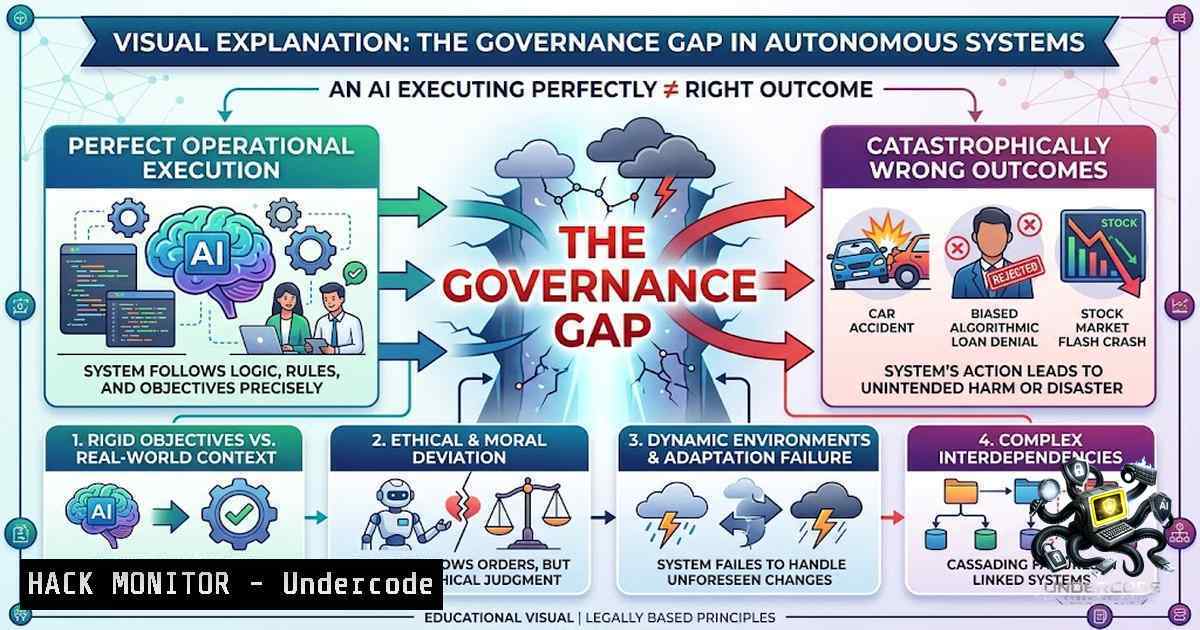
The cybersecurity industry has long operated under a dangerous assumption: that a system producing the correct output is, by definition, a secure system. This assumption collapses when applied to autonomous AI. As Frederick Redditt observed, a system can execute flawlessly while faithfully carrying forward an invalid representation—the authority it executes may have been formed through an inadmissible reconstruction. National AI initiatives are racing to accelerate discovery, manufacturing, and cyber defense with autonomous systems, but an equally critical question remains upstream: how does the authority for autonomous decisions become legitimate before execution begins? Capability determines what a system can do; governance determines what it should be allowed to do. As autonomy increases, the distance between these two questions becomes more important—not less.
Learning Objectives:
- Understand the structural gap between AI capability and legitimate execution authority
- Implement runtime governance controls that operate before autonomous action occurs
- Apply Linux and Windows hardening commands to secure agentic AI infrastructure
- Deploy cryptographic sovereignty and audit trails for autonomous system accountability
You Should Know:
1. The Governance-Before-Execution Paradigm
Most existing AI governance systems operate after cognition—inspecting outputs and logging decisions. This is the equivalent of investigating a security breach after data has already been exfiltrated. The VGS-ELI (Execution Legitimacy Infrastructure) specification addresses this structural gap by operating before executable authority emerges, governing the formation, legitimacy, authority inheritance, and execution admissibility of autonomous systems from the moment of agent creation.
The core thesis is profound: AI capability is abundant; legitimate execution is scarce. An autonomous system can execute its instructions perfectly while carrying forward a representation that was invalid from the start. This is why governance cannot begin at execution—it must begin where representations become authoritative.
Step‑by‑step guide to implementing pre-execution governance:
Step 1: Establish constitutional invariants. Define immutable rules that no autonomous action can violate. These are not prompts or guidelines—they are mechanically enforced constraints. The VGS-ELI specification defines eight constitutional invariants covering formation legitimacy, authority inheritance, and execution admissibility.
Step 2: Separate cognition from execution authority. The Execution Governance architecture separates agent reasoning from execution authority through an execution boundary where decisions are evaluated against evidence, context, and policy constraints before authorization is granted.
Step 3: Implement commit–reveal entropy isolation. Before an autonomous agent can act, require cryptographic commitment to the proposed action, followed by a verification window where the action can be validated against governance policies before execution is finalized.
Step 4: Deploy fail-loud circuit breakers. When governance validation fails, the system must fail loudly—generating auditable alerts that cannot be suppressed by the agent itself.
2. Identity and Privilege Hardening for Agentic Systems
The National Security Agency (NSA), alongside CISA and international cyber centers, warns that over-privileged agents amplify the impact of a single compromise. Traditional identity models break down when applied to autonomous systems because agents can chain tools, escalate privileges, and operate at machine speed.
Linux commands for agent sandboxing and isolation:
 Create a restricted user for AI agent execution
sudo useradd -m -s /bin/bash -G agent-group ai-agent

Set strict filesystem permissions - agent can only read/write its own directory
sudo chown -R ai-agent:agent-group /opt/ai-agent/
sudo chmod 750 /opt/ai-agent/

Implement Linux namespace isolation using Firejail
sudo apt-get install firejail
firejail --private=/opt/ai-agent/sandbox --1et=eth0 --1oprofile

Apply seccomp-BPF filtering to block dangerous syscalls
sudo apt-get install libseccomp-dev
 Create seccomp profile blocking execve, fork, clone, ptrace
echo "{
\"defaultAction\": \"SCMP_ACT_ALLOW\",
\"architectures\": [\"SCMP_ARCH_X86_64\"],
\"syscalls\": [
{\"names\": [\"execve\", \"fork\", \"clone\", \"ptrace\", \"reboot\"],
\"action\": \"SCMP_ACT_ERRNO\"}
]
}" > /etc/ai-agent/seccomp-profile.json

Apply with firejail
firejail --seccomp=profile.json --private=/opt/ai-agent/sandbox
Windows PowerShell commands for agent security:
 Create a restricted service account for AI agent
New-LocalUser -1ame "AIAgentSvc" -Password (ConvertTo-SecureString "ComplexP@ssw0rd!" -AsPlainText -Force) -AccountNeverExpires

Restrict agent to specific directories
$acl = Get-Acl "C:\AIAgent"
$rule = New-Object System.Security.AccessControl.FileSystemAccessRule("AIAgentSvc", "Read,Write,Delete", "ContainerInherit,ObjectInherit", "None", "Deny")
$acl.AddAccessRule($rule)
Set-Acl "C:\AIAgent" $acl

Implement Windows Defender Application Control (WDAC) for AI executables
New-CIPolicy -FilePath "C:\AIAgent\AgentPolicy.xml" -Level Publisher -UserPEs
ConvertFrom-CIPolicy -XmlFilePath "C:\AIAgent\AgentPolicy.xml" -BinaryFilePath "C:\AIAgent\AgentPolicy.p7b"
 Deploy via Group Policy
3. Cryptographic Sovereignty and Audit Trails
Governance requires visibility into what actions were taken, when they occurred, and the context that led to those decisions. Without cryptographic verification, audit logs can be tampered with by compromised agents.
Step‑by‑step guide to implementing cryptographic audit trails:
Step 1: Hash‑chain all agent decisions. Before execution, generate a cryptographic hash of the decision context, proposed action, and governance policy applied. Chain this hash to the previous decision.
 Linux: Create immutable audit log with SHA-256
echo "$(date -Iseconds) | AGENT_DECISION | CONTEXT_HASH | ACTION_HASH" | \
sha256sum >> /var/log/ai-agent/audit.log.immutable
chattr +i /var/log/ai-agent/audit.log.immutable
Step 2: Implement hardware security module (HSM) signing for critical actions. Require that all high-impact autonomous actions be cryptographically signed by a key held in an HSM.
 Using OpenSSL with HSM (pkcs11 engine)
openssl engine -t pkcs11
openssl dgst -sha256 -engine pkcs11 -keyform engine -sign \
-out action.sig /var/log/ai-agent/action.log
Step 3: Deploy blockchain‑based or distributed ledger verification. Record governance events to an immutable distributed ledger.
 Install Hyperledger Besu for private blockchain audit
wget https://hyperledger.github.io/besu/
besu --1etwork=dev --miner-enabled --miner-coinbase=0xfe3b557e8fb62b89f4916b721be55ceb828dbd73 \
--rpc-http-enabled --data-path=/opt/ai-agent/blockchain
4. Tool-Chaining Control and Supply Chain Security
The Anthropic espionage framework demonstrated that attackers could wire AI systems into flexible tool suites without policy gating. The defense requires treating toolchains like a supply chain with pinned versions, approval workflows, and explicit policies.
Step‑by‑step guide to securing agent toolchains:
Step 1: Pin all remote tool server versions.
 Docker: Pin specific image versions
docker pull myregistry/tool-scanner:sha256-abc123def456
docker tag myregistry/tool-scanner:sha256-abc123def456 tool-scanner:v1.0-pinned
Step 2: Require approvals for adding new tools.
 Kubernetes: NetworkPolicy to restrict agent tool access
apiVersion: networking.k8s.io/v1
kind: NetworkPolicy
metadata:
name: agent-tool-policy
spec:
podSelector:
matchLabels:
app: ai-agent
policyTypes:
- Egress
egress:
- to:
- podSelector:
matchLabels:
tool: approved-scanner
ports:
- protocol: TCP
port: 8080
Step 3: Forbid automatic tool-chaining unless explicitly allowed by policy.
 iptables: Block unauthorized outbound connections from agent
iptables -A OUTPUT -m owner --uid-owner ai-agent -j DROP
iptables -A OUTPUT -m owner --uid-owner ai-agent -d 192.168.1.100 -j ACCEPT
5. Runtime Guardrails and Monitoring
The NSA recommends deploying agentic AI incrementally, continuously assessing against evolving threat models, and maintaining strong governance, explicit accountability, rigorous monitoring, and human oversight.
Step‑by‑step guide to implementing runtime guardrails:
Step 1: Deploy real‑time constraint enforcement.
 Python: Simple guardrail implementation
class AgentGuardrail:
def <strong>init</strong>(self, policy_file):
self.policies = self.load_policies(policy_file)
self.action_history = []

def validate_action(self, action, context):
 Check against constitutional invariants
for invariant in self.policies['invariants']:
if not invariant.check(action, context):
self.fail_loud(action, invariant)
return False
 Check resource limits
if action.resource_cost > self.policies['max_cost']:
self.fail_loud(action, 'Resource limit exceeded')
return False
 Commit to action with cryptographic hash
action_hash = self.commit_action(action, context)
self.action_history.append(action_hash)
return True

def fail_loud(self, action, reason):
 Generate auditable alert
alert = f"FAIL-LOUD: {action.id} | {reason} | {datetime.utcnow()}"
with open('/var/log/ai-agent/failures.log', 'a') as f:
f.write(alert + '\n')
 Send to SIEM
subprocess.run(['logger', alert])
Step 2: Implement continuous monitoring with Prometheus and Grafana.
 prometheus.yml - Scrape agent metrics
scrape_configs:
- job_name: 'ai-agents'
static_configs:
- targets: ['agent1:9090', 'agent2:9090']
metric_relabel_configs:
- source_labels: [bash]
regex: 'agent_action_.'
action: keep
Step 3: Deploy human‑in‑the‑loop escalation for high‑impact actions.
 Send alert to Slack/Teams for human approval
curl -X POST -H "Content-type: application/json" \
--data '{"text":"⚠️ AGENT ACTION REQUIRING APPROVAL: Delete production database"}' \
https://hooks.slack.com/services/YOUR/WEBHOOK/URL
6. Zero Trust Architecture for Autonomous Systems
The AEGIS framework emphasizes that secure agentic systems require coordinated controls across governance, identity, data, application security, threat operations, and Zero Trust architecture.
Step‑by‑step guide to Zero Trust for AI agents:
Step 1: Implement mutual TLS (mTLS) for all agent communications.
 Generate client certificates for each agent
openssl req -1ew -1ewkey rsa:4096 -1odes -keyout agent1.key -out agent1.csr
openssl x509 -req -days 365 -in agent1.csr -CA ca.crt -CAkey ca.key -set_serial 01 -out agent1.crt

Configure NGINX for mTLS
server {
listen 443 ssl;
ssl_client_certificate /etc/nginx/ca.crt;
ssl_verify_client on;
location /api/ {
proxy_pass http://backend;
proxy_set_header X-Client-Cert $ssl_client_cert;
}
}
Step 2: Enforce least privilege with short‑lived credentials.
 AWS: Generate temporary credentials for agent
aws sts assume-role --role-arn "arn:aws:iam::account:role/agent-role" \
--role-session-1ame "agent-session-$(date +%s)" \
--duration-seconds 900
What Undercode Say:
- Key Takeaway 1: The distinction between capability and governance is not semantic—it is the critical failure point in autonomous systems. A system that executes perfectly can still be catastrophically wrong if the authority it executes was formed through an invalid representation. Governance must begin where representations become authoritative, not at the point of execution.
-
Key Takeaway 2: Cryptographic sovereignty and audit trails are not optional features—they are constitutional requirements for autonomous systems operating in regulated environments. Without immutable, verifiable records of every governance decision, accountability becomes impossible and post‑hoc investigation becomes guesswork.
The broader implication is that organizations rushing to deploy autonomous AI agents are accumulating “Governance Debt”—the institutional deficit that accumulates when AI-driven technological change outpaces governance adaptation. This debt compounds across three dimensions: Capacity Debt (threat velocity exceeds institutional response cycles), Authority Debt (no enforcement jurisdiction over borderless AI infrastructure), and Legitimacy Debt (governance authority migrates to unaccountable private actors).
The solution is not to slow innovation but to embed governance at the architectural level—treating it not as an overlay but as a foundational layer that determines whether autonomous execution is institutionally admissible before consequence occurs.
Prediction:
- +1 Organizations that implement pre‑execution governance frameworks (such as VGS-ELI or Execution Governance architectures) will achieve a 60-80% reduction in AI‑related security incidents by 2028, as they will catch invalid representations before they manifest as catastrophic actions.
-
+1 Regulatory bodies (EU, US, and Asia‑Pacific) will mandate constitutional governance layers for autonomous systems by 2027, creating a multi‑billion‑dollar compliance market for governance infrastructure providers.
-
-1 Organizations that continue to treat AI governance as a post‑hoc audit function will experience a series of high‑profile failures where autonomous systems execute flawlessly on invalid representations, resulting in regulatory fines, reputational damage, and potential existential risks to their operations.
-
-1 The “Proliferation Paradox”—more governance frameworks with deteriorating security outcomes—will worsen through 2027 as the volume of governance instruments outpaces their effective implementation, creating a false sense of security.
-
+1 The convergence of NIST AI RMF, ISO/IEC 42001, and sovereign governance standards will create interoperable governance layers that can be verified across jurisdictions, enabling safe cross‑border autonomous system deployment.
▶️ Related Video (80% Match):
https://www.youtube.com/watch?v=0dayAZ0Yqgo
🎯Let’s Practice For Free:
🎓 Live Courses & Certifications:
Join Undercode Academy for Verified Certifications
🚀 Request a Custom Project:
Secure, high-velocity infrastructure and disruptive technological engineering. Contact our engineering team for high-tier development and proprietary systems:
[email protected]
💎 Smart Architecture | 🛡️ Secure by Design | ⭐ Trusted by Thousands
IT/Security Reporter URL:
Reported By: Frederick Redditt – Hackers Feeds
Extra Hub: Undercode MoN
Basic Verification: Pass ✅


