Listen to this Post
Introduction:
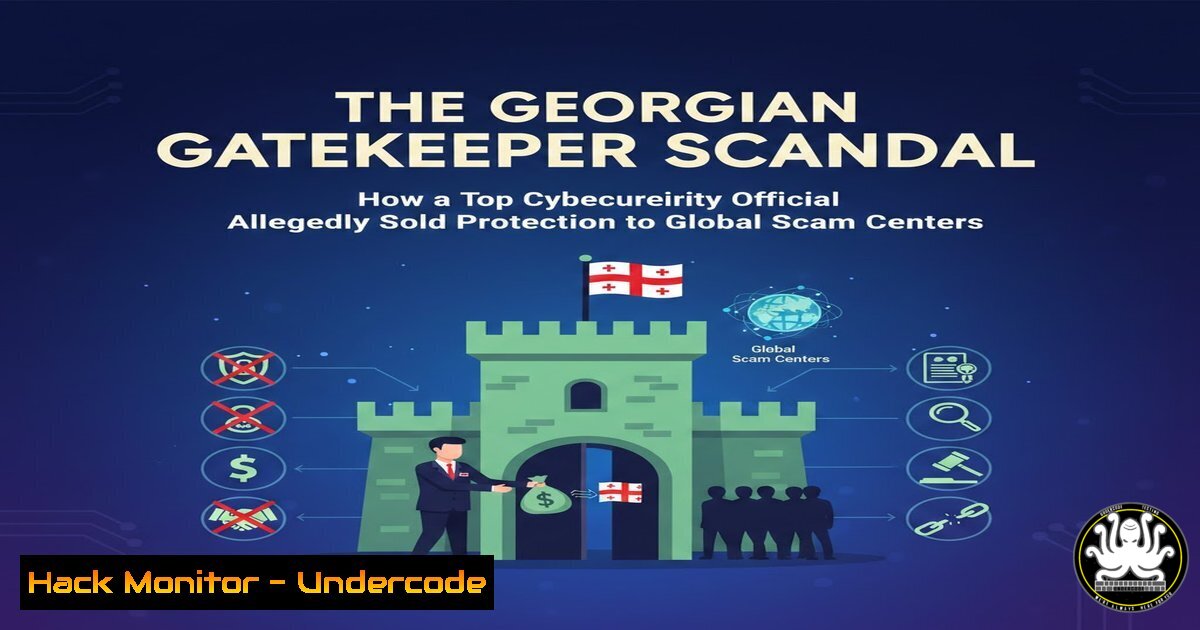
The recent arrest of Georgia’s former State Security Service head, Grigol Liluashvili, on bribery charges for protecting international scam call centers is a stark case study in institutional capture. This incident transcends a simple corruption story, revealing how cybercriminal enterprises actively seek to compromise the very regulatory and law enforcement bodies designed to stop them. For cybersecurity professionals, it underscores the critical threat of insider risk at the highest levels and the blurred lines between physical security governance and digital crime facilitation.
Learning Objectives:
- Understand the operational model of modern scam call centers and their need for “geographic safe havens.”
- Analyze the indicators of compromised internal governance and how to audit for regulatory capture.
- Implement technical controls and investigative techniques to trace and disrupt the financial and communication infrastructures of such hybrid criminal operations.
You Should Know:
- The Anatomy of a Modern Scam Call Center Infrastructure
Modern scam operations, like those allegedly protected in Georgia, are not simple phone banks. They are hybrid digital-physical entities relying on VoIP (Voice over Internet Protocol), cloud infrastructure, and global money mule networks. Technically, they often use automated dialing software (like Asterisk-based systems) and SIP trunking to spoof caller IDs and appear as legitimate local numbers.
Step-by-step guide explaining what this does and how to use it.
Infrastructure Setup: Operators deploy private PBX systems, often on compromised or bulletproof hosting services. A basic setup might involve an Asterisk server:
 Install Asterisk on a Linux server (e.g., Ubuntu)
sudo apt update
sudo apt install asterisk
 Configure sip.conf and extensions.conf for auto-dialing patterns
nano /etc/asterisk/sip.conf
The configuration would define fake outbound caller IDs (CallerID= "Bank Security" <+1234567890>).
Call Spoofing & Automation: They use dialing scripts to target number lists (leads). The operation’s resilience depends on its ability to rapidly change VoIP providers and IP addresses when blocks are issued.
Counter-Measure – Traffic Analysis: Network defenders can use SIEM rules or network intrusion detection systems (like Suricata) to detect patterns of high-volume, short-duration outbound SIP connections to diverse international endpoints.
 Example Suricata rule alerting on high VoIP traffic from a single internal host
alert sip any any -> any any (msg:"High Volume SIP Calls Potential Scam Center"; flow:established,to_server; threshold: type threshold, track by_src, count 100, seconds 60; sid:1000001; rev:1;)
- Detecting the Financial Footprint: Following the Bribe Money
The alleged $1.36 million in bribes highlights the financial scale. Criminal entities use cryptocurrency mixers, shell companies, and informal value transfer systems to obscure payments. Forensic accountants and threat hunters look for blockchain analytics clues or anomalous bank transfers to shell companies registered in lax jurisdictions.
Step-by-step guide explaining what this does and how to use it.
Blockchain Analysis: If cryptocurrency was used, investigators trace transactions from known scam-associated wallets to exchange deposit addresses. Tools like Chainalysis Reactor or open-source explorers (Blockchain.com) can visualize flows.
Action: Take a suspected Bitcoin address and trace its outgoing transactions (Outputs). Look for clustering to identify exchange deposits, which may be subject to KYC requests.
Bank Statement Analysis: Automated scripts can flag transactions to high-risk jurisdictions. A simple Python script using pandas could audit CSV export of transactions:
import pandas as pd
df = pd.read_csv('bank_statement.csv')
high_risk_jurisdictions = ['Jurisdiction A', 'Jurisdiction B']
flagged = df[df['Counterparty Country'].isin(high_risk_jurisdictions)]
print(flagged[['Date', 'Amount', 'Counterparty']])
- Insider Threat Mitigation: Auditing Privileged Access & Anomalous Behavior
The case exemplifies a catastrophic insider threat. Organizations must implement stringent controls for privileged users, especially those with regulatory or enforcement power. This involves logging, behavioral analytics, and mandatory oversight.
Step-by-step guide explaining what this does and how to use it.
Implement Privileged Access Management (PAM): All access to sensitive systems (e.g., law enforcement databases, license revocation systems) should be via a PAM solution requiring multi-factor authentication and session recording.
Configure Audit Logging: On critical Windows servers hosting regulatory data, enable detailed PowerShell logging and forward logs to a secured SIEM.
 Enable PowerShell Module and Script Block Logging via Group Policy or locally
 In an administrative PowerShell:
Set-WinEventLogState -Name "Microsoft-Windows-PowerShell/Operational" -Enabled:$true
 Forward logs to a SIEM (e.g., Splunk Universal Forwarder)
User & Entity Behavior Analytics (UEBA): Deploy UEBA tools to baseline normal activity for privileged users (like the Security Chief) and alert on anomalies—e.g., accessing files unrelated to their role, or querying databases about specific companies under investigation.
4. Technical Disruption of Call Center Operations
Beyond arresting individuals, the technical infrastructure must be dismantled. This involves collaboration with ISPs, VoIP providers, and CERTs to sinkhole domains, block IP ranges, and revoke SIP trunks.
Step-by-step guide explaining what this does and how to use it.
Passive DNS Reconnaissance: Use tools like `dnsdumpster` or `SecurityTrails` to map all domains and subdomains associated with the scam operation’s IP addresses.
Subpoena & Takedown: With legal authority, work with hosting providers to issue a takedown. This can involve seizing the server or null-routing its IP at the BGP level.
 Example null-route on a Cisco router (to blackhole traffic to scam server IP 192.0.2.100)
ip route 192.0.2.100 255.255.255.255 Null0
VoIP Provider Blacklisting: Share fraudulent SIP trunk credentials or calling patterns with industry groups like the STIR/SHAKEN governance authority to have the carrier’s credentials revoked industry-wide.
5. Hardening National Cybersecurity Posture Against Institutional Capture
The scandal points to systemic vulnerability. Nations must build resilient, transparent frameworks where single points of failure (like a powerful security chief) cannot be easily co-opted. This involves distributed oversight, whistleblower protections, and independent audits.
Step-by-step guide explaining what this does and how to use it.
Implement Zero-Trust for Government Networks: Assume breach. Segment the network so that access to cybercrime investigation databases is separate from other functions and requires continuous validation.
Mandatory Transparency Logs: Use blockchain or cryptographically verifiable audit trails for high-stakes actions (e.g., “issue protection order,” “drop investigation”). A simplified concept using a hash chain:
import hashlib
previous_hash = "initial_hash"
action = "Case_1234_Closed_By_Chief"
current_hash = hashlib.sha256(f"{previous_hash}{action}".encode()).hexdigest()
 Log `action` and `current_hash` to an immutable ledger. Any alteration breaks the chain.
International Cooperation Frameworks: Establish standard MLAT (Mutual Legal Assistance Treaty) protocols and real-time threat intelligence sharing channels with bodies like INTERPOL’s Cybercrime Directorate to reduce dependency on potentially compromised national gatekeepers.
What Undercode Say:
- The Highest Bidder Controls the Gate: This case proves that cybercriminal syndicates view corrupting senior officials as a viable, cost-effective operational expense. The ROI on a $1.3M bribe is immense when it facilitates hundreds of millions in fraud.
- Technical Controls Must Survive Institutional Failure: Security architectures, especially in government and critical regulation, must be designed to limit damage from top-level insider threats. Logging, transparency, and distributed authority are not just IT policies but national security imperatives.
Analysis:
The scandal is not an anomaly but a template. As cybercrime profits soar, the incentive to target mid-to-high-level government officials in countries with strategic geographic or regulatory positions will only increase. This moves the battlefield from firewalls and endpoints to the integrity of human institutions. The technical response, therefore, must evolve to include governance hardening—applying the principles of least privilege, segmentation, and immutable auditing to political and regulatory power structures themselves. The future of combating cybercrime lies as much in securing our legal and institutional processes as it does in securing our networks.
Prediction:
This event will catalyze a shift in how international cybercrime enforcement agencies vet and monitor their own senior personnel, leading to wider adoption of financial surveillance and routine polygraph or integrity tests for officials in sensitive cyber roles. Within five years, we will see the rise of “Governance, Risk, and Compliance (GRC) Technology” focused specifically on detecting institutional capture, using AI to analyze patterns between regulatory actions, criminal infrastructure longevity, and the financial dealings of officials. Failure to implement such systemic checks will lead to more “Georgian Gatekeeper” scenarios, effectively creating state-sanctioned safe zones for cybercriminal enterprises.
▶️ Related Video (76% Match):
🎯Let’s Practice For Free:
IT/Security Reporter URL:
Reported By: Michael Tchuindjang – Hackers Feeds
Extra Hub: Undercode MoN
Basic Verification: Pass ✅


