Listen to this Post
Introduction:
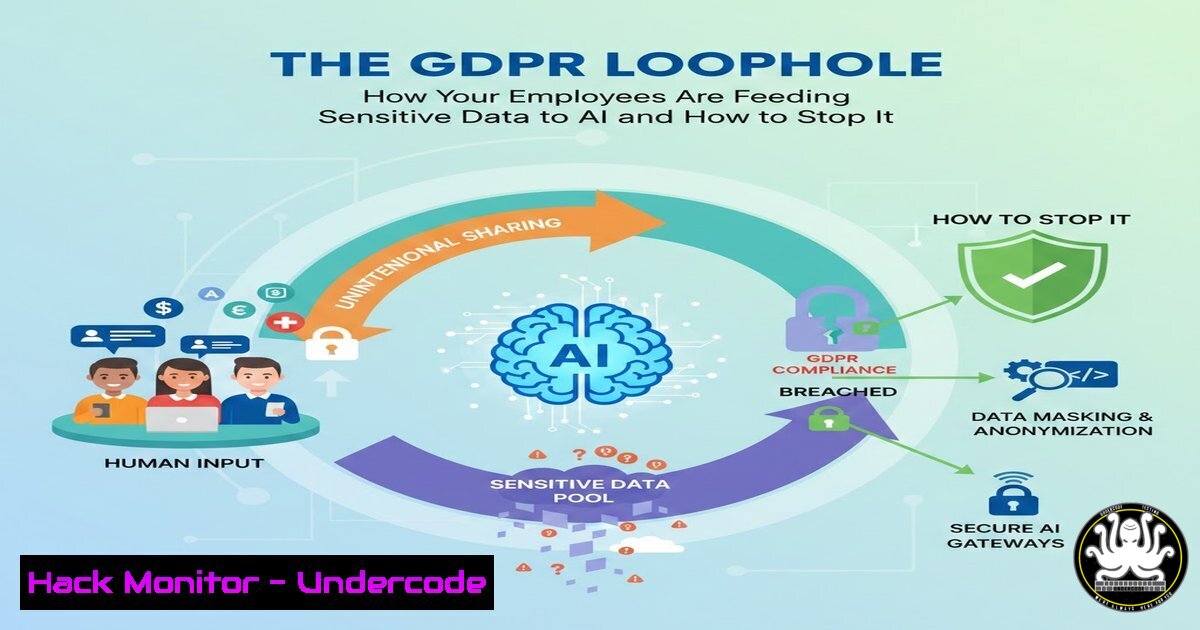
The recent EU agreement to allow the use of anonymized user data for machine learning has created a new frontier of corporate risk. While the policy aims to balance innovation and privacy, it has inadvertently exposed a critical vulnerability: the human element. Employees, often with the best intentions, are inputting sensitive company and customer data into public AI chatbots, creating a massive data exfiltration crisis that existing policies alone cannot prevent.
Learning Objectives:
- Understand the technical and behavioral risks of employees using public AI tools with corporate data.
- Learn how to implement technical safeguards, including Data Loss Prevention (DLP) tools and network-level controls.
- Develop a strategy for anonymizing data for legitimate AI use cases while maintaining compliance.
You Should Know:
1. The Anatomy of an AI Data Leak
When an employee pastes a customer list, internal source code, or a confidential strategy document into a public AI interface, that data is often transmitted to a third-party server and can be used to train models, potentially exposing it in responses to other users. This is not a theoretical risk; it’s a daily occurrence in organizations lacking specific AI data governance.
Step-by-step guide explaining what this does and how to use it.
Step 1: Identify Data Flow. Use a web proxy or firewall log to see outbound traffic to AI service domains (e.g., api.openai.com, generativelanguage.googleapis.com). This reveals the scale of internal usage.
Linux Command (using `tcpdump` for analysis):
sudo tcpdump -i any -A 'host api.openai.com' | head -100
This command captures and displays the first 100 packets sent to OpenAI’s API, which can help identify if unencrypted (HTTP) data is being transmitted. Most traffic will be HTTPS, but the command confirms communication.
Windows Command (using PowerShell to check network connections):
Get-NetTCPConnection | Where-Object {$_.RemoteAddress -like "openai"} | Select-Object LocalAddress, LocalPort, RemoteAddress, RemotePort, State
This checks for active TCP connections to servers with “openai” in their address.
Step 2: Classify Your Sensitive Data. You cannot protect what you do not know. Use tools like Microsoft Purview or open-source classifiers to scan your repositories for Personally Identifiable Information (PII), Intellectual Property (IP), and credentials.
2. Implementing Technical Guardrails: Blocking and Monitoring
Awareness is not enough; technical enforcement is required. This involves controlling access at the network and application level.
Step-by-step guide explaining what this does and how to use it.
Step 1: Block Public AI Endpoints at the Firewall. The most straightforward method is to block access to known AI platform URLs at your corporate firewall or web filter. This is a blunt instrument but highly effective for non-sanctioned use.
Example Firewall Policy: Create a rule to DENY outbound traffic for the entire organization to destination FQDNs like .openai.com, .anthropic.com, and .bard.google.com.
Step 2: Deploy a Client-Side DLP Solution. For more granular control, use a DLP agent on endpoints. Tools like Microsoft Purview Information Protection can be configured to detect and block the copying of sensitive data into unapproved applications, including web browsers.
Configuration Snippet (Conceptual): A DLP policy rule might look like:
`IF (Content contains [PII: Credit Card Number]) AND (Application is [Web Browser]) AND (Destination URL is [in AI Domains Blocklist]) THEN ACTION = Block and Alert.`
3. The Right Way: Building a Secure AI Sandbox
Instead of a blanket ban, provide a secure, sanctioned alternative. This involves deploying a local AI model or using a cloud API with a strict data processing agreement.
Step-by-step guide explaining what this does and how to use it.
Step 1: Deploy a Local LLM. For tasks that require absolute data confidentiality, run an open-source model like Llama 3 or Mistral 7B on internal infrastructure.
Docker Command to run a local LLM (using Ollama):
docker run -d -p 11434:11434 --name ollama -v ollama:/root/.ollama ollama/ollama
docker exec -it ollama ollama run llama3
This starts a containerized Ollama instance and runs the Llama 3 model, providing a completely internal chatbot.
Step 2: Utilize Azure OpenAI Service with Data Protection. If using Microsoft Azure, their OpenAI service offers data handling assurances where prompts and responses are not used to train other models.
Process: Route all internal AI development through this approved, compliant endpoint, which can be whitelisted in your firewall while others are blocked.
4. Data Anonymization for Legitimate AI Use
The GDPR amendment permits the use of anonymized data. Technically anonymizing data is a non-trivial process that goes beyond simply removing names.
Step-by-step guide explaining what this does and how to use it.
Step 1: Identify Direct and Quasi-Identifiers. Direct identifiers (name, SSN) are easy. Quasi-identifiers (zip code, birthdate, gender) can be combined to re-identify individuals.
Step 2: Apply Anonymization Techniques. Use techniques like k-anonymity, l-diversity, or differential privacy. A simple Python script using the `presidio-anonymizer` library can perform this.
Python Code Snippet:
from presidio_anonymizer import AnonymizerEngine
from presidio_analyzer import AnalyzerEngine

text = "My name is John Doe and my phone number is 212-555-1234."
analyzer = AnalyzerEngine()
analyzer_results = analyzer.analyze(text=text, language='en')
engine = AnonymizerEngine()
anonymized_result = engine.anonymize(text=text, analyzer_results=analyzer_results)
print(anonymized_result.text)
 Output: "My name is <PERSON> and my phone number is <PHONE_NUMBER>."
5. Enforcing Policy with Technology: The Technical Kill-Switch
As one commenter suggested, contractual threats are one thing; technical enforcement is another. Combine policy with automated detection and response.
Step-by-step guide explaining what this does and how to use it.
Step 1: Deploy a Cloud Access Security Broker (CASB). A CASB like Microsoft Defender for Cloud Apps can monitor SaaS application usage, including shadow IT AI tools, and detect anomalous data transfers.
Step 2: Create Automated Playbooks. In your Security Information and Event Management (SIEM) system, create an alert rule for large data uploads to external AI domains.
Example Splunk SPL Query (Conceptual):
index=firewall_logs dest_ip="api.openai.com" bytes_out > 100000
| stats sum(bytes_out) as TotalDataExfil by src_ip user
| where TotalDataExfil > 100000
This would alert on any internal IP (src_ip) sending more than 100KB to OpenAI’s API.
What Undercode Say:
- Technology, Not Just Training, is the Answer. While cybersecurity awareness is the foundation, it is a flawed defense on its own. A robust security posture requires layered technical controls that automatically prevent policy violations.
- The “Sanctioned Path” Strategy is Critical. A outright ban on AI is both unenforceable and counterproductive. The winning strategy is to acknowledge the utility of AI and provide a secure, compliant, and easy-to-use alternative that makes the risky public option obsolete.
The analysis reveals a fundamental shift in the data leakage threat model. The enemy is no longer just a malicious hacker; it is a well-meaning employee using a productivity tool. The comments on the original post highlight this dichotomy, with one side advocating for better training and tools (Enterprise Data Protection) and the other for strict punitive measures. The most effective CISO will merge these views: creating clear, harsh consequences for policy violation while simultaneously building a technological environment that makes it nearly impossible to violate the policy in the first place. The GDPR amendment is a catalyst, forcing organizations to finally get serious about data governance in the age of AI.
Prediction:
The current trend of ad-hoc AI usage will lead to a significant data breach within the next 12-18 months, where corporate intellectual property or massive customer datasets are leaked via an AI model’s training data. This will trigger a wave of lawsuits and regulatory fines that far exceed GDPR penalties to date. In response, we will see the rapid emergence and adoption of “AI Security Posture Management” (AISPM) as a standard cybersecurity category, focusing exclusively on monitoring, governing, and securing corporate interactions with generative AI models.
🎯Let’s Practice For Free:
IT/Security Reporter URL:
Reported By: Stanimir Kostadinov – Hackers Feeds
Extra Hub: Undercode MoN
Basic Verification: Pass ✅


