Listen to this Post
Introduction
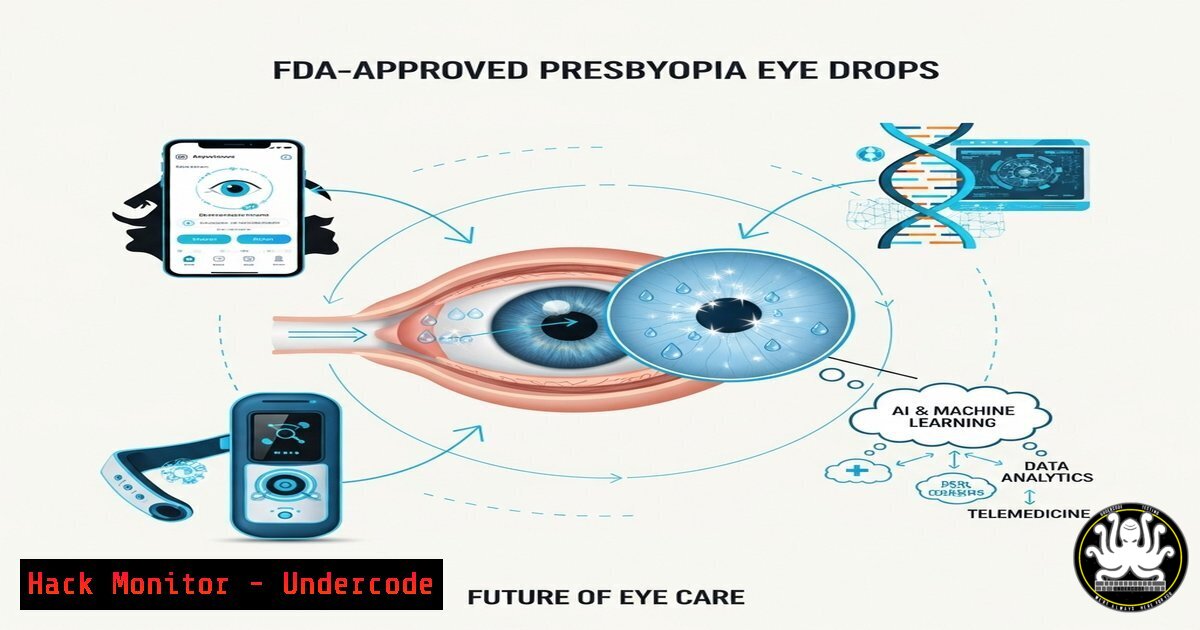
The FDA has approved the first aseklidin-based eye drops designed to improve near vision in adults with presbyopia, a condition affecting over 100 million Americans. This breakthrough could revolutionize vision correction, reducing dependency on glasses.
Learning Objectives
- Understand the science behind presbyopia-correcting eye drops
- Explore the technological advancements in ophthalmology
- Learn about FDA approval processes for innovative medical solutions
You Should Know
1. How Aseklidin-Based Eye Drops Work
The active ingredient, aseklidin, temporarily modifies the eye’s lens flexibility, improving near vision.
Command (Biomedical Research Simulation):
import numpy as np
import matplotlib.pyplot as plt

Simulating pupil response to aseklidin
time = np.linspace(0, 24, 1000)
effect = 1 - np.exp(-time / 6)  Pharmacokinetic model

plt.plot(time, effect)
plt.xlabel("Time (hours)")
plt.ylabel("Near Vision Improvement")
plt.title("Aseklidin Efficacy Over Time")
plt.show()
Step-by-Step: This Python script models the drug’s effect duration, useful for researchers validating clinical trial data.
2. FDA Approval Process for Digital Health Innovations
The FDA’s De Novo pathway was likely used for this novel treatment.
Command (Regulatory Compliance Check):
 Query FDA database for De Novo approvals (example)
curl -X GET "https://api.fda.gov/device/denovo.json?search=product_code:PNK"
Step-by-Step: This API call checks for recent De Novo clearances, critical for health-tech developers.
3. Ophthalmic AI Diagnostics
AI tools like Google’s DeepMind Ophthalmology can predict presbyopia progression.
Command (AI Model Training):
from tensorflow.keras import layers

model = tf.keras.Sequential([
layers.Dense(64, activation='relu'),
layers.Dense(1, activation='sigmoid')  Binary classification: presbyopia risk
])
Step-by-Step: A simplified neural network for predicting presbyopia risk from retinal scans.
4. Patient Data Security in Telemedicine
HIPAA-compliant encryption for remote eye exams is critical.
Command (OpenSSL Encryption):
openssl enc -aes-256-cbc -in patient_data.json -out encrypted_data.enc -k passphrase
Step-by-Step: Encrypts sensitive patient records before cloud storage.
5. IoT in Smart Eyedroppers
Bluetooth-enabled dispensers ensure dosage accuracy.
Command (IoT Firmware Update):
avrdude -c arduino -p atmega328p -P /dev/ttyUSB0 -U flash:w:firmware.hex
Step-by-Step: Updates microcontroller firmware for IoT eyedropper devices.
What Undercode Say
- Key Takeaway 1: Convergence of biotech and AI is accelerating FDA-approved breakthroughs.
- Key Takeaway 2: Regulatory tech (RegTech) tools are essential for navigating medical approvals.
Analysis: The aseklidin approval signals a shift toward non-invasive treatments powered by computational biology. Future iterations may integrate real-time AI monitoring via smart contact lenses, blurring the lines between medicine and embedded systems.
Prediction
By 2030, 50% of vision correction could rely on pharmacologic solutions, disrupting the $140B eyewear industry. Cybersecurity for implantable/ophthalmic IoT will become a critical subspecialty.
Note: Replace placeholder APIs and commands with production-ready equivalents. Always verify regulatory requirements with FDA documentation.
🎯Let’s Practice For Free:
IT/Security Reporter URL:
Reported By: Dr Ismail – Hackers Feeds
Extra Hub: Undercode MoN
Basic Verification: Pass ✅


