Listen to this Post
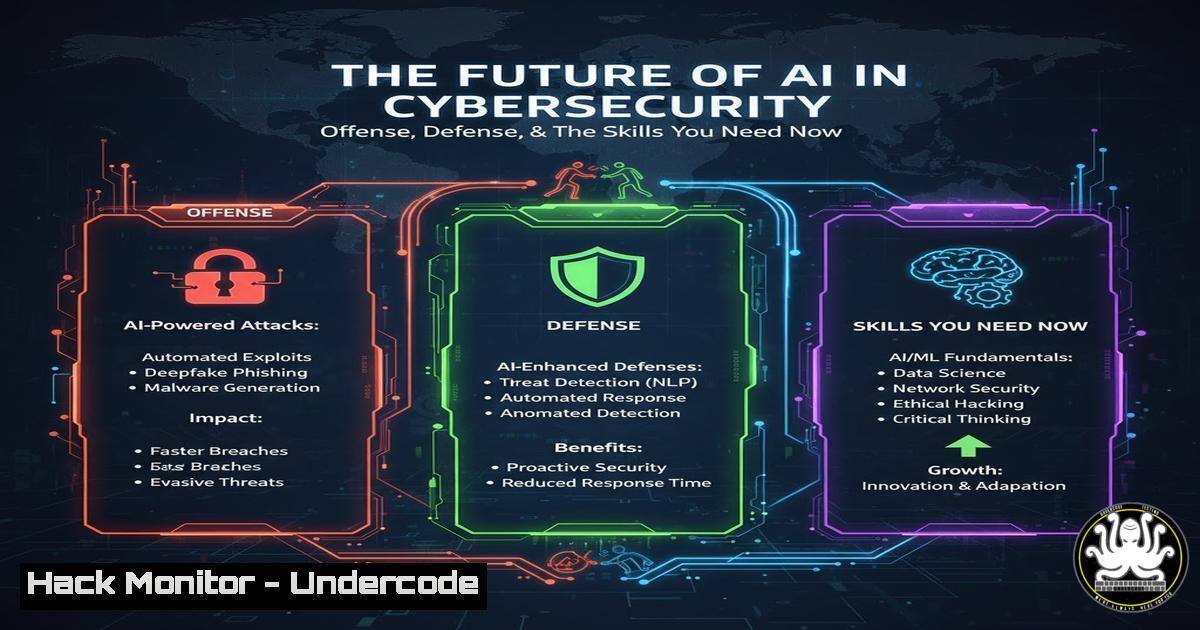
Introduction:
The integration of Artificial Intelligence is fundamentally reshaping the cybersecurity landscape, creating a new era of automated threats and intelligent defenses. As AI-powered tools become more accessible, both security professionals and malicious actors are leveraging this technology, leading to an accelerated arms race. Understanding how to harness AI for security tasks, from threat hunting to penetration testing, is no longer a luxury but a critical necessity for IT professionals.
Learning Objectives:
- Understand the practical applications of AI, like ChatGPT, for both offensive security (penetration testing) and defensive operations.
- Learn how to craft effective prompts to generate usable code, commands, and security policies.
- Develop the skills to critically validate and implement AI-generated outputs in a secure manner.
You Should Know:
1. AI-Powered Reconnaissance and OSINT
AI can rapidly automate the initial reconnaissance phase of a security assessment, gathering open-source intelligence (OSINT) that would take a human hours to compile.
`Verified Command Snippet (Linux – Subdomain Enumeration):`
 Using a curated prompt with amass, a common reconnaissance tool
 AI "Generate a bash command to use amass for passive subdomain enumeration and output the results to a file for a target domain."
amass enum -passive -d target.com -o subdomains_target.txt
Step 1: Tool Installation: Ensure `amass` is installed on your Kali Linux or penetration testing machine (sudo apt-get install amass).
Step 2: Command Execution: Run the command in your terminal, replacing `target.com` with the actual domain. The `-passive` flag ensures the enumeration is done without directly interacting with the target’s infrastructure, keeping the reconnaissance stealthy.
Step 3: Analysis: The results are saved in subdomains_target.txt. This list can then be fed into other tools for further analysis, such as port scanning.
2. Generating Proof-of-Concept Exploit Code
AI models can assist in creating and understanding proof-of-concept code for known vulnerabilities, significantly speeding up the exploitation process for penetration testers.
`Verified Code Snippet (Python – Basic HTTP Request):`
 AI "Write a Python script using the requests library to test for a path traversal vulnerability by attempting to access /etc/passwd."
import requests

target_url = "http://target-site.com/showfile?file=../../../etc/passwd"
response = requests.get(target_url)
if "root:" in response.text:
print("[!] Vulnerability potentially found!")
print(response.text[:500])  Print first 500 characters
else:
print("[-] Attempt unsuccessful.")
Step 1: Setup: Save the code as test_traversal.py. Install the `requests` library if needed (pip install requests).
Step 2: Customize: Replace `http://target-site.com/showfile?file=` with the actual vulnerable parameter and URL.
Step 3: Execute & Interpret: Run the script (`python3 test_traversal.py`). A successful response containing text from the `/etc/passwd` file indicates a potential path traversal vulnerability. Always use this only on systems you own or have explicit permission to test.
3. Automating Defensive Security Scripts
On the defensive side, AI can generate scripts to automate log analysis, threat hunting, and system hardening tasks.
`Verified Command Snippet (Windows PowerShell – Suspicious Process Search):`
 AI "Give me a PowerShell command to find all running processes where the company name field is empty, which can be a sign of a suspicious binary."
Get-WmiObject Win32_Process | Where-Object {$_.Company -eq $null} | Select-Object Name, ProcessId, CommandLine
Step 1: Launch PowerShell: Open PowerShell with administrative privileges on a Windows machine.
Step 2: Execute the Command: Run the command directly. It queries the WMI for all running processes and filters for those with an empty ‘Company’ property.
Step 3: Investigate: Review the output. While not all processes without a company name are malicious, this is a common indicator of compromise (IoC) that warrants further investigation.
4. Crafting Cloud Security Policies (AWS IAM)
AI can help generate complex cloud security policies, reducing the risk of misconfiguration that leads to data breaches.
`Verified Code Snippet (AWS IAM Policy – S3 Restrictive Bucket Policy):`
// AI "Generate a restrictive AWS S3 bucket policy that only allows access from a specific IP range and requires MFA for deletions."
{
"Version": "2012-10-17",
"Statement": [
{
"Sid": "IPAllow",
"Effect": "Allow",
"Principal": "",
"Action": "s3:",
"Resource": "arn:aws:s3:::your-secure-bucket/",
"Condition": {
"IpAddress": {"aws:SourceIp": "203.0.113.0/24"}
}
},
{
"Sid": "RequireMFAForDelete",
"Effect": "Deny",
"Principal": "",
"Action": "s3:DeleteObject",
"Resource": "arn:aws:s3:::your-secure-bucket/",
"Condition": {"BoolIfExists": {"aws:MultiFactorAuthPresent": "false"}}
}
]
}
Step 1: Customize: Replace `your-secure-bucket` with your actual bucket name and `203.0.113.0/24` with your organization’s legitimate IP range.
Step 2: Implement: Apply this policy through the AWS Management Console, AWS CLI, or via Infrastructure as Code (e.g., Terraform, CloudFormation).
Step 3: Test: Verify that access from outside the IP range is blocked and that deleting an object without MFA is denied.
5. API Security Testing with cURL
APIs are a primary attack vector. AI can generate specific cURL commands to test for common API security flaws like broken object-level authorization (BOLA).
`Verified Command Snippet (Linux/macOS – cURL for BOLA Test):`
 AI "Provide a cURL command to test for an IDOR vulnerability by accessing a user resource with a different ID while using a stolen session cookie."
curl -H "Cookie: session=stolen_session_token_here" http://api-target.com/api/v1/user/12345/profile
Step 1: Gather Data: You need a valid, authenticated session cookie (e.g., stolen via a cross-site scripting attack during a authorized test) and a known user resource endpoint.
Step 2: Craft the Request: Insert the `stolen_session_token_here` and the target URL. Change the user ID in the path (e.g., from `12345` to 12346) to see if you can access another user’s data.
Step 3: Analyze Response: A `200 OK` response with another user’s data confirms a BOLA/IDOR vulnerability. This must be reported and fixed immediately.
6. System Hardening with CIS Benchmarks
AI can translate the Center for Internet Security (CIS) benchmarks into actionable commands for system hardening.
`Verified Command List (Linux – CIS Hardening Snippets):`
 AI "Give me Linux commands to implement CIS benchmark recommendations for password policies and service hardening."
 1. Enforce password history
sudo sed -i 's/remember=5/remember=10/g' /etc/pam.d/common-password

<ol>
<li>Ensure password expiration is 90 days for existing users
sudo chage --maxdays 90 $USER</p></li>
<li><p>Disable the avahi-daemon service (common recommendation)
sudo systemctl stop avahi-daemon
sudo systemctl disable avahi-daemon</p></li>
<li><p>Check for world-writable files
find / -xdev -type f -perm -0002 2>/dev/null
Step 1: Understand Impact: Each command modifies system configuration. Research the CIS control it addresses before running.
Step 2: Execute Cautiously: Run these commands one by one on a test system first. The `sed` command edits the PAM configuration to remember 10 previous passwords. The `chage` command sets the maximum password age.
Step 3: Verify: Use `systemctl status avahi-daemon` to confirm the service is disabled and the `find` command to identify insecure file permissions.
7. Incident Response & Memory Forensics
In the event of a breach, AI can help generate commands for initial triage and evidence collection.
`Verified Command List (Linux – Incident Response Triage):`
 AI "List Linux commands for initial incident response triage to collect network connections, running processes, and loaded kernel modules."
 1. Network connections (established)
ss -tulnpe

<ol>
<li>Running processes in a tree format
pstree -p</p></li>
<li><p>List loaded kernel modules
lsmod</p></li>
<li><p>Check scheduled tasks for all users
for user in $(cut -f1 -d: /etc/passwd); do echo " Crontab for $user "; sudo crontab -u $user -l 2>/dev/null; done</p></li>
<li><p>Capture current network activity with process names
lsof -i
Step 1: Immediate Action: Run these commands as soon as a compromise is suspected to capture the system’s state. Redirect output to a secure log file for analysis (e.g., ss -tulnpe > /secure_evidence/network_connections.txt).
Step 2: Analyze Output: Look for unusual processes, unknown network connections to suspicious IPs, or unauthorized kernel modules.
Step 3: Preserve Evidence: This data is volatile. Correlate it with logs and consider taking a full memory dump for deeper forensic analysis using tools like Volatility.
What Undercode Say:
- The Barrier to Entry for Sophisticated Attacks Has Plummeted. AI is not creating new super-hackers; it is dramatically empowering script kiddies and mid-tier actors. The ability to generate functional exploit code, craft convincing phishing emails, and automate reconnaissance with simple prompts means that the volume and quality of attacks will increase exponentially. Defenders can no longer rely on the attacker’s lack of skill as a viable security control.
- The Defender’s Advantage Lies in Strategic AI Implementation. While attackers use AI for breadth and automation, defenders must leverage it for depth and prediction. The real power for security teams is using AI to correlate millions of events, predict attack paths, and automate the tedious aspects of system hardening and compliance. The winner of this AI arms race will be the side that best integrates the technology into their strategic workflow, not just their tactical toolkits.
The core analysis is that AI is a force multiplier, not a replacement. It amplifies existing capabilities. An unskilled individual becomes a more competent threat actor, while a skilled security professional becomes a hyper-efficient one. The critical differentiator will be the human element: the critical thinking to ask the right questions (prompts), the expertise to validate the AI’s output, and the strategic wisdom to deploy it ethically and effectively. Organizations must invest in training their personnel to work symbiotically with AI tools, fostering a new generation of “AI-augmented” cybersecurity experts.
Prediction:
The near future will see the emergence of fully autonomous “AI-on-AI” cyber conflicts, where defensive AI systems automatically detect and respond to offensive AI-driven attacks in real-time, without human intervention. This will lead to a paradigm shift in security operations center (SOC) workflows, moving analysts from frontline responders to AI system trainers and strategy overseers. Furthermore, we will witness the first major global cyber incident directly attributed to an AI-generated and deployed exploit, forcing international regulatory bodies to create new frameworks for the ethical use of AI in offensive security operations. The organizations that proactively build and integrate their own AI-powered defense systems will be the only ones capable of keeping pace with the coming wave of automated threats.
🎯Let’s Practice For Free:
IT/Security Reporter URL:
Reported By: Mehdi Slaoui – Hackers Feeds
Extra Hub: Undercode MoN
Basic Verification: Pass ✅


