Listen to this Post
Introduction:
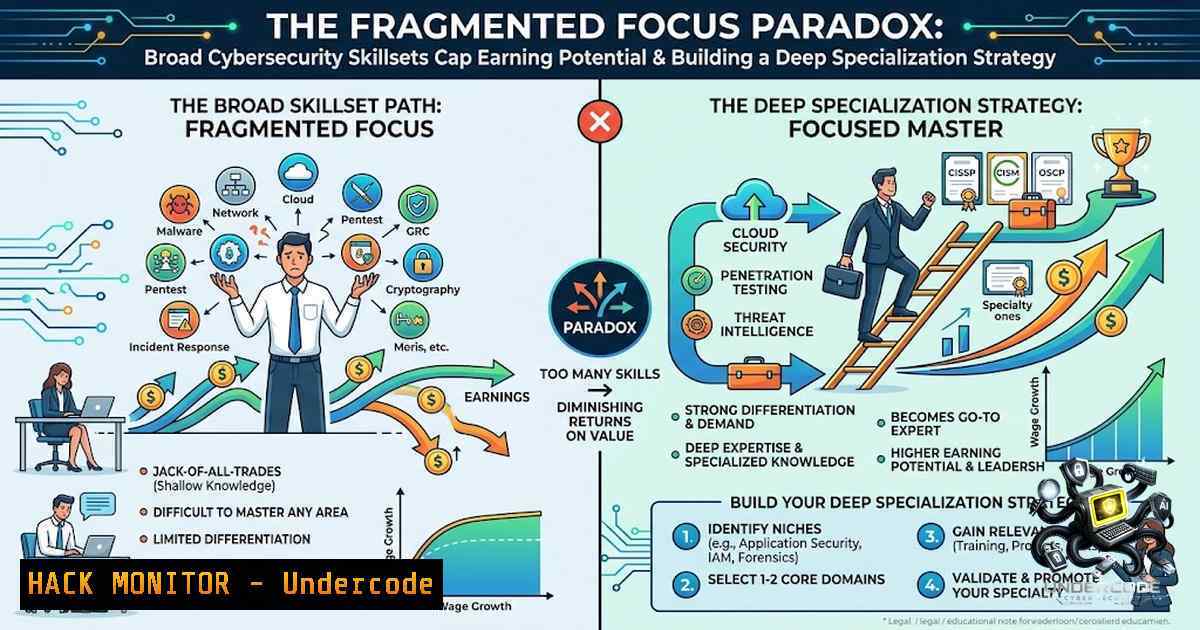
In the modern cybersecurity and GRC (Governance, Risk, and Compliance) landscape, the common narrative dictates that versatility is the ultimate asset. However, data from labor market analytics and career progression patterns indicate a stark reality: high compensation follows a steep depth curve rather than a wide breadth. The primary bottleneck preventing professionals from reaching elite income levels is not a lack of technical aptitude or work ethic, but rather the fragmentation of focus across parallel tracks such as cybersecurity frameworks, operational analytics, and side tech gigs, which dilutes the expertise required for top-tier roles.
Learning Objectives:
- Understand the economic principle of specialization versus generalization in the context of IT and cybersecurity.
- Identify the key technical domains (GRC, Ethical Hacking, Data Analytics) that are commonly fragmented.
- Learn how to leverage specific tools, commands, and frameworks to build a verifiable deep specialization.
You Should Know:
- The Depth vs. Breadth Trade-off in Security Operations
The core issue lies in the cognitive overhead required to maintain proficiency across disparate domains. For instance, mastering ISO 27001 implementation requires deep knowledge of control objectives, statement of applicability (SoA), and risk treatment plans. Simultaneously, maintaining proficiency in ethical hacking (e.g., using Metasploit or Nmap) requires a different “muscle memory” involving network protocols and exploit development. Splitting time between these results in “mid-level competence” in four areas rather than “elite expertise” in one.
Step-by-Step Guide to Auditing Your Skill Fragmentation:
- Step 1: Inventory your technical activities. List the tools you used in the last 30 days (e.g., Splunk, Power BI, Metasploit, Burp Suite).
- Step 2: Calculate the time ratio. For each tool, estimate the hours spent.
- Step 3: Categorize by domain. Group these tools into domains (e.g., GRC/Audit vs. Penetration Testing vs. Data Analytics).
- Step 4: Identify the “Primary” track. Select the domain that aligns with your highest-paying job requirements or long-term market demand.
- Step 5: Eliminate “Non-Core” distractions. De-prioritize side gigs (e.g., crypto annotation) that do not contribute to your primary specialization narrative.
- Operational Management & Analytics as a Force Multiplier
While the post mentions HMO workflow management and DAX/Power Pivot data modeling, in a cybersecurity context, these skills are not the primary commodity. Instead, they are “force multipliers.” Understanding how to query security logs using advanced Excel or Power BI to visualize attack patterns is a niche skill. However, relying on this as a primary track often leads to a career ceiling as a “report generator” rather than a “security architect.”
Technical Implementation for Security Analytics:
If you are merging security with analytics, focus on parsing Windows Event Logs or Linux Syslog using command-line tools before visualizing them.
Linux Command for Log Extraction:
To extract failed login attempts from `/var/log/auth.log` to feed into a reporting tool:
grep "Failed password" /var/log/auth.log | awk '{print $1, $2, $3, $9, $11}' | sort | uniq -c > failed_logins.csv
Windows PowerShell Command for Event Logs:
To retrieve security Event ID 4625 (Failed logon) for analysis:
Get-WinEvent -LogName Security | Where-Object { $<em>.Id -eq 4625 } | Select-Object TimeCreated, @{Name='User';Expression={$</em>.Properties[bash].Value}} | Export-Csv -Path failed_logins.csv
Tutorial: Use these outputs to create pivot tables in Excel, visualizing which IPs or users are generating the most alerts. However, remember that this is a secondary skill; the primary value is interpreting this data from a threat-actor perspective.
- The GRC Framework Foundation (ISO 27001 & NIST)
To specialize in Cybersecurity & GRC, one must move beyond theoretical knowledge. The post correctly identifies ISO 27001 and risk assessment methodologies. The highest earners in this space are those who can map technical vulnerabilities to business risks using quantitative models (e.g., FAIR).
Step-by-Step Guide to a GRC Risk Assessment:
- Step 1: Asset Inventory. Use Nmap to scan a network range and identify active assets:
nmap -sn 192.168.1.0/24. - Step 2: Vulnerability Identification. Run a basic vulnerability scan using `nmap -sV –script=vuln
` to identify known CVE vulnerabilities. - Step 3: Risk Calculation. For each vulnerability identified, calculate the “Risk Score” using the formula:
Risk = (Impact Likelihood). - Step 4: Control Mapping. Map the identified vulnerabilities to ISO 27001 Annex A controls (e.g., A.12.6.1 Management of technical vulnerabilities).
- Step 5: Mitigation Strategy. Document technical remediation (e.g., `apt-get update` for Linux or Windows Update) and administrative controls.
4. API Security and Cloud Hardening
A deep specialization currently yields the highest ROI in Cloud Security and API Security. Instead of juggling Web3 evaluation, focus on securing cloud-1ative workloads. This involves specific commands to harden misconfigurations.
API Security Configuration (Linux Environment):
When configuring a REST API (e.g., using Nginx), you must enforce strict rate limiting to prevent brute-force attacks.
limit_req_zone $binary_remote_addr zone=mylimit:10m rate=5r/m;

server {
location /api/ {
limit_req zone=mylimit burst=10 nodelay;
proxy_pass http://backend;
}
}
Cloud Hardening (AWS CLI):
To enforce security groups that restrict inbound traffic to only necessary IPs, use the AWS CLI:
aws ec2 authorize-security-group-ingress --group-id sg-12345 --protocol tcp --port 22 --cidr 203.0.113.0/24
Step-by-step: Review IAM policies to ensure least privilege. Use `aws iam list-users` and `aws iam list-attached-user-policies` to audit permissions.
5. Vulnerability Exploitation & Mitigation (The Hacker Mindset)
To achieve “elite” status, one must understand how attacks work to effectively defend or audit against them. For example, exploiting simple misconfigurations like default credentials.
Step-by-Step Exploit/Mitigation Practice:
- Step 1: Use Hydra to test for weak SSH credentials (For educational purposes on your own lab).
`hydra -l admin -P /usr/share/wordlists/rockyou.txt ssh://192.168.1.10`
- Step 2: Observe the successful login.
- Step 3: Mitigation: Implement SSH key-based authentication and disable password authentication by editing `/etc/ssh/sshd_config` and setting
PasswordAuthentication no.
- The Cost of Fragmented Focus on Earning Potential
The core thesis of the post is that “mid-level competence” across multiple fields results in a salary ceiling that is generally lower than a “senior-level” specialist. If you are balancing Cybersecurity, Data Analytics, and Web3, your CV reads as a “Jack of all Trades.” Recruiters for high-paying security roles (e.g., Security Architect, CISO) look for deep penetration into a specific framework or technology stack (e.g., AWS Security Specialty or CISSP).
What Undercode Say:
- Key Takeaway 1: Versatility is a trap if it prevents you from achieving “recognized depth.” The market pays a premium for experts who can solve niche problems (e.g., cloud forensics) rather than generalists who can do basic tasks in many areas.
- Key Takeaway 2: To escape the fragmentation trap, you must “cultivate a professional identity.” If you choose GRC, pivot all side-projects towards ISO 27001 audits or risk quantification. If you choose Tech/Cyber, pivot towards exploit development or cloud security. Kill the projects that do not serve that narrative.
Analysis:
The modern professional is constantly exposed to “shiny object syndrome” due to the rapid evolution of tech (AI Annotation, Web3). However, the fundamental laws of economics dictate that scarcity drives price. Deep specialization creates scarcity. While the post highlights Data Analytics (Power Pivot) as a distinct track, the most effective strategy is to integrate that analytical capability into your primary track. Instead of being a “Security Analyst who can use Excel,” you need to be a “Security Engineer who uses Python to automate data analysis of threat feeds.” That differentiation is subtle but crucial.
Prediction:
- +1: Professionals who consolidate their focus into a single, high-demand vertical (e.g., AI Security or Cloud GRC) will see a 30-40% increase in earning potential within the next 18-24 months as the market matures and requires deeper specialization to handle complex regulations (e.g., EU AI Act).
- -1: Professionals who continue to dilute their efforts across unrelated technical and operational tracks will find themselves displaced by AI automation tools that can handle “mid-level” tasks (like basic log analysis or report generation) faster and cheaper, forcing a career pivot or a salary decrease.
▶️ Related Video (70% Match):
🎯Let’s Practice For Free:
🎓 Live Courses & Certifications:
Join Undercode Academy for Verified Certifications
🚀 Request a Custom Project:
Secure, high-velocity infrastructure and disruptive technological engineering. Contact our engineering team for high-tier development and proprietary systems:
[email protected]
💎 Smart Architecture | 🛡️ Secure by Design | ⭐ Trusted by Thousands
IT/Security Reporter URL:
Reported By: https://lnkd.in/p/ebPppByD – Hackers Feeds
Extra Hub: Undercode MoN
Basic Verification: Pass ✅


