Listen to this Post
Introduction:
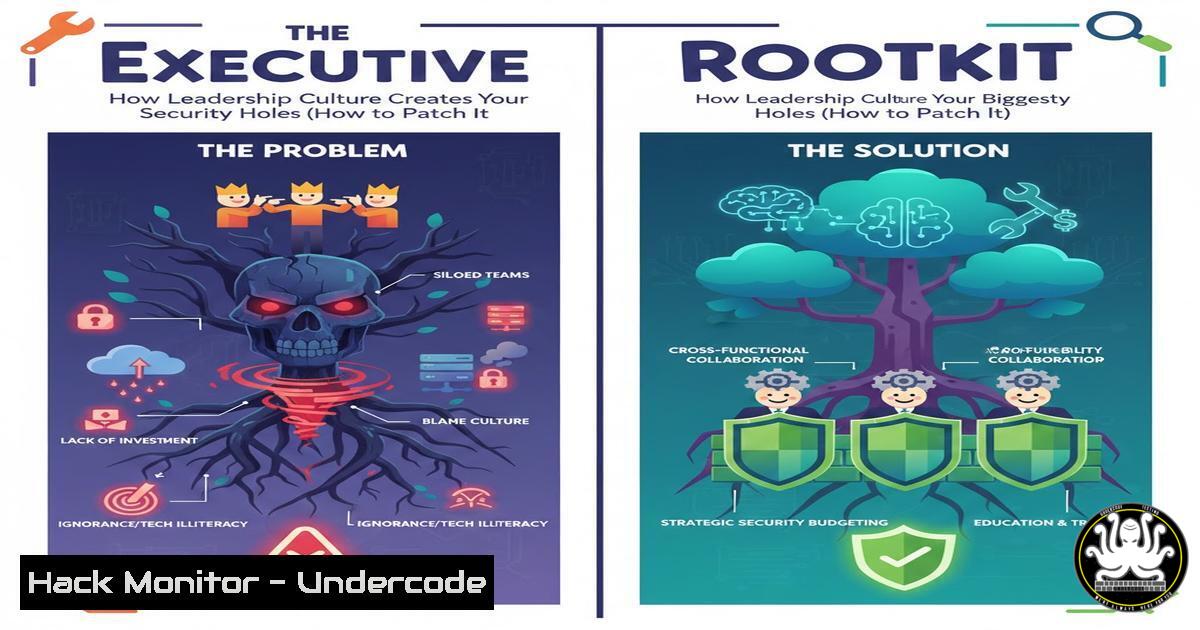
The pervasive myth of “security culture” as an employee awareness problem is a dangerous distraction masking the true vulnerability: executive decision-making. Real security culture is defined not by phishing test scores, but by the risks leadership accepts, the behaviors they reward, and the accountability they design. This article deconstructs how top-down cultural failures manifest as technical debt and exploitable weaknesses, providing a roadmap to audit and harden the organizational layer where risk is truly born.
Learning Objectives:
- Diagnose how executive priorities directly create specific, exploitable technical vulnerabilities.
- Implement technical controls and audits that enforce accountability at the permission, patch, and policy level.
- Build a framework to translate cultural rhetoric into measurable, technical, and governance-level actions.
You Should Know:
- Excessive Permissions: The Technical Debt Approved at the Top
When executives demand unfettered speed or treat security as a “blocker,” the result is often a proliferation of standing privileged access. This “access sprawl” is a direct technical outcome of a culture that rewards shortcuts.
Step‑by‑step guide explaining what this does and how to use it.
An audit of standing administrative privileges is the first technical counter to this cultural failure.
– On Windows (Active Directory): Use PowerShell to identify users with excessive rights.
 Find all members of privileged groups like Domain Admins, Enterprise Admins
Get-ADGroupMember -Identity "Domain Admins" | Select-Object name, distinguishedName
 Audit for users with "DCSync" rights (can replicate AD database for credential theft)
Import-Module ActiveDirectory
(Get-ACL "AD:DC=domain,DC=com").Access | Where-Object {$_.ObjectType -eq "1131f6aa-9c07-11d1-f79f-00c04fc2dcd2"} | Format-List IdentityReference
– On Linux/AWS/GCP/Azure: The principle is identical. Enforce Joint Privilege Access Management (JIT) and audit standing roles.
 Example AWS CLI command to list all IAM users and their attached policies
aws iam list-users --query 'Users[].UserName'
aws iam list-attached-user-policies --user-name <username>
 In Azure, use Microsoft Graph API or Portal to review role assignments
The Fix: Implement a Privileged Access Management (PAM) solution. Make elevated access time-bound, justified, and logged. Culture change: Tie executive KPIs to the reduction of standing privileged accounts.
- Deprioritized Patching: Mapping Unpatched Systems to Business Decisions
The infamous “temporary exception” for a critical patch is a cultural artifact, not an operational necessity. It signals that uptime or project deadlines are valued above risk reduction.
Step‑by‑step guide explaining what this does and how to use it.
You must technically track the chain of approval for deferred patches to assign ownership.
– Establish a CMDB & Vulnerability Correlation: Use tools like Nessus, Qualys, or OpenVAS to scan.
– Automate Reporting with Context: Generate reports that don’t just list CVEs, but link them to the asset owner and the approved deviation ticket.
 Example using Nessus CLI and jq to parse scan data, focusing on critical vulnerabilities older than 30 days
nessuscli scan list --status completed
 Use API to pull details, filter for critical/severe, and output to a CSV with system owner data
– Patch Management Commands:
 Linux (apt-based): Simulate and apply security updates only
sudo apt update && sudo apt list --upgradable | grep -i security
sudo apt-get --only-upgrade install <security-package-name>
 Windows: Via PowerShell
Get-HotFix | Sort-Object InstalledOn -Descending | Select-Object -First 20
 Install updates (requires WSUS or Microsoft Update configuration)
The Fix: Implement a rigid patch SLA policy. Require VP-level sign-off for any deviation, with a mandatory compensating control (e.g., network segmentation). Publicly track metrics like “Mean Time to Patch Critical Vulns.”
3. Rewarding Silence: Disabling Security Logging and Alerts
A culture that punishes messengers leads to the intentional weakening of detective controls. Alerts get tuned to “reduce noise,” and critical logs are not collected.
Step‑by‑step guide explaining what this does and how to use it.
Harden your logging infrastructure to be resilient to cultural interference.
– Enable Immutable Audit Trails:
– Linux (auditd): Configure rules to monitor critical files and system calls, write logs to a remote, append-only filesystem.
 Key rule to monitor /etc/passwd for changes (immutable)
sudo auditctl -w /etc/passwd -p wa -k identity_management
 Ensure auditd config is locked down
sudo chattr +i /etc/audit/audit.rules
– Windows: Enable Advanced Audit Policy via `gpedit.msc` or PowerShell, forward logs to a secured SIEM.
 Configure PowerShell logging (Module/ScriptBlock)
Turn on Module Logging and ScriptBlock Logging via Group Policy or <code>Register-PSSessionConfiguration</code>.
– Centralized SIEM Rule Validation: Create a daily automated test to verify critical detection rules are active and alerting.
 Example pseudo-code for a SIEM API check
curl -k -u api_user:password https://siem.company.com/api/alerts/rule_status?rule_id=CRITICAL_LOGON_AFTER_HOURS
 Should return "enabled: true"
The Fix: Establish a “Security Monitoring Charter” approved by the Board. Mandate that any change to critical alerting or log retention requires a formal risk assessment filed with the audit committee.
- Risk Acceptance Without Ownership: The Ghost in the GRC Machine
Executives often “accept risk” on spreadsheets that are disconnected from the technical environment, leaving no trace for system administrators.
Step‑by‑step guide explaining what this does and how to use it.
Technical enforcement of risk acceptance tickets.
- Integrate GRC Tickets with Cloud/IaaS Policy: Use tools like HashiCorp Sentinel, AWS Service Control Policies, or Azure Policy.
- Example – AWS S3 Bucket Without Encryption: A risk is accepted for a legacy application. The technical control ensures the exception is documented in the infrastructure.
Terraform with Sentinel policy example (concept)
Main.tf might create an unencrypted bucket, but...
Sentinel policy checks for a valid risk ticket ID in the resource tags
import "tfplan/v2" as tfplan
buckets_without_encryption = filter tfplan.resource_changes as _, rc {
rc.type is "aws_s3_bucket" and
rc.change.after.server_side_encryption_configuration is empty and
(rc.change.after.tags["Risk-Accepted-Ticket"] is null or rc.change.after.tags["Risk-Accepted-Ticket"] is "")
}
Block the provision if no valid ticket tag is present
The Fix: Implement a mandatory tagging policy for all cloud resources. Any deviation from security baseline (open port, no encryption) requires a tag with a risk ticket number that auto-expires in 90 days, forcing re-approval.
- Demanding Speed Without Safe Pipelines: The CI/CD Compromise
“Just get it deployed” leads to disabled SAST/SCA gates, oversized production service accounts, and disabled runtime protection.
Step‑by‑step guide explaining what this does and how to use it.
Enforce security in the pipeline programmatically.
- Example GitLab CI/CD Security Job: The following job will fail the pipeline if critical vulnerabilities are found, and cannot be overridden without merging a specific `.risk` file.
.gitlab-ci.yml snippet
sast:
stage: test
image: secure-scanner:latest
script:</li>
<li>/scanner/run-sast --critical-threshold high
allow_failure: false  This is key - do not allow the pipeline to pass on failure
except:</li>
<li>main
rules:</li>
<li>if: $CI_COMMIT_BRANCH != "main" && ! $CI_COMMIT_MESSAGE =~ /RISK-ACCEPTED:./
To bypass, commit message MUST include "RISK-ACCEPTED: TICKET-12345"
- Infrastructure as Code (IaC) Security: Use `checkov` or `tfsec` in pre-commit hooks.
Pre-commit hook example
.pre-commit-config.yaml
repos:</li>
<li>repo: https://github.com/bridgecrewio/checkov.git
rev: '2.3.324'
hooks:</li>
<li>id: checkov
args: ['--directory', '.', '--skip-check', 'CKV_AWS_8']  Skipping a check requires a comment
The Fix: Grant developers the authority to slow down deployments for security, backed by executive policy. Measure and reward “Mean Time to Remediate in Pipeline,” not just “Deployment Frequency.”
What Undercode Say:
- Key Takeaway 1: Every exploitable technical vulnerability—from stale permissions to unpatched systems—can be traced back to a leadership incentive, decision, or tolerated behavior. The attack surface is a physical manifestation of corporate culture.
- Key Takeaway 2: Technical controls must be designed not just to thwart external attackers, but to enforce internal accountability. Logging, permissions, and pipeline gates must be hardened against cultural decay as diligently as they are against threat actors.
The core analysis is that cybersecurity’s “soft” problem is, in fact, a series of very hard technical problems created at the top. The CISO’s role evolves from implementing security tools to performing a continuous audit of executive decisions and their technical outcomes. The most critical patch is not for a server, but for the organizational logic that allows risk to be delegated downward while authority is retained upward. True resilience is built when security tooling is configured to report not just on system health, but on the health of the governance that shapes it.
Prediction:
The increasing regulatory focus on director and officer liability (as seen in SEC rules, GDPR, and potential future US federal laws) will force a convergence of GRC platforms and technical security tools. We will see the rise of “Accountability Assurance” technology—automated systems that map technical deviations directly to executive-approved risk tickets and flag gaps in real-time for audit committees. AI will be used not just to detect anomalous user behavior, but to model and predict how leadership decisions (e.g., budget cuts, merger plans) will alter the organization’s risk posture in six months. The CISO role will bifurcate: the technical operator and the executive accountability officer. Companies that fail to technically encode executive accountability will face not just breaches, but existential legal and regulatory consequences that personal liability insurance cannot cover.
▶️ Related Video (76% Match):
🎯Let’s Practice For Free:
IT/Security Reporter URL:
Reported By: Joshuacopeland Unpopularopinion – Hackers Feeds
Extra Hub: Undercode MoN
Basic Verification: Pass ✅


