Listen to this Post
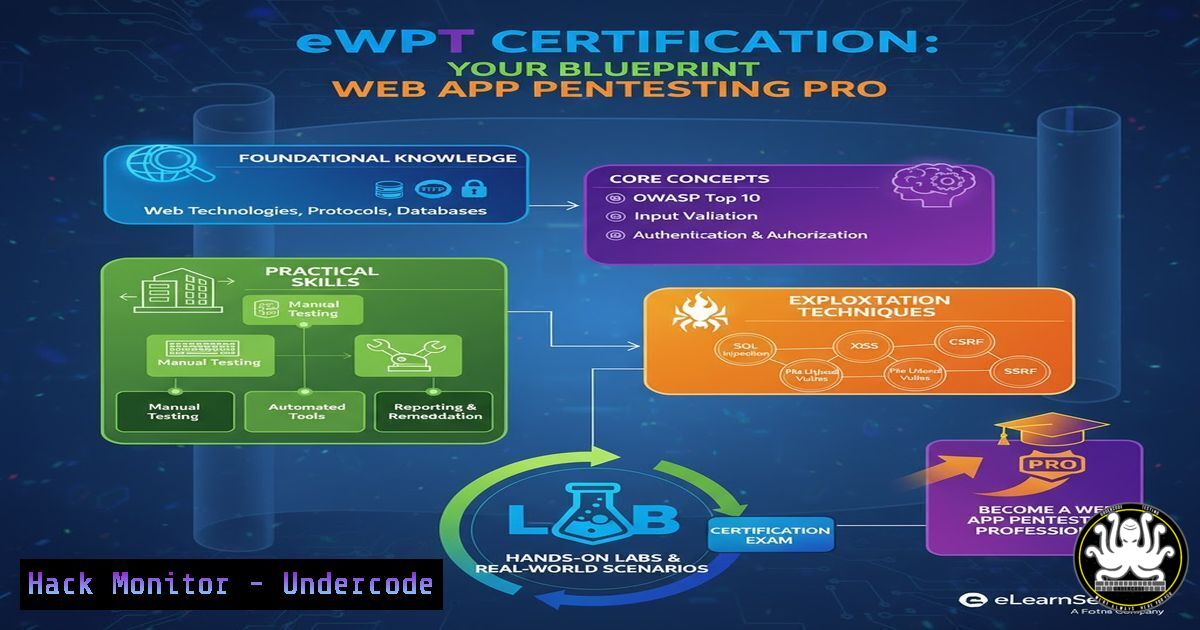
Introduction:
The eWPT (eLearnSecurity Web Application Penetration Tester) certification is a highly respected, practical credential that validates hands-on skills in identifying and exploiting web application vulnerabilities. In an era where web applications are the primary attack vector for cyber threats, mastering the art of ethical hacking against them is a critical career differentiator. This article deconstructs the core competencies tested in the eWPT and provides a tactical guide to the tools and techniques you need to master.
Learning Objectives:
- Understand the end-to-end methodology of a professional web application penetration test.
- Gain proficiency in using industry-standard tools for reconnaissance, vulnerability assessment, and exploitation.
- Learn to document and report findings effectively, translating technical vulnerabilities into business risk.
You Should Know:
1. Mastering the Art of Reconnaissance and Enumeration
The first phase of any successful penetration test is thorough reconnaissance. This involves actively and passively gathering information about the target to identify potential entry points without triggering alarms.
Step‑by‑step guide explaining what this does and how to use it.
Step 1: Passive Reconnaissance: Use tools like `whois` and online databases to gather information about the target domain, including its registration details and IP block.
Command: `whois example.com`
Step 2: Subdomain Enumeration: Discover hidden subdomains which often host development, staging, or administrative portals. Tools like `Sublist3r` are highly effective.
Command: `sublist3r -d example.com`
Step 3: Directory and File Brute-Forcing: Use tools like `gobuster` or `dirb` to find hidden directories, backup files, and configuration files.
Command: `gobuster dir -u http://example.com -w /usr/share/wordlists/dirb/common.txt`
2. Vulnerability Assessment with Automated Scanners
While manual testing is paramount, automated scanners provide a crucial first pass to identify low-hanging fruit. The eWPT exam expects proficiency in using tools like Burp Suite and Nikto.
Step‑by‑step guide explaining what this does and how to use it.
Step 1: Proxy Your Traffic: Configure your browser to use a local proxy like Burp Suite. This allows you to intercept, inspect, and modify all HTTP/S requests.
Step 2: Spider the Application: Use Burp’s Spider tool to automatically crawl the entire application, discovering content and functionality.
Step 3: Run an Active Scan: Initiate Burp’s Active Scanner to automatically test for common vulnerabilities like SQLi, XSS, and file inclusion. For a quick server-level assessment, use Nikto.
Command: `nikto -h http://example.com`
3. Exploiting Injection Flaws: SQLi and Command Injection
Injection vulnerabilities remain a top critical risk. The eWPT exam rigorously tests your ability to find and exploit them, moving from basic detection to advanced bypass techniques.
Step‑by‑step guide explaining what this does and how to use it.
Step 1: Identify a Potential Injection Point: Look for user inputs like search bars, login forms, and URL parameters.
Step 2: Test for SQL Injection (SQLi): Use a single quote (') to break the SQL query and observe errors. Then, use a union-based or boolean-based blind SQLi attack to extract data.
Example Payload: `’ UNION SELECT 1, database(), user() — -`
Step 3: Exploit Command Injection: Use shell metacharacters to break out of the application’s command and execute system commands.
Example Payload: `; whoami` or `| cat /etc/passwd`
4. Bypassing Client-Side Controls and Session Management
Modern applications often implement security controls on the client side, which can be easily bypassed. Understanding session mechanics like cookies is fundamental.
Step‑by‑step guide explaining what this does and how to use it.
Step 1: Analyze Cookies and Tokens: Use browser developer tools to inspect cookies for sensitive data like `admin=false` or easily predictable session tokens.
Step 2: Manipulate Hidden Form Fields: Change the values of hidden form fields (e.g., price=100) directly in the browser or via a proxy before submitting the request.
Step 3: Forge JWT Tokens: If the application uses JSON Web Tokens (JWT), use a tool like `jwt_tool` to test for weak signing algorithms (e.g., “none”) or to brute-force the secret key.
5. Achieving Remote Code Execution (RCE)
RCE is the ultimate goal for many attackers, providing full control over the web server. This is often achieved by chaining lower-severity vulnerabilities.
Step‑by‑step guide explaining what this does and how to use it.
Step 1: Find a File Upload Feature: Locate any functionality that allows file uploads.
Step 2: Upload a Web Shell: Bypass file type filters (e.g., by changing the extension or Content-Type header) to upload a malicious script like a PHP web shell.
Example Web Shell (shell.php): ``
Step 3: Execute Commands: Access the uploaded shell via the browser and use the `cmd` parameter to run operating system commands.
URL: `http://example.com/uploads/shell.php?cmd=whoami`
6. Post-Exploitation and Privilege Escalation
Gaining a shell is only half the battle. The eWPT exam tests your ability to pivot and escalate privileges within the system.
Step‑by‑step guide explaining what this does and how to use it.
Step 1: Stabilize Your Shell: Use Python or other scripting languages to spawn a fully interactive TTY shell.
Command: `python -c ‘import pty; pty.spawn(“/bin/bash”)’`
Step 2: Enumerate the System: Look for misconfigured file permissions, sudo rights, or kernel vulnerabilities that can be exploited for privilege escalation.
Command (Linux): `find / -perm -4000 2>/dev/null` to find SUID binaries.
Command (Windows): `whoami /priv` to check user privileges.
7. Crafting the Professional Penetration Test Report
A penetration test is useless if the findings are not communicated effectively. The eWPT places significant emphasis on clear, concise, and professional reporting.
Step‑by‑step guide explaining what this does and how to use it.
Step 1: Structure Your Report: Include an Executive Summary, Technical Details, a Risk Assessment (e.g., CVSS score), and Remediation Recommendations for each finding.
Step 2: Provide Evidence: For every vulnerability, include the vulnerable URL, the request/response pairs from your proxy, and screenshots of the successful exploitation.
Step 3: Tailor to Your Audience: The executive summary should explain business risk, while the technical details should be precise enough for a developer to reproduce and fix the issue.
What Undercode Say:
- The eWPT is a practical benchmark that proves you can do the work, not just pass a multiple-choice test. Its hands-on nature is its greatest strength.
- Success hinges on a methodological approach. Rushing to exploit without proper reconnaissance and enumeration will leave critical vulnerabilities undiscovered.
- The true value of a pentester lies in their report. Clearly articulating the risk and providing actionable remediation steps is as important as finding the vulnerability itself.
The eWPT certification effectively bridges the gap between theoretical knowledge and real-world application. It forces candidates to adopt the mindset of an attacker, systematically probing for weaknesses and thinking creatively to chain vulnerabilities. For organizations, a certified professional brings a validated, structured approach to securing web assets, moving beyond checkbox compliance to genuine risk reduction. The skills tested are directly transferable to today’s most common and damaging cyber threats.
Prediction:
The methodologies and vulnerabilities covered by the eWPT will remain foundational, but the context will evolve. We will see a greater emphasis on testing APIs (REST, GraphQL) and cloud-native applications (serverless, containers) in future certifications. The core principles of injection, broken access control, and server misconfigurations will persist, but the attack surface will expand into the software supply chain and AI-integrated applications, requiring pentesters to continuously adapt their tools and techniques.
🎯Let’s Practice For Free:
IT/Security Reporter URL:
Reported By: 0xgunrunner Small – Hackers Feeds
Extra Hub: Undercode MoN
Basic Verification: Pass ✅


